-

- À propos de cette page
- Langues
- Commentaires des utilisateurs
- Citation
- Téléchargements
- Espèces associées
-



Envoyez vos Photos et vidéos
Images | vidéos | Images Google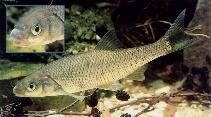 Leuciscus leuciscus
Photo de Zienert, S.
Images | vidéos | Images Google
Photo de Zienert, S.
Classification / Noms Noms communs | Synonymes | Catalog of Fishes(Genre, Espèce) | ITIS | CoL | WoRMS | Cloffa
> Cypriniformes (Carps) > Leuciscidae (Minnows) > Leuciscinae
Etymology: Leuciscus: Greek, leykiskos = white mullet (Ref. 45335).
More on author: Linnaeus.
Etymology: Leuciscus: Greek, leykiskos = white mullet (Ref. 45335).
More on author: Linnaeus.
Environnement : milieu / zone climatique / profondeur / gamme de distribution Écologie
; eau douce; saumâtre benthopélagique; pH range: 6.0 - 8.0; potamodrome (Ref. 51243); profondeur 1 - ? m. Temperate; 4°C - 22°C (Ref. 41616); 72°N - 41°N, 10°W - 155°E
Distribution Territoires | Zones FAO | Écosystèmes | Occurrences | Carte par point | Introductions | Faunafri
Europe and Asia: North, Baltic, White and Barents Sea basins; Caspian basin, in Volga and Ural drainages; Black Sea basin, from Danube to Dniepr drainages; Atlantic basin, in Seine drainage; Mediterranean basin from Rhône to Arch drainages (France). Only very localized in Danube main river in Romania, in Scandinavia north of 69°N and most of cenral Finland. Populations from Siberia and East Asia usually referred to Leuciscus leuciscus are distinct species, Leuciscus baicalensis and Leuciscus dzungaricus (Ref. 59043). Has become widespread in Europe and gained access to Ireland as a bait fish. At least one country reports adverse ecological impact after introduction (Ref. 1739).
Longueur à la première maturité / Taille / Poids / Âge
Maturité: Lm 17.9 range ? - ? cm
Max length : 40.0 cm TL mâle / non sexé; (Ref. 30578); common length : 15.0 cm TL mâle / non sexé; (Ref. 556); poids max. publié: 1.0 kg (Ref. 30578); âge max. reporté: 16 années (Ref. 41616)
Max length : 40.0 cm TL mâle / non sexé; (Ref. 30578); common length : 15.0 cm TL mâle / non sexé; (Ref. 556); poids max. publié: 1.0 kg (Ref. 30578); âge max. reporté: 16 années (Ref. 41616)
Description synthétique Clés d'identification | Morphologie | Morphométrie
Épines dorsales (Total) : 2 - 3; Rayons mous dorsaux (Total) : 7 - 9; Épines anales: 3; Rayons mous anaux: 8 - 9; Vertèbres: 42 - 46. Diagnosed from congeners in Europe by the following characters: subinferior or subterminal mouth; subequal jaw, upper jaw slightly longer; upper lip tip about level with center of eye; not projecting snout; articulation of lower jaw distinctly behind anterior margin of eye; horizontal branch of preoperculum shorter than vertical branch; and 40-50 + 1-2 scales on lateral line (Ref. 59043). Rarely longer than 30 cm TL; normally 47-52 scales in lateral line; anal fin concave; caudal fin forked with 19 rays (Ref. 41616).
Body shape (shape guide): fusiform / normal; Cross section: oval.
Body shape (shape guide): fusiform / normal; Cross section: oval.
Gregarious fish which swims near the surface (Ref. 30578). Inhabits moderate to fast-flowing large streams to large rivers with rock or gravel bottom. Adults aggregate in dense swarms in winter in the lower reaches of rivers or backwaters and often migrate to spawning streams in autumn and overwinter there. Juveniles spend winter in cavities along the shores. Early juveniles occur in very shallow shoreline habitats and when they grow, they leave the shores for faster-flowing waters. Feeding larvae thrive along shores. Prey on small invertebrates. Spawns in fast-flowing water on shallow gravel beds, often in small tributaries (Ref. 59043). Breeds in March and April (Ref. 30578). Pale yellow eggs are found attached to gravel and stones in shallow, flowing water (Ref. 41678).
Cycle de vie et comportement reproducteur Maturité | Reproduction | Frai | Œufs | Fécondité | Larves
Regularly undertake migration of some tens of km to spawning sites, which are often situated in tributaries. Males form large aggregations, each male defending a small territory. Females lay sticky eggs into excavaitons made in gravel (Ref. 59043).
Référence principale
Téléchargez vos références | Références | Coordinateur | Collaborateurs
Kottelat, M. and J. Freyhof, 2007. Handbook of European freshwater fishes. Publications Kottelat, Cornol and Freyhof, Berlin. 646 pp. (Ref. 59043)
Statut dans la liste rouge de l'IUCN (Ref. 130435: Version 2025-2)
Préoccupation mineure (LC) ; Date assessed: 17 October 2023
CITES
Not Evaluated
Menace pour l'homme
Potential pest (Ref. 13686)
Utilisations par l'homme
Pêcheries: sans intérêt; pêche sportive: oui; appât: usually
FAO - pêcheries: débarquements; Publication: search | FishSource |
Plus d'informations
Écologie trophique
Aliments (proies)
Composition du régime alimentaire
Consommation alimentaire
Rations alimentaires
Prédateurs
Aliments (proies)
Composition du régime alimentaire
Consommation alimentaire
Rations alimentaires
Prédateurs
Dynamique des populations
Paramètres de croissance
Âges / tailles maximales
Longueur-poids rel.
Rel. longueur-longueur.
Fréquences de longueurs
Conversion de masse
Recrutement
Abondance
Paramètres de croissance
Âges / tailles maximales
Longueur-poids rel.
Rel. longueur-longueur.
Fréquences de longueurs
Conversion de masse
Recrutement
Abondance
Anatomie
Surface branchiale
Cerveau
Otolithe
Surface branchiale
Cerveau
Otolithe
Physiologie
Composition corporelle
Nutriments
Consommation d'oxygène
Type de natation
Vitesse de nage
Pigments visuels
Son de poisson
Maladies et parasites
Toxicité (CL50)
Composition corporelle
Nutriments
Consommation d'oxygène
Type de natation
Vitesse de nage
Pigments visuels
Son de poisson
Maladies et parasites
Toxicité (CL50)
Liées à l'homme
Systèmes d'aquaculture
Profils d'aquaculture
Souches
Cas de ciguatera
Timbres, pièces de monnaie, divers
Systèmes d'aquaculture
Profils d'aquaculture
Souches
Cas de ciguatera
Timbres, pièces de monnaie, divers
Outils
Quiz bio | E-book | Guide de terrain | Clés d'identification | Générateur de fréquences de longueur | Outil de dynamique de population | Carte par point |
Capture-MSY |
Articles particuliers
Télécharger en XML
Sources Internet
AFORO (otoliths) | Alien/Invasive Species database | Aquatic Commons | BHL | Cloffa | Websites from users | FishWatcher | CISTI | Catalog of Fishes: Genre, Espèce | DiscoverLife | DORIS | ECOTOX | FAO - pêcheries: débarquements; Publication: search | Faunafri | Fishipedia | Fishtrace | GloBI | Google Books | Google Scholar | Google | IGFA World Record | Bases de données nationales | OneZoom | Open Tree of Life | Otolith Atlas of Taiwan Fishes | Aquariums publics | PubMed | Reef Life Survey | Socotra Atlas | TreeBase | Arbre de Vie | Wikipedia: aller à, chercher | World Records Freshwater Fishing | Zoological Record
Estimations basées sur des modèles
Indice de diversité phylogénétique (Réf. 82804): PD50 = 0.5000 [Uniqueness, from 0.5 = low to 2.0 = high].
Bayesian length-weight: a=0.00631 (0.00545 - 0.00731), b=3.16 (3.13 - 3.19), in cm total length, based on LWR estimates for this species (Ref. 93245).
Niveau trophique (Réf. 69278): 2.9 ±0.1 se; based on diet studies.
Résilience (Réf. 120179): Milieu, temps minimum de doublement de population : 1,4 à 4,4 années (K=0.18-0.25; tm=3-4; tmax=10).
Nutriments (Ref. 124155): Calcium = 113 [51, 231] mg/100g; Iron = 0.783 [0.453, 1.420] mg/100g; Protein = 19.1 [17.5, 20.8] %; Omega3 = 0.601 [0.267, 1.255] g/100g; Selenium = 8.31 [4.09, 16.84] μg/100g; VitaminA = 25.7 [8.6, 75.4] μg/100g; Zinc = 1.02 [0.69, 1.49] mg/100g (wet weight);