-

- Over deze pagina
- Talen
- Feedback van gebruikers
- Citatie
- Uploads
- Verwante soorten
-



Uploaden van uw Foto's en video's
Afbeeldingen | video's | Google afbeelding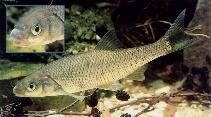 Leuciscus leuciscus
Afbeelding van Zienert, S.
Afbeeldingen | video's | Google afbeelding
Afbeelding van Zienert, S.
Classificatie / Namen Lokale namen | Synoniemen | Catalog of Fishes(Genus, Soort(en)) | ITIS | CoL | WoRMS | Cloffa
> Cypriniformes (Carps) > Leuciscidae (Minnows) > Leuciscinae
Etymology: Leuciscus: Greek, leykiskos = white mullet (Ref. 45335).
More on author: Linnaeus.
Etymology: Leuciscus: Greek, leykiskos = white mullet (Ref. 45335).
More on author: Linnaeus.
Milieu: milieu / Klimaatzone / Diepte / verspreidingsgebied Ecologie
; zoet water; brak water benthopelagisch; pH range: 6.0 - 8.0; potamodroom (Ref. 51243); diepte 1 - ? m. Temperate; 4°C - 22°C (Ref. 41616); 72°N - 41°N, 10°W - 155°E
Verspreiding Gebieden | FAO regio's | Ecosystemen | Voorkomen | Verspreidingskaart | Introducties | Faunafri
Europe and Asia: North, Baltic, White and Barents Sea basins; Caspian basin, in Volga and Ural drainages; Black Sea basin, from Danube to Dniepr drainages; Atlantic basin, in Seine drainage; Mediterranean basin from Rhône to Arch drainages (France). Only very localized in Danube main river in Romania, in Scandinavia north of 69°N and most of cenral Finland. Populations from Siberia and East Asia usually referred to Leuciscus leuciscus are distinct species, Leuciscus baicalensis and Leuciscus dzungaricus (Ref. 59043). Has become widespread in Europe and gained access to Ireland as a bait fish. At least one country reports adverse ecological impact after introduction (Ref. 1739).
Lengte bij maturiteit / Grootte / Gewicht / Leeftijd
Maturiteit: Lm 17.9 range ? - ? cm
Max length : 40.0 cm TL mannelijk / geslacht onbekend; (Ref. 30578); common length : 15.0 cm TL mannelijk / geslacht onbekend; (Ref. 556); max. gepubliceerd gewicht: 1.0 kg (Ref. 30578); max. gerapporteerde leeftijd: 16 Jaren (Ref. 41616)
Max length : 40.0 cm TL mannelijk / geslacht onbekend; (Ref. 30578); common length : 15.0 cm TL mannelijk / geslacht onbekend; (Ref. 556); max. gepubliceerd gewicht: 1.0 kg (Ref. 30578); max. gerapporteerde leeftijd: 16 Jaren (Ref. 41616)
Korte beschrijving Determinatiesleutels | Morfologie | Morfometrie
Dorsale stekels (totaal) : 2 - 3; Dorsale zachte stralen (totaal) : 7 - 9; Anale stekels: 3; Anale zachte stralen: 8 - 9; Wervels: 42 - 46. Diagnosed from congeners in Europe by the following characters: subinferior or subterminal mouth; subequal jaw, upper jaw slightly longer; upper lip tip about level with center of eye; not projecting snout; articulation of lower jaw distinctly behind anterior margin of eye; horizontal branch of preoperculum shorter than vertical branch; and 40-50 + 1-2 scales on lateral line (Ref. 59043). Rarely longer than 30 cm TL; normally 47-52 scales in lateral line; anal fin concave; caudal fin forked with 19 rays (Ref. 41616).
Body shape (shape guide): fusiform / normal; Cross section: oval.
Body shape (shape guide): fusiform / normal; Cross section: oval.
Gregarious fish which swims near the surface (Ref. 30578). Inhabits moderate to fast-flowing large streams to large rivers with rock or gravel bottom. Adults aggregate in dense swarms in winter in the lower reaches of rivers or backwaters and often migrate to spawning streams in autumn and overwinter there. Juveniles spend winter in cavities along the shores. Early juveniles occur in very shallow shoreline habitats and when they grow, they leave the shores for faster-flowing waters. Feeding larvae thrive along shores. Prey on small invertebrates. Spawns in fast-flowing water on shallow gravel beds, often in small tributaries (Ref. 59043). Breeds in March and April (Ref. 30578). Pale yellow eggs are found attached to gravel and stones in shallow, flowing water (Ref. 41678).
Levenscyclus en paargedrag Maturiteit | Voortplanting | Paaien | Eieren | Fecunditeit | Larven
Regularly undertake migration of some tens of km to spawning sites, which are often situated in tributaries. Males form large aggregations, each male defending a small territory. Females lay sticky eggs into excavaitons made in gravel (Ref. 59043).
Hoofdreferentie
Upload uw referenties | Referenties | Coördinator | Medewerkers
Kottelat, M. and J. Freyhof, 2007. Handbook of European freshwater fishes. Publications Kottelat, Cornol and Freyhof, Berlin. 646 pp. (Ref. 59043)
Status op de Rode Lijst van het IUCN (Ref. 130435: Version 2025-2)
Niet bedreigd (LC) ; Date assessed: 17 October 2023
CITES
Not Evaluated
Gevaar voor de mens
Potential pest (Ref. 13686)
Gebruik door de mens
Visserij: van geen belang; sportvis: ja; aas: usually
FAO - visserij: aanvoer; Publication: search | FishSource |
Meer informatie
Trofische ecologie
Voedsel (prooien)
Dieetsamenstelling
Voedselconsumptie
Voedselrantsoenen
Predatoren
Voedsel (prooien)
Dieetsamenstelling
Voedselconsumptie
Voedselrantsoenen
Predatoren
Populatiedynamica
Groeiparameters
Max. leeftijden / maten
Lengte-gewicht rel.
Lengte-lengte rel.
Lengtefrequenties
Massaconversie
Rekrutering
Abundantie
Groeiparameters
Max. leeftijden / maten
Lengte-gewicht rel.
Lengte-lengte rel.
Lengtefrequenties
Massaconversie
Rekrutering
Abundantie
Levenscyclus
Voortplanting
Maturiteit
Rijpheid/kieuwen rel.
Fecunditeit
Paaien
Paaibestanden
Eieren
Ontwikkeling van de eieren
Larven
Larvale populatiedynamiek
Voortplanting
Maturiteit
Rijpheid/kieuwen rel.
Fecunditeit
Paaien
Paaibestanden
Eieren
Ontwikkeling van de eieren
Larven
Larvale populatiedynamiek
Anatomie
Kieuwoppervlak
Hersenen
Otoliet
Kieuwoppervlak
Hersenen
Otoliet
Fysiologie
Lichaamssamenstelling
Voedingsstoffen
Zuurstofverbruik
Type zwemmen
Zwemsnelheid
Visuele pigmenten
Vis geluid
Ziekten en parasieten
Toxiciteit (LC50)
Lichaamssamenstelling
Voedingsstoffen
Zuurstofverbruik
Type zwemmen
Zwemsnelheid
Visuele pigmenten
Vis geluid
Ziekten en parasieten
Toxiciteit (LC50)
Menselijk gerelateerd
Aquacultuursystemen
Aquacultuurprofielen
Kweeklijnen
Ciguatera gevallen
Postzegels, munten, diversen.
Aquacultuursystemen
Aquacultuurprofielen
Kweeklijnen
Ciguatera gevallen
Postzegels, munten, diversen.
Tools
Biologische quiz | E-boek | Veldgids | Determinatiesleutels | Lengtefrequentie Tool | Levenscyclus tool | Verspreidingskaart |
Vangst-MSY |
Speciale rapporten
Bekijk gegevens voor het houden in een aquarium | Bekijk Fact Sheets voor de soort | Bekijk Aquacultuur Fact Sheets
Download XML
Internetbronnen
AFORO (otoliths) | Exoten/Invasieve soorten database | Aquatic Commons | BHL | Cloffa | Websites from users | Bekijk FishWatcher | CISTI | Catalog of Fishes: Genus, Soort(en) | DiscoverLife | DORIS | ECOTOX | FAO - visserij: aanvoer; Publication: search | Faunafri | Fishipedia | Fishtrace | GloBI | Google Books | Google Scholar | Google | IGFA World Record | Nationale databanken | OneZoom | Open Tree of Life | Otolith Atlas of Taiwan Fishes | Publieke aquaria | PubMed | Reef Life Survey | Socotra Atlas | TreeBase | Tree of Life | Wikipedia: ga naar, zoek | World Records Freshwater Fishing | Zoological Record
Schattingen op basis van modellen
Fylogenetische diversiteitsindex (Ref. 82804): PD50 = 0.5000 [Uniqueness, from 0.5 = low to 2.0 = high].
Bayesian length-weight: a=0.00631 (0.00545 - 0.00731), b=3.16 (3.13 - 3.19), in cm total length, based on LWR estimates for this species (Ref. 93245).
Trofisch niveau (Ref. 69278): 2.9 ±0.1 se; based on diet studies.
Weerstandsvermogen (Ref. 120179): Gemiddeld, minimale populatieverdubbelingstijd 1,4-4,4 jaar (K=0.18-0.25; tm=3-4; tmax=10).
Voedingsstoffen (Ref. 124155): Calcium = 113 [51, 231] mg/100g; Iron = 0.783 [0.453, 1.420] mg/100g; Protein = 19.1 [17.5, 20.8] %; Omega3 = 0.601 [0.267, 1.255] g/100g; Selenium = 8.31 [4.09, 16.84] μg/100g; VitaminA = 25.7 [8.6, 75.4] μg/100g; Zinc = 1.02 [0.69, 1.49] mg/100g (wet weight);