-

- Om denna sida
- Språk
- Återkoppling från användare
- Referens
- Uppladdningar
-
Relaterade arter
- Arter i
Urophycis - Arter i
Phycidae - - Klassificering -
- Phycidae
- Gadiformes
- Teleostei
- Chordata
- Animalia
- Arter i
-



Lägg till din observation i Fish Watcher
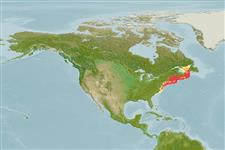
| Native range | All suitable habitat | Point map | Year 2050 |
|
| This map was computer-generated and has not yet been reviewed. |
| Urophycis chuss AquaMaps Data sources: GBIF OBIS |
Ladda upp din foton och Videor
Bilder | Ljud | Google image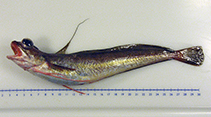 Urophycis chuss
Bild av Mac Eachern, W.J.
Bilder | Ljud | Google image
Bild av Mac Eachern, W.J.
Klassificering / Namn Populärnamn | synonymer | Catalog of Fishes(Släkte, Arter) | ITIS | CoL | WoRMS | Cloffa
> Gadiformes (Cods) > Phycidae (Phycid hakes)
Etymology: Urophycis: Greek, oura = tail + Greek, phyke, pykis, -idos = the female of a fish that lives among algae (Greek = phykon), related with the gudgeon (Ref. 45335).
More on author: Walbaum.
Etymology: Urophycis: Greek, oura = tail + Greek, phyke, pykis, -idos = the female of a fish that lives among algae (Greek = phykon), related with the gudgeon (Ref. 45335).
More on author: Walbaum.
Miljö: miljö / Klimatzon / djupintervall / distributionsområde Ekologi
marina bottenlevande; havsvandrande (Ref. 51243); djupintervall 35 - 1152 m (Ref. 57178), usually 110 - 130 m. Temperate; 51°N - 33°N, 79°W - 58°W
Utbredning Territorier | FAO områden | Ekosystem | Förekomster | Prickkarta | Utplanteringar | Faunafri
Northwest Atlantic: North Carolina to southern Nova Scotia, straying to the Gulf of St. Lawrence. Rare European records are probably misidentifications of Urophycis tenuis.
Längd vid första mognad / Storlek / Vikt / Ålder
Könsmognad: Lm 26.0 range ? - ? cm
Max length : 66.0 cm TL hane/ej könsbestämd; (Ref. 40637); publicerad maxvikt: 3.6 kg (Ref. 40637)
Max length : 66.0 cm TL hane/ej könsbestämd; (Ref. 40637); publicerad maxvikt: 3.6 kg (Ref. 40637)
Kort beskrivning Bestämningsnycklar | Morfologi | Morfometri
Taggstrålar i ryggfenan (totalt) : 0; Taggstrålar i analfenan: 0. First dorsal fin ray elongated. Pelvic fins also reaching about the anal fin origin. Body color variable, reddish to olive brown dorsally, sometimes very dark or mottled; lower sides paler, sometimes with dusky dots; belly and underside of the head pale. A dusky blotch present on the opercle. The fins are generally dark, except for the pelvic fins, which are pale.
Body shape (shape guide): elongated; Cross section: circular.
Body shape (shape guide): elongated; Cross section: circular.
Found on soft muddy and sandy bottoms, but never on rocks, gravel or shells. Juveniles live along the coasts at shallow depths (4-6 m); adults migrate to deeper waters, generally to between 110 and 130 m, and in some instances, to over 550 m. Juveniles live in scallops (Placopecten magellanicus) and remain close to scallop beds until they mature (Ref. 9988). They prefer temperatures of 8-10°C (Ref. 5951). Feed on shrimps, amphipods and other crustaceans, also on squid and herring, flatfish, mackerel and others. Utilized fresh, dried or salted and frozen; also small fish are used for fishmeal ; eaten steamed, microwaved and baked (Ref. 9988). Maximum depth reported from Ref. 57178.
Livscykel och parningsbeteende Könsmognad | Reproduktion | Lek | Ägg | Fekunditet | Larver
Huvudreferens
Ladda upp dina referenser | referenser | Koordinator | Medarbetare
Cohen, D.M., T. Inada, T. Iwamoto and N. Scialabba, 1990. FAO species catalogue. Vol. 10. Gadiform fishes of the world (Order Gadiformes). An annotated and illustrated catalogue of cods, hakes, grenadiers and other gadiform fishes known to date. FAO Fish. Synop. 125(10). Rome: FAO. 442 p. (Ref. 1371)
CITES
Not Evaluated
Hot mot människor
Harmless
Mänskliga användningsområden
Fiskeri: kommersiell; sportfisk: ja
FAO - fiskeri: landningar; Publication: search | FishSource | Havet omkring oss
Ytterligare information
Populationsdynamik
Tillväxtparametrar
Max. åldrar / storlekar
Längd-vikt rel.
Längd-längd rel.
Längd-frekvenser
Massakonvertering
Rekrytering
Abundans
Tillväxtparametrar
Max. åldrar / storlekar
Längd-vikt rel.
Längd-längd rel.
Längd-frekvenser
Massakonvertering
Rekrytering
Abundans
Livscykel
Reproduktion
Könsmognad
Mognad/Gills rel.
Fekunditet
Lek
Lekande aggregat
Ägg
Utveckling av ägg
Larver
Larvdynamik
Reproduktion
Könsmognad
Mognad/Gills rel.
Fekunditet
Lek
Lekande aggregat
Ägg
Utveckling av ägg
Larver
Larvdynamik
Anatomi
Gälyta
Hjärna
Otolit
Gälyta
Hjärna
Otolit
Fysiologi
Kroppssammansättning
Näringsämnen
Syreförbrukning
Typ av simning
Simhastighet
Visuella pigment
Ljud från fisk
Sjukdomar & Parasiter
Toxicitet (LC50)
Kroppssammansättning
Näringsämnen
Syreförbrukning
Typ av simning
Simhastighet
Visuella pigment
Ljud från fisk
Sjukdomar & Parasiter
Toxicitet (LC50)
Genetik
Genom
Genetik
Heterozygositet
Ärftlighet
Genetisk mångfald
Genom
Genetik
Heterozygositet
Ärftlighet
Genetisk mångfald
Människorelaterad
Vattenbrukssystem
Vattenbruksprofiler
Avelslinjer
Ciguatera-fall
Frimärken, mynt, diverse.
Vattenbrukssystem
Vattenbruksprofiler
Avelslinjer
Ciguatera-fall
Frimärken, mynt, diverse.
Verktyg
E-bok | Fälthandbok | Bestämningsnycklar | Längdfördelnings-verktyg | Livshistorie-verktyg | Prickkarta |
Fångst-MSY |
Särskilda rapporter
Kontrollera för underhåll av akvarium | Kontrollera om det finns faktablad om arter | Kontrollera om det finns faktablad om vattenbruk
Ladda ner XML
Internet-källor
AFORO (otoliths) | Aquatic Commons | BHL | Cloffa | Websites from users | Check FishWatcher | CISTI | Catalog of Fishes: Släkte, Arter | DiscoverLife | ECOTOX | FAO - fiskeri: landningar; Publication: search | Faunafri | Fishipedia | Fishtrace | GloBI | Google Books | Google Scholar | Google | IGFA World Record | OceanAdapt | OneZoom | Open Tree of Life | Otolith Atlas of Taiwan Fishes | Offentliga akvarier | PubMed | Reef Life Survey | Socotra Atlas | TreeBase | Tree of Life | Wikipedia: Go, sök | World Records Freshwater Fishing | Zoologiskt register
Uppskattningar baserade på modeller
Önskad temperatur (Ref. 123201): 1.6 - 11.1, mean 5 °C (based on 23 cells).
Index för fylogenetisk mångfald (Ref. 82804): PD50 = 0.5044 [Uniqueness, from 0.5 = low to 2.0 = high].
Bayesian length-weight: a=0.00407 (0.00319 - 0.00520), b=3.11 (3.04 - 3.18), in cm total length, based on LWR estimates for this species (Ref. 93245).
Trofisk nivå (Ref. 69278): 3.7 ±0.3 se; based on diet studies.
Generation time: 5.8 ( na - na) years. Estimated as median ln(3)/K based on 1 growth studies.
Resiliens (Ref. 120179): Mellan, lägsta populationsfördubblingstid 1,4-4,4 år (K=0.19; tm=2-3).
Prior r = 0.20, 95% CL = 0.13 - 0.30, Based on 3 full stock assessments.
Näringsämnen (Ref. 124155): Calcium = 27.7 [17.1, 58.1] mg/100g; Iron = 0.353 [0.196, 0.651] mg/100g; Protein = 17.2 [16.0, 18.5] %; Omega3 = 0.412 [0.217, 0.750] g/100g; Selenium = 25.8 [13.2, 49.7] μg/100g; VitaminA = 16.2 [4.3, 55.6] μg/100g; Zinc = 0.435 [0.306, 0.627] mg/100g (wet weight);