-

- À propos de cette page
- Langues
- Commentaires des utilisateurs
- Citation
- Téléchargements
-
Espèces associées
- Espèces pour
Alosa - Espèces pour
Alosidae - - Classification -
- Alosidae
- Clupeiformes
- Teleostei
- Chordata
- Animalia
- Espèces pour
-



Envoyez vos Photos et vidéos
Images | Images Google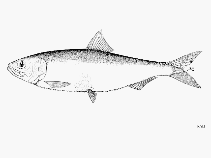 Alosa maeotica
Photo de FAO
Images | Images Google
Photo de FAO
Classification / Noms Noms communs | Synonymes | Catalog of Fishes(Genre, Espèce) | ITIS | CoL | WoRMS | Cloffa
> Clupeiformes (Herrings) > Alosidae (Shads and Sardines)
Etymology: Alosa: Latin, alausa = a fish cited by Ausonius and Latin, halec = pickle, dealing with the Greek word hals = salt; it is also the old Saxon name for shad = "alli" ; 1591 (Ref. 45335).
Eponymy: This is a toponym referring to Maeotis, the ancient name for the Sea of Azov, where these species occur. (Ref. 128868), visit book page.
Etymology: Alosa: Latin, alausa = a fish cited by Ausonius and Latin, halec = pickle, dealing with the Greek word hals = salt; it is also the old Saxon name for shad = "alli" ; 1591 (Ref. 45335).
Eponymy: This is a toponym referring to Maeotis, the ancient name for the Sea of Azov, where these species occur. (Ref. 128868), visit book page.
Environnement : milieu / zone climatique / profondeur / gamme de distribution Écologie
marin; eau douce; saumâtre pelagic-neritic. Temperate; 48°N - 40°N, 27°E - 43°E (Ref. 188)
Distribution Territoires | Zones FAO | Écosystèmes | Occurrences | Carte par point | Introductions | Faunafri
Eurasia: Black Sea and Sea of Azov.
Longueur à la première maturité / Taille / Poids / Âge
Maturité: Lm 14.0, range 13 - 15 cm
Max length : 33.2 cm TL mâle / non sexé; (Ref. 96734); 33.8 cm TL (female); common length : 18.0 cm SL mâle / non sexé; (Ref. 188); poids max. publié: 331.70 g (Ref. 96734); poids max. publié: 331.70 g; âge max. reporté: 6 années (Ref. 10547)
Max length : 33.2 cm TL mâle / non sexé; (Ref. 96734); 33.8 cm TL (female); common length : 18.0 cm SL mâle / non sexé; (Ref. 188); poids max. publié: 331.70 g (Ref. 96734); poids max. publié: 331.70 g; âge max. reporté: 6 années (Ref. 10547)
Description synthétique Clés d'identification | Morphologie | Morphométrie
Épines dorsales (Total) : 0; Épines anales: 0. Body fairly elongate, more `herring-like' than `shad-like'. Gill rakers thin and straight, often closely packed and pointed, usually shorter than gill filaments. Teeth well developed in both jaws. Other Black Sea Alosa have more gill rakers (A. caspia 50 to 80 and A. pontica 47 to 66). Sardinella aurita is more slender, has many more gill rakers and i 8 pelvic fin rays.
Body shape (shape guide): fusiform / normal; Cross section: compressed.
Body shape (shape guide): fusiform / normal; Cross section: compressed.
Non-anadromous, entering limans and lower parts of river deltas, but only occasionally in freshwater. They are more or less abundant in lower reaches of rivers and coastal lagoons. A cold-loving species, tolerating 3 or 4°C.(Ref. 188). At sea, pelagic in deep water and enters brackish lagoons to spawn. Mature adults spawn first at 2 years and many individuals spawn for 2-4 seasons. Eggs sink to bottom. Spent individuals return to the sea to feed. In autumn, they migrate to southern Black Sea to overwinter. Juveniles migrate to the sea or estuaries during the first summer (Ref. 59043). Adults feed mainly on small fishes (mainly sprats and anchovies) also on shrimps, gammarids and other large crustaceans (Ref. 188). In northern Black Sea, the decline in habitat quality in suitable estuarine ecosystems is expected to have an impact in the immediate future (Ref. 59043).
Cycle de vie et comportement reproducteur Maturité | Reproduction | Frai | Œufs | Fécondité | Larves
Juveniles migrate to sea or remain in estuaries during their first summer (Ref. 59043). In autumn, they migrate to southern Black Sea to overwinter. As spring approaches, they start to move into brackish lagoons to spawn until early summer. After spawning, spent fish return to sea to feed. Many individuals spawn for 2-4 seasons (Ref. 59043).
Référence principale
Téléchargez vos références | Références | Coordinateur | Collaborateurs
Whitehead, P.J.P., 1985. FAO Species Catalogue. Vol. 7. Clupeoid fishes of the world (suborder Clupeoidei). An annotated and illustrated catalogue of the herrings, sardines, pilchards, sprats, shads, anchovies and wolf-herrings. FAO Fish. Synop. 125(7/1):1-303. Rome: FAO. (Ref. 188)
Statut dans la liste rouge de l'IUCN (Ref. 130435: Version 2025-2)
Préoccupation mineure (LC) ; Date assessed: 26 June 2022
CITES
Not Evaluated
Menace pour l'homme
Harmless
Utilisations par l'homme
Pêcheries: intérêt commercial mineur
FAO - Publication: search | FishSource |
Plus d'informations
Écologie trophique
Aliments (proies)
Composition du régime alimentaire
Consommation alimentaire
Rations alimentaires
Prédateurs
Aliments (proies)
Composition du régime alimentaire
Consommation alimentaire
Rations alimentaires
Prédateurs
Dynamique des populations
Paramètres de croissance
Âges / tailles maximales
Longueur-poids rel.
Rel. longueur-longueur.
Fréquences de longueurs
Conversion de masse
Recrutement
Abondance
Paramètres de croissance
Âges / tailles maximales
Longueur-poids rel.
Rel. longueur-longueur.
Fréquences de longueurs
Conversion de masse
Recrutement
Abondance
Cycle de vie
Reproduction
Maturité
Maturité/épines rel.
Fécondité
Frai
Agrégats de frai
Œufs
Développement de l'œuf
Larves
Dynamique des populations larvaires
Reproduction
Maturité
Maturité/épines rel.
Fécondité
Frai
Agrégats de frai
Œufs
Développement de l'œuf
Larves
Dynamique des populations larvaires
Anatomie
Surface branchiale
Cerveau
Otolithe
Surface branchiale
Cerveau
Otolithe
Physiologie
Composition corporelle
Nutriments
Consommation d'oxygène
Type de natation
Vitesse de nage
Pigments visuels
Son de poisson
Maladies et parasites
Toxicité (CL50)
Composition corporelle
Nutriments
Consommation d'oxygène
Type de natation
Vitesse de nage
Pigments visuels
Son de poisson
Maladies et parasites
Toxicité (CL50)
Génétique
génôme
Génétique
Hétérozygotie
Héritabilité
Diversité génétique
génôme
Génétique
Hétérozygotie
Héritabilité
Diversité génétique
Liées à l'homme
Systèmes d'aquaculture
Profils d'aquaculture
Souches
Cas de ciguatera
Timbres, pièces de monnaie, divers
Systèmes d'aquaculture
Profils d'aquaculture
Souches
Cas de ciguatera
Timbres, pièces de monnaie, divers
Outils
E-book | Guide de terrain | Générateur de fréquences de longueur | Outil de dynamique de population | Carte par point |
Capture-MSY |
Articles particuliers
Télécharger en XML
Sources Internet
AFORO (otoliths) | Aquatic Commons | BHL | Cloffa | Websites from users | FishWatcher | CISTI | Catalog of Fishes: Genre, Espèce | DiscoverLife | ECOTOX | FAO - Publication: search | Faunafri | Fishipedia | Fishtrace | GloBI | Google Books | Google Scholar | Google | IGFA World Record | Bases de données nationales | OneZoom | Open Tree of Life | Otolith Atlas of Taiwan Fishes | PubMed | Reef Life Survey | Socotra Atlas | TreeBase | Arbre de Vie | Wikipedia: aller à, chercher | World Records Freshwater Fishing | Zoological Record
Estimations basées sur des modèles
Indice de diversité phylogénétique (Réf. 82804): PD50 = 0.5000 [Uniqueness, from 0.5 = low to 2.0 = high].
Bayesian length-weight: a=0.00631 (0.00422 - 0.00942), b=3.09 (2.97 - 3.21), in cm total length, based on LWR estimates for this species & Genus-body shape (Ref. 93245).
Niveau trophique (Réf. 69278): 4.4 ±0.8 se; based on diet studies.
Résilience (Réf. 120179): Milieu, temps minimum de doublement de population : 1,4 à 4,4 années (tmax=6).