-

- Over deze pagina
- Talen
- Feedback van gebruikers
- Citatie
- Uploads
- Verwante soorten
-



Waarneming toevoegen in Fish Watcher
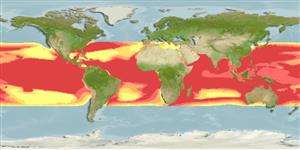
| Native range | All suitable habitat | Point map | Year 2050 |
|
| This map was computer-generated and has not yet been reviewed. |
| Sphyrna mokarran AquaMaps Data sources: GBIF OBIS |
Uploaden van uw Foto's en video's
Afbeeldingen | video's | Postzegels, munten, diversen. | Google afbeelding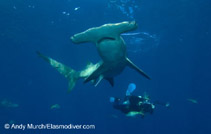 Sphyrna mokarran
Afbeelding van Murch, A.
Afbeeldingen | video's | Postzegels, munten, diversen. | Google afbeelding
Afbeelding van Murch, A.
Classificatie / Namen Lokale namen | Synoniemen | Catalog of Fishes(Genus, Soort(en)) | ITIS | CoL | WoRMS | Cloffa
Elasmobranchii (haaien en roggen) (sharks and rays) > Carcharhiniformes (Ground sharks) > Sphyrnidae (Hammerhead, bonnethead, or scoophead sharks)
Etymology: Sphyrna: Probable misspelling of sphyra (Gr.), hammer, referring to their hammer-shaped heads (See ETYFish); mokarran: Arabic vernacular for this shark, described from the Red Sea, possibly from mogharn, horned, referring to the shape of its head (See ETYFish).
More on author: Rüppell.
Etymology: Sphyrna: Probable misspelling of sphyra (Gr.), hammer, referring to their hammer-shaped heads (See ETYFish); mokarran: Arabic vernacular for this shark, described from the Red Sea, possibly from mogharn, horned, referring to the shape of its head (See ETYFish).
More on author: Rüppell.
Milieu: milieu / Klimaatzone / Diepte / verspreidingsgebied Ecologie
marien; brak water pelagic-oceanic; oceanodroom (Ref. 87829); diepte 1 - 300 m (Ref. 37816), usually 1 - 100 m (Ref. 89972). Subtropical; 40°N - 37°S, 180°W - 180°E
Verspreiding Gebieden | FAO regio's | Ecosystemen | Voorkomen | Verspreidingskaart | Introducties | Faunafri
Circumglobal in coastal warm temperate and tropical seas (Ref. 13562). Western Atlantic: North Carolina, USA to Uruguay, including the Gulf of Mexico and Caribbean. Eastern Atlantic: Mediterranean and Morocco to Senegal. Indo-Pacific: throughout the Indian Ocean; Ryukyu Islands to New Caledonia and French Polynesia. Eastern Pacific: southern Baja California, Mexico to Peru. Highly migratory species.
Lengte bij maturiteit / Grootte / Gewicht / Leeftijd
Maturiteit: Lm 249.5, range 210 - 300 cm
Max length : 610 cm TL mannelijk / geslacht onbekend; (Ref. 244); common length : 370 cm TL mannelijk / geslacht onbekend; (Ref. 13562); max. gepubliceerd gewicht: 449.5 kg (Ref. 40637); max. gerapporteerde leeftijd: 30 Jaren (Ref. 116211)
Max length : 610 cm TL mannelijk / geslacht onbekend; (Ref. 244); common length : 370 cm TL mannelijk / geslacht onbekend; (Ref. 13562); max. gepubliceerd gewicht: 449.5 kg (Ref. 40637); max. gerapporteerde leeftijd: 30 Jaren (Ref. 116211)
Korte beschrijving Determinatiesleutels | Morfologie | Morfometrie
Dorsale stekels (totaal) : 0; Anale stekels: 0. A very large hammerhead also with a notch at the center of the head (Ref. 5578). Front margin of head gently curved in juveniles, becoming nearly straight in adults, with slight median notch (Ref. 26938). 1st dorsal fin very high and curved; 2nd dorsal and pelvic fins high and with deeply concave rear margins. Light grey or grey-brown above, white below; fins without conspicuous markings (Ref. 5578).
Body shape (shape guide): elongated.
Body shape (shape guide): elongated.
A coastal-pelagic, semi-oceanic shark, found close inshore and well offshore, over the continental shelves, island terraces, and in passes and lagoons (Ref. 244, 58302). Often bottom and reef associated at 1-80 m (Ref. 58302). Prefers to feed on stingrays and other batoids, groupers and sea catfishes, but also preys on other small bony fishes, crabs, squid, other sharks, rays, and lobsters (Ref. 244, 13562, 1602). A viviparous species, with 13-42 of about 56 to 70 cm young in a litter (Ref. 26938, 1602). Potentially dangerous to people (Ref. 13562) but only few, if any, of the attacks on people can be definitely attributed to it because of the apparent difficulty of distinguishing large hammerhead species involved in attacks (Ref. 244). Caught occasionally by target shark longline, demersal tangle net and tuna gillnet fisheries (Ref.58048). Meat utilized for human consumption (fresh, fresh-frozen, dried-salted, and smoked), liver oil for vitamins, fins for soup, hides for leather, and carcasses for fishmeal (Ref. 244). Its large fins, including the tail, sail-like first dorsal fin, are prized in the Oriental sharkfin trade (Ref. 47737).
Levenscyclus en paargedrag Maturiteit | Voortplanting | Paaien | Eieren | Fecunditeit | Larven
Viviparous with a yolk sac placenta and 13-42 young in a litter (Ref. 244); 6-42 pups after gestation period of ~11 months (Ref.58048). Size at birth between 50 to 70 cm TL (Ref.58048, Ref. 13562).
Hoofdreferentie
Upload uw referenties | Referenties | Coördinator : Compagno, Leonard J.V. | Medewerkers
Compagno, L.J.V., 1984. FAO Species Catalogue. Vol. 4. Sharks of the world. An annotated and illustrated catalogue of shark species known to date. Part 2 - Carcharhiniformes. FAO Fish. Synop. 125(4/2):251-655. Rome: FAO. (Ref. 244)
Status op de Rode Lijst van het IUCN (Ref. 130435: Version 2025-2)
Ernstig bedreigd (CR) (A2bd); Date assessed: 09 November 2018
Gevaar voor de mens
Other (Ref. 244)
Gebruik door de mens
Visserij: commercieel; sportvis: ja
FAO - Publication: search | FishSource | Sea Around Us
Meer informatie
Trofische ecologie
Voedsel (prooien)
Dieetsamenstelling
Voedselconsumptie
Voedselrantsoenen
Predatoren
Voedsel (prooien)
Dieetsamenstelling
Voedselconsumptie
Voedselrantsoenen
Predatoren
Populatiedynamica
Groeiparameters
Max. leeftijden / maten
Lengte-gewicht rel.
Lengte-lengte rel.
Lengtefrequenties
Massaconversie
Rekrutering
Abundantie
Groeiparameters
Max. leeftijden / maten
Lengte-gewicht rel.
Lengte-lengte rel.
Lengtefrequenties
Massaconversie
Rekrutering
Abundantie
Levenscyclus
Voortplanting
Maturiteit
Rijpheid/kieuwen rel.
Fecunditeit
Paaien
Paaibestanden
Eieren
Ontwikkeling van de eieren
Larven
Larvale populatiedynamiek
Voortplanting
Maturiteit
Rijpheid/kieuwen rel.
Fecunditeit
Paaien
Paaibestanden
Eieren
Ontwikkeling van de eieren
Larven
Larvale populatiedynamiek
Fysiologie
Lichaamssamenstelling
Voedingsstoffen
Zuurstofverbruik
Type zwemmen
Zwemsnelheid
Visuele pigmenten
Vis geluid
Ziekten en parasieten
Toxiciteit (LC50)
Lichaamssamenstelling
Voedingsstoffen
Zuurstofverbruik
Type zwemmen
Zwemsnelheid
Visuele pigmenten
Vis geluid
Ziekten en parasieten
Toxiciteit (LC50)
Menselijk gerelateerd
Aquacultuursystemen
Aquacultuurprofielen
Kweeklijnen
Ciguatera gevallen
Postzegels, munten, diversen.
Aquacultuursystemen
Aquacultuurprofielen
Kweeklijnen
Ciguatera gevallen
Postzegels, munten, diversen.
Tools
E-boek | Veldgids | Determinatiesleutels | Lengtefrequentie Tool | Levenscyclus tool | Verspreidingskaart |
Vangst-MSY |
Speciale rapporten
Bekijk gegevens voor het houden in een aquarium | Bekijk Fact Sheets voor de soort | Bekijk Aquacultuur Fact Sheets
Download XML
Internetbronnen
AFORO (otoliths) | Exoten/Invasieve soorten database | Aquatic Commons | BHL | Cloffa | Websites from users | Bekijk FishWatcher | CISTI | Catalog of Fishes: Genus, Soort(en) | DiscoverLife | ECOTOX | FAO - Publication: search | Faunafri | Fishipedia | Fishtrace | GloBI | GoMexSI (interaction data) | Google Books | Google Scholar | Google | IGFA World Record | Nationale databanken | OneZoom | Open Tree of Life | Otolith Atlas of Taiwan Fishes | PubMed | Reef Life Survey | Socotra Atlas | TreeBase | Tree of Life | Wikipedia: ga naar, zoek | World Records Freshwater Fishing | Zoological Record
Schattingen op basis van modellen
Gewenste temperatuur (Ref. 123201): 21.3 - 28.9, mean 27.2 °C (based on 4410 cells).
Fylogenetische diversiteitsindex (Ref. 82804): PD50 = 0.5006 [Uniqueness, from 0.5 = low to 2.0 = high].
Bayesian length-weight: a=0.00229 (0.00131 - 0.00401), b=3.10 (2.94 - 3.26), in cm total length, based on LWR estimates for this species & (Sub)family-body (Ref. 93245).
Trofisch niveau (Ref. 69278): 4.3 ±0.5 se; based on diet studies.
Weerstandsvermogen (Ref. 120179): laag, minimale populatieverdubbelingstijd 4,5-14 jaar (tmax=30; tm=8.2; Fec=13).
Voedingsstoffen (Ref. 124155): Calcium = 6.09 [1.31, 34.08] mg/100g; Iron = 0.597 [0.148, 1.835] mg/100g; Protein = 20.7 [18.6, 22.9] %; Omega3 = 0.168 [0.066, 0.417] g/100g; Selenium = 33.5 [10.8, 93.8] μg/100g; VitaminA = 4.93 [1.58, 16.43] μg/100g; Zinc = 0.393 [0.195, 0.737] mg/100g (wet weight);