-

- Om denna sida
- Språk
- Återkoppling från användare
- Referens
- Uppladdningar
-
Relaterade arter
- Arter i
Polycentrus - Arter i
Polycentridae - - Klassificering -
- Polycentridae
- Ovalentaria/misc
- Teleostei
- Chordata
- Animalia
- Arter i
-



Polycentrus jundia Coutinho & Wosiacki, 2014
Ladda upp din foton och Videor
Google image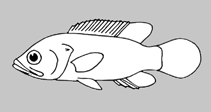 No image available for this species;
drawing shows typical species in Polycentridae.
Google image
drawing shows typical species in Polycentridae.
Klassificering / Namn Populärnamn | synonymer | Catalog of Fishes(Släkte, Arter) | ITIS | CoL | WoRMS | Cloffa
> Ovalentaria/misc (Various families in series Ovalentaria) > Polycentridae (Leaffishes)
Etymology: Polycentrus: Greek, poly = a lot of + Greek, kentron = sting (Ref. 45335); jundia: The specific name is derived from the Tupi word 'jundiá' meaning 'head with spine', and refers to the large amount of serrations present on the head bones of the new species. A noun in apposition.
Etymology: Polycentrus: Greek, poly = a lot of + Greek, kentron = sting (Ref. 45335); jundia: The specific name is derived from the Tupi word 'jundiá' meaning 'head with spine', and refers to the large amount of serrations present on the head bones of the new species. A noun in apposition.
Miljö: miljö / Klimatzon / djupintervall / distributionsområde Ekologi
; sötvatten bentopelagisk. Tropical
Utbredning Territorier | FAO områden | Ekosystem | Förekomster | Prickkarta | Utplanteringar | Faunafri
South America: Rio Negro basin in Brazil.
Storlek / Vikt / Ålder
Kort beskrivning Bestämningsnycklar | Morfologi | Morfometri
Taggstrålar i ryggfenan (totalt) : 15 - 16; Mjukstrålar i ryggfenan (totalt) : 7 - 9; Taggstrålar i analfenan: 11 - 12; Mjukstrålar i analfenan: 5 - 6. Polycentrus jundia can be distinguished from P. schomburgkii by the following characters: diagonal upper postorbital band being shorter than orbital diameter (vs. longer); median postorbital horizontal band present (vs. absent); subocular band being shorter than orbital diameter (vs. length of subocular band equal to or greater than orbital diameter; snout blunt (vs. protruding); mouth isognathous (vs. prognathous); serrations absent on lower edge of lacrimal or two tiny serrations at the posterior
end (vs. 8-14 conspicuous serrations distributed throughout the lower edge); posterior edge of vertical arm of preopercle fully serrated (vs. smooth edge); five pungent opercular spines, the three dorsalmost largest (vs. one or two short spines); subopercle widely serrated along most of the edge (vs. no serrations); cleithrum with serrations on posterior dorsal margin (vs. no serrations); interopercle with widely serrated edge (vs. clusters of three to five serrations along the edge of varying position between individuals); fourth pectoral-fin ray reaching vertical through anal-fin origin (vs. reaching vertical from spine III or IV of anal fin); 19-20 scales on dorsal-fin base (vs. 26-31); 12-14 scales on anal-fin base (vs. 16-20); 19-21 predorsal scales (vs. 28-30); and median opercular blotch absent (vs. present) (Ref. 102655).
Livscykel och parningsbeteende Könsmognad | Reproduktion | Lek | Ägg | Fekunditet | Larver
Huvudreferens
Ladda upp dina referenser | referenser | Koordinator | Medarbetare
Coutinho, D.P. and W.B. Wosiacki, 2014. A new species of leaffish Polycentrus Müller & Troschel, 1849 (Percomorpha: Polycentridae) from the rio Negro, Brazil. Neotrop. Ichthyol. 12(4):747-753. (Ref. 102655)
CITES
Not Evaluated
Hot mot människor
Harmless
Mänskliga användningsområden
FAO - Publication: search | FishSource |
Ytterligare information
Trofisk ekologi
Livsmedelsartiklar (preys)
Födosammansättning
Födointag
Matransoner
Predatorer
Livsmedelsartiklar (preys)
Födosammansättning
Födointag
Matransoner
Predatorer
Populationsdynamik
Tillväxtparametrar
Max. åldrar / storlekar
Längd-vikt rel.
Längd-längd rel.
Längd-frekvenser
Massakonvertering
Rekrytering
Abundans
Tillväxtparametrar
Max. åldrar / storlekar
Längd-vikt rel.
Längd-längd rel.
Längd-frekvenser
Massakonvertering
Rekrytering
Abundans
Livscykel
Reproduktion
Könsmognad
Mognad/Gills rel.
Fekunditet
Lek
Lekande aggregat
Ägg
Utveckling av ägg
Larver
Larvdynamik
Reproduktion
Könsmognad
Mognad/Gills rel.
Fekunditet
Lek
Lekande aggregat
Ägg
Utveckling av ägg
Larver
Larvdynamik
Anatomi
Gälyta
Hjärna
Otolit
Gälyta
Hjärna
Otolit
Fysiologi
Kroppssammansättning
Näringsämnen
Syreförbrukning
Typ av simning
Simhastighet
Visuella pigment
Ljud från fisk
Sjukdomar & Parasiter
Toxicitet (LC50)
Kroppssammansättning
Näringsämnen
Syreförbrukning
Typ av simning
Simhastighet
Visuella pigment
Ljud från fisk
Sjukdomar & Parasiter
Toxicitet (LC50)
Genetik
Genom
Genetik
Heterozygositet
Ärftlighet
Genetisk mångfald
Genom
Genetik
Heterozygositet
Ärftlighet
Genetisk mångfald
Människorelaterad
Vattenbrukssystem
Vattenbruksprofiler
Avelslinjer
Ciguatera-fall
Frimärken, mynt, diverse.
Vattenbrukssystem
Vattenbruksprofiler
Avelslinjer
Ciguatera-fall
Frimärken, mynt, diverse.
Verktyg
Särskilda rapporter
Kontrollera för underhåll av akvarium | Kontrollera om det finns faktablad om arter | Kontrollera om det finns faktablad om vattenbruk
Ladda ner XML
Internet-källor
AFORO (otoliths) | Aquatic Commons | BHL | Cloffa | Websites from users | Check FishWatcher | CISTI | Catalog of Fishes: Släkte, Arter | DiscoverLife | ECOTOX | FAO - Publication: search | Faunafri | Fishipedia | Fishtrace | GloBI | Google Books | Google Scholar | Google | IGFA World Record | OneZoom | Open Tree of Life | Otolith Atlas of Taiwan Fishes | PubMed | Reef Life Survey | Socotra Atlas | TreeBase | Tree of Life | Wikipedia: Go, sök | World Records Freshwater Fishing | Zoobank | Zoologiskt register
Uppskattningar baserade på modeller
Index för fylogenetisk mångfald (Ref. 82804): PD50 = 0.7812 [Uniqueness, from 0.5 = low to 2.0 = high].
Bayesian length-weight: a=0.01122 (0.00514 - 0.02450), b=3.04 (2.87 - 3.21), in cm total length, based on all LWR estimates for this body shape (Ref. 93245).
Trofisk nivå (Ref. 69278): 3.3 ±0.5 se; based on size and trophs of closest relatives