-

- À propos de cette page
- Langues
- Commentaires des utilisateurs
- Citation
- Téléchargements
- Espèces associées
-



Nomorhamphus rex Huylebrouck, Hadiaty & Herder, 2012
Envoyez vos Photos et vidéos
Images Google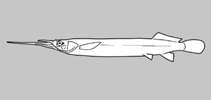 No image available for this species;
drawing shows typical species in Zenarchopteridae.
Images Google
drawing shows typical species in Zenarchopteridae.
Classification / Noms Noms communs | Synonymes | Catalog of Fishes(Genre, Espèce) | ITIS | CoL | WoRMS | Cloffa
> Beloniformes (Needle fishes) > Zenarchopteridae (Internally fertilized halfbeaks)
Etymology: Nomorhamphus: Greek, nema = filament + Greek, rhamphos = bill, peak (Ref. 45335); rex: Name from Latin meaning king; referring to the teeth, similar to the dentition of the late Cretaceous Tyrannosaurus rex; noun in apposition.
Etymology: Nomorhamphus: Greek, nema = filament + Greek, rhamphos = bill, peak (Ref. 45335); rex: Name from Latin meaning king; referring to the teeth, similar to the dentition of the late Cretaceous Tyrannosaurus rex; noun in apposition.
Environnement : milieu / zone climatique / profondeur / gamme de distribution Écologie
; eau douce pélagique; profondeur 0 - ? m. Tropical
Distribution Territoires | Zones FAO | Écosystèmes | Occurrences | Carte par point | Introductions | Faunafri
Asia: Indonesia.
Taille / Poids / Âge
Maturité: Lm ? range ? - ? cm
Max length : 4.4 cm SL mâle / non sexé; (Ref. 91778); 6.4 cm SL (female)
Max length : 4.4 cm SL mâle / non sexé; (Ref. 91778); 6.4 cm SL (female)
Description synthétique Clés d'identification | Morphologie | Morphométrie
Rayons mous dorsaux (Total) : 11 - 13; Rayons mous anaux: 14 - 15; Vertèbres: 37 - 40. This species is distinguished from its congeners by the shape of the andropodium in males: sickle-shape spiculus is curved dorsally, the proximal and middle segments in contact with the distal tip of the third anal-fin ray; the spiculus' distal segments are curved ventrally, no contact to third anal-fin ray; in males, the second anal-fin ray with 3 or 4 segments proximal to paired spines, third or fourth segment with a dorsal and a ventral row of 'subsegments' forming squares and rectangles of different sizes, the third or fourth segment appears to be subdivided into two separate rays, from the half of its length up to the spines, with a varying number of subsegments (?5 subsegments per row); first segment of the first anal-fin ray slightly constricted longitudinally, giving the appearance of 2 distinct rays; third anal-fin ray composed of 2 elongate segments, each approximately half the length of the entire ray, followed by a few short segments at the distal tip, which contact the spiculus; the fourth anal-fin ray divided into 3 rows from approximately the third of its length, forming a kind of a covering for the third anal fin ray with one dorsal and two lateral rows beneath (Ref. 91778). Nomorhamphus rex have a relatively longer lower jaw, LJLB 5.7-11.3 times in SL vs. 13.4-15.9 in N. ebrardtii and 8.8-22.2 in N. kolonodalensis (Ref. 44897).
Body shape (shape guide): elongated; Cross section: compressed.
Body shape (shape guide): elongated; Cross section: compressed.
Found in small, fast flowing river of few meters width that are partially covered by forest canopy, with gravel and sand bottoms. Occurs with Oryzias celebensis, Telmatherina cf. bonti,
Anabas testudineus, Channa striata, Trichopodus pectoralis, Trichopodus pectoralis, Mugilogobius sp., Aplocheilus panchax, and Poecilia reticulata (Ref. 91778).
Cycle de vie et comportement reproducteur Maturité | Reproduction | Frai | Œufs | Fécondité | Larves
Référence principale
Téléchargez vos références | Références | Coordinateur | Collaborateurs
Huylebrouck, J., R.K. Hadiaty and F. Herder, 2012. Nomorhamphus rex, a new species of viviparous halfbeak (Atherinomorpha: Beloniformes: Zenarchopteridae) endemic to Sulawesi Selatan, Indonesia. The Raffles Bulletin of Zoology 60(2):477-485. (Ref. 91778)
Statut dans la liste rouge de l'IUCN (Ref. 130435: Version 2025-2)
Préoccupation mineure (LC) ; Date assessed: 29 June 2018
CITES
Not Evaluated
Menace pour l'homme
Harmless
Utilisations par l'homme
FAO - Publication: search | FishSource |
Plus d'informations
Écologie trophique
Aliments (proies)
Composition du régime alimentaire
Consommation alimentaire
Rations alimentaires
Prédateurs
Aliments (proies)
Composition du régime alimentaire
Consommation alimentaire
Rations alimentaires
Prédateurs
Écologie
Écologie
Écologie
Dynamique des populations
Paramètres de croissance
Âges / tailles maximales
Longueur-poids rel.
Rel. longueur-longueur.
Fréquences de longueurs
Conversion de masse
Recrutement
Abondance
Paramètres de croissance
Âges / tailles maximales
Longueur-poids rel.
Rel. longueur-longueur.
Fréquences de longueurs
Conversion de masse
Recrutement
Abondance
Cycle de vie
Reproduction
Maturité
Maturité/épines rel.
Fécondité
Frai
Agrégats de frai
Œufs
Développement de l'œuf
Larves
Dynamique des populations larvaires
Reproduction
Maturité
Maturité/épines rel.
Fécondité
Frai
Agrégats de frai
Œufs
Développement de l'œuf
Larves
Dynamique des populations larvaires
Anatomie
Surface branchiale
Cerveau
Otolithe
Surface branchiale
Cerveau
Otolithe
Physiologie
Composition corporelle
Nutriments
Consommation d'oxygène
Type de natation
Vitesse de nage
Pigments visuels
Son de poisson
Maladies et parasites
Toxicité (CL50)
Composition corporelle
Nutriments
Consommation d'oxygène
Type de natation
Vitesse de nage
Pigments visuels
Son de poisson
Maladies et parasites
Toxicité (CL50)
Génétique
génôme
Génétique
Hétérozygotie
Héritabilité
Diversité génétique
génôme
Génétique
Hétérozygotie
Héritabilité
Diversité génétique
Liées à l'homme
Systèmes d'aquaculture
Profils d'aquaculture
Souches
Cas de ciguatera
Timbres, pièces de monnaie, divers
Systèmes d'aquaculture
Profils d'aquaculture
Souches
Cas de ciguatera
Timbres, pièces de monnaie, divers
Outils
E-book | Guide de terrain | Générateur de fréquences de longueur | Outil de dynamique de population | Carte par point |
Capture-MSY |
Articles particuliers
Télécharger en XML
Sources Internet
AFORO (otoliths) | Aquatic Commons | BHL | Cloffa | Websites from users | FishWatcher | CISTI | Catalog of Fishes: Genre, Espèce | DiscoverLife | ECOTOX | FAO - Publication: search | Faunafri | Fishipedia | Fishtrace | GloBI | Google Books | Google Scholar | Google | IGFA World Record | OneZoom | Open Tree of Life | Otolith Atlas of Taiwan Fishes | PubMed | Reef Life Survey | Socotra Atlas | TreeBase | Arbre de Vie | Wikipedia: aller à, chercher | World Records Freshwater Fishing | Zoobank | Zoological Record
Estimations basées sur des modèles
Indice de diversité phylogénétique (Réf. 82804): PD50 = 0.5000 [Uniqueness, from 0.5 = low to 2.0 = high].
Bayesian length-weight: a=0.00457 (0.00200 - 0.01044), b=3.03 (2.82 - 3.24), in cm total length, based on LWR estimates for this (Sub)family-body shape (Ref. 93245).
Niveau trophique (Réf. 69278): 3.1 ±0.4 se; based on size and trophs of closest relatives