-

- Aengenai halaman ini
- bahasa
- Umpan balik pengguna
- Kutipan
- Unggahan
- spesis berkaitan
-



Nomorhamphus rex Huylebrouck, Hadiaty & Herder, 2012
muatnaik fotos/gambar dan video
imej Google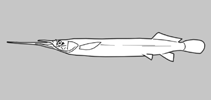 No image available for this species;
drawing shows typical species in Zenarchopteridae.
imej Google
drawing shows typical species in Zenarchopteridae.
klasifikasi / Nama Nama-nama umum | Sinonim (persamaan) | Catalog of Fishes(Marga, Jenis) | ITIS | CoL | WoRMS | Cloffa
> Beloniformes (Needle fishes) > Zenarchopteridae (Internally fertilized halfbeaks)
Etymology: Nomorhamphus: Greek, nema = filament + Greek, rhamphos = bill, peak (Ref. 45335); rex: Name from Latin meaning king; referring to the teeth, similar to the dentition of the late Cretaceous Tyrannosaurus rex; noun in apposition.
Etymology: Nomorhamphus: Greek, nema = filament + Greek, rhamphos = bill, peak (Ref. 45335); rex: Name from Latin meaning king; referring to the teeth, similar to the dentition of the late Cretaceous Tyrannosaurus rex; noun in apposition.
Lingkungan: lingkungan / zona iklim / kisaran kedalaman / jangkauan distribusi Ekologi
; air tawar pelagis, permukaan; kisaran kedalaman 0 - ? m. Tropical
Penyebaran Wilayah | Daerah-daerah FAO | Ekosistem | Kemunculan | peta titik | Introduksi | Faunafri
Asia: Indonesia.
Ukuran / Berat / umur
deskripsi pendek Kunci identifiaksi (pengenalan) | Morfologi | Morfometrik
duri punggung lunak (Keseluruhan (total)) : 11 - 13; Sirip dubur lunak: 14 - 15; vertebrata, bertulang belakang: 37 - 40. This species is distinguished from its congeners by the shape of the andropodium in males: sickle-shape spiculus is curved dorsally, the proximal and middle segments in contact with the distal tip of the third anal-fin ray; the spiculus' distal segments are curved ventrally, no contact to third anal-fin ray; in males, the second anal-fin ray with 3 or 4 segments proximal to paired spines, third or fourth segment with a dorsal and a ventral row of 'subsegments' forming squares and rectangles of different sizes, the third or fourth segment appears to be subdivided into two separate rays, from the half of its length up to the spines, with a varying number of subsegments (?5 subsegments per row); first segment of the first anal-fin ray slightly constricted longitudinally, giving the appearance of 2 distinct rays; third anal-fin ray composed of 2 elongate segments, each approximately half the length of the entire ray, followed by a few short segments at the distal tip, which contact the spiculus; the fourth anal-fin ray divided into 3 rows from approximately the third of its length, forming a kind of a covering for the third anal fin ray with one dorsal and two lateral rows beneath (Ref. 91778). Nomorhamphus rex have a relatively longer lower jaw, LJLB 5.7-11.3 times in SL vs. 13.4-15.9 in N. ebrardtii and 8.8-22.2 in N. kolonodalensis (Ref. 44897).
Body shape (shape guide): elongated; Cross section: compressed.
Body shape (shape guide): elongated; Cross section: compressed.
Found in small, fast flowing river of few meters width that are partially covered by forest canopy, with gravel and sand bottoms. Occurs with Oryzias celebensis, Telmatherina cf. bonti,
Anabas testudineus, Channa striata, Trichopodus pectoralis, Trichopodus pectoralis, Mugilogobius sp., Aplocheilus panchax, and Poecilia reticulata (Ref. 91778).
Siklus hidup dan perilaku kawin Kematangan | Reproduksi, perkembang biakan | Pemijahan | telur-telur | Fekunditas | Larva
rujukan utama
Unggah referensi Anda | Acuan | Koordinator | mitra
Huylebrouck, J., R.K. Hadiaty and F. Herder, 2012. Nomorhamphus rex, a new species of viviparous halfbeak (Atherinomorpha: Beloniformes: Zenarchopteridae) endemic to Sulawesi Selatan, Indonesia. The Raffles Bulletin of Zoology 60(2):477-485. (Ref. 91778)
Status IUCN Red List (Ref. 130435: Version 2025-2)
kurang bimbang (LC) ; Date assessed: 29 June 2018
CITES
Not Evaluated
ancaman kepada manusia
Harmless
penggunaan manusia
FAO - Publication: search | FishSource |
informasi lanjut
Ekologi trofik
Item makanan (mangsa)
Komposisi makanan
Konsumsi makanan
Ransum makanan
Pemangsa
Item makanan (mangsa)
Komposisi makanan
Konsumsi makanan
Ransum makanan
Pemangsa
Ekologi
Ekologi
Ekologi
Dinamika populasi
Parameter pertumbuhan
Maks. usia / ukuran
Panjang-berat rel.
Panjang-panjang rel.
ukuran frekuensi
Konversi massa
pemulihan
Kelimpahan
Parameter pertumbuhan
Maks. usia / ukuran
Panjang-berat rel.
Panjang-panjang rel.
ukuran frekuensi
Konversi massa
pemulihan
Kelimpahan
Siklus hidup
Reproduksi, perkembang biakan
Kematangan
Kedewasaan / insang rel.
Fekunditas
Pemijahan
Agregasi pemijahan
telur-telur
pekembangan telor
Larva
Dinamika larva
Reproduksi, perkembang biakan
Kematangan
Kedewasaan / insang rel.
Fekunditas
Pemijahan
Agregasi pemijahan
telur-telur
pekembangan telor
Larva
Dinamika larva
Anatomi
Area insang
Otak
Otolith
Area insang
Otak
Otolith
Fisiologi
Komposisi tubuh
Nutrisi
Konsumsi oksigen
Jenis renang
Kecepatan berenang
Pigmen visual
Suara ikan
Penyakit & Parasit
Toksisitas (LC50)
Komposisi tubuh
Nutrisi
Konsumsi oksigen
Jenis renang
Kecepatan berenang
Pigmen visual
Suara ikan
Penyakit & Parasit
Toksisitas (LC50)
Genetika
genom
Genetika
Heterozigositas
Diturunkan
Keanekaragaman Genetik
genom
Genetika
Heterozigositas
Diturunkan
Keanekaragaman Genetik
Yang berhubungan dengan manusia
Sistem akuakultur
profil budidaya air
Strain
Kasus Ciguatera
Perangko, koin, dll.
Sistem akuakultur
profil budidaya air
Strain
Kasus Ciguatera
Perangko, koin, dll.
Alat, peralatan
E-book | Penuntun lapangan | tanda freqkuenci panjang | peringkat sejarah hidup | peta titik |
Tangkap-MSY |
laporan khas
muat turun XML
Sumber internet
AFORO (otoliths) | Aquatic Commons | BHL | Cloffa | Websites from users | semak peneliti ikan | CISTI | Catalog of Fishes: Marga, Jenis | DiscoverLife | ECOTOX | FAO - Publication: search | Faunafri | Fishipedia | Fishtrace | GloBI | Google Books | Google Scholar | Google | IGFA World Record | OneZoom | Open Tree of Life | Otolith Atlas of Taiwan Fishes | PubMed | Reef Life Survey | Socotra Atlas | TreeBase | Tree of Life | Wikipedia: pergi, Cari | World Records Freshwater Fishing | Zoobank | Catatan Zoologi
Estimasi berdasarkan model
Indeks keanekaragaman filogenetik (Acuan 82804): PD50 = 0.5000 [Uniqueness, from 0.5 = low to 2.0 = high].
Bayesian length-weight: a=0.00457 (0.00200 - 0.01044), b=3.03 (2.82 - 3.24), in cm total length, based on LWR estimates for this (Sub)family-body shape (Ref. 93245).
Tingkat Trofik (Acuan 69278): 3.1 ±0.4 se; based on size and trophs of closest relatives