-

- Om denna sida
- Språk
- Återkoppling från användare
- Referens
- Uppladdningar
- Relaterade arter
-



Nothobranchius pienaari Shidlovskiy, Watters & Wildekamp, 2010
Ladda upp din foton och Videor
Google image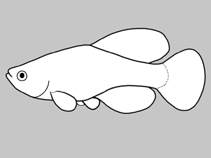 No image available for this species;
drawing shows typical species in Nothobranchiidae.
Google image
drawing shows typical species in Nothobranchiidae.
Klassificering / Namn Populärnamn | synonymer | Catalog of Fishes(Släkte, Arter) | ITIS | CoL | WoRMS | Cloffa
> Cyprinodontiformes (Rivulines, killifishes and live bearers) > Nothobranchiidae (African rivulines)
Etymology: Nothobranchius: Greek, nothos = false + Greek, brangchia = gill (Ref. 45335); pienaari: Named after Dr. U. de V. Pienaar, retired biologist of the Kruger National Park, Republic of South Africa, and discoverer of Nothobranchius species, in honour of his efforts to protect and conserve these populations; the species name is pronounced 'pea-nahri' (Ref. 85866).
Eponymy: Dr Uys de Villiers ‘Tol’ Pienaar (1930–2011) was a South African biologist and game warden, whose doctorate was awarded by Wits Medical School (1953). [...] (Ref. 128868), visit book page.
Etymology: Nothobranchius: Greek, nothos = false + Greek, brangchia = gill (Ref. 45335); pienaari: Named after Dr. U. de V. Pienaar, retired biologist of the Kruger National Park, Republic of South Africa, and discoverer of Nothobranchius species, in honour of his efforts to protect and conserve these populations; the species name is pronounced 'pea-nahri' (Ref. 85866).
Eponymy: Dr Uys de Villiers ‘Tol’ Pienaar (1930–2011) was a South African biologist and game warden, whose doctorate was awarded by Wits Medical School (1953). [...] (Ref. 128868), visit book page.
Miljö: miljö / Klimatzon / djupintervall / distributionsområde Ekologi
; sötvatten bentopelagisk. Tropical
Utbredning Territorier | FAO områden | Ekosystem | Förekomster | Prickkarta | Utplanteringar | Faunafri
Africa: coastal lowlands of central and southern Mozambique and northeastern South Africa (Ref. 85866).
Storlek / Vikt / Ålder
Könsmognad: Lm ? range ? - ? cm
Max length : 3.9 cm SL hane/ej könsbestämd; (Ref. 85866); 3.6 cm SL (female)
Max length : 3.9 cm SL hane/ej könsbestämd; (Ref. 85866); 3.6 cm SL (female)
Kort beskrivning Bestämningsnycklar | Morfologi | Morfometri
Taggstrålar i ryggfenan (totalt) : 0; Mjukstrålar i ryggfenan (totalt) : 14 - 16; Taggstrålar i analfenan: 0; Mjukstrålar i analfenan: 15 - 17. Diagnosis: Morphology similar to Nothobranchius rachovii and N. krysanovi but distinguished from those by a slightly deeper body in males (Ref. 85866). Nothobranchius pienaari is distinguished from other species of the genus by the following combination og characters: male with colouration consisting of alternating blue-green to grey-green and dark red-brown to almost black scale margins and oblique bars on body and dorsal and anal fins, dark brown spotted basal half of caudal fin, and orange subterminal and black terminal band (Ref. 85866). It can be distinguished from the other species of the subgenus Nothobranchius as follows: from N. furzeri by male colouration and a slightly higher number of dorsal fin rays, 14-16 vs. 14-15; from N. orthonotus by male colouration, lower number of scales on the mid-longitudinal series, 26-31 vs. 28-33; and from N. kadleci by male colouration and shape of the frontal region, higher number of dorsal and anal fin rays, 14-16 vs. 13-14 and 15-17 vs. 13-14 (Ref. 85866). Female distinguished by faint brown oblique bars on posterior part of flanks (Ref. 85866). Nothobranchius pienaari can also be distinguished from N. rachovii and N. krysanovi by a much higher number of diploid chromosomes, 2n=34 vs. 2n=16 for N. rachovii and 2n=18 for N. krysanovi; it can also be distinguished from the karyotypes of N. furzeri and N. orthonotus that both have with 2n=38 a higher number of chromosomes (Ref. 85866).
Body shape (shape guide): fusiform / normal.
Body shape (shape guide): fusiform / normal.
Found in temporary pools and swamps in the floodplains of several rivers flowing into the Indian Ocean south of the lower Zambezi River; usually found in water-filled depressions in the floodplains of rivers and bordering swamps; water depth is variable with the progress of the season (Ref. 85866). Aquatic vegetation may consist of Nymphea, Ottelia, Lagarosiphon and Utricularia species (Ref. 85866).
Livscykel och parningsbeteende Könsmognad | Reproduktion | Lek | Ägg | Fekunditet | Larver
Huvudreferens
Ladda upp dina referenser | referenser | Koordinator | Medarbetare
Shidlovskiy, K.M., B.R. Watters and R.H. Wildekamp, 2010. Notes on the annual killifish species Nothobranchius rachovii (Cyprinodontiformes; Nothobranchiidae) with the description of two new species. Zootaxa 2724:37-57. (Ref. 85866)
Status på IUCN:s rödlista (Ref. 130435: Version 2025-2)
Least Concern (LC) ; Date assessed: 08 January 2019
CITES
Not Evaluated
Hot mot människor
Harmless
Mänskliga användningsområden
FAO - Publication: search | FishSource |
Ytterligare information
Trofisk ekologi
Livsmedelsartiklar (preys)
Födosammansättning
Födointag
Matransoner
Predatorer
Livsmedelsartiklar (preys)
Födosammansättning
Födointag
Matransoner
Predatorer
Populationsdynamik
Tillväxtparametrar
Max. åldrar / storlekar
Längd-vikt rel.
Längd-längd rel.
Längd-frekvenser
Massakonvertering
Rekrytering
Abundans
Tillväxtparametrar
Max. åldrar / storlekar
Längd-vikt rel.
Längd-längd rel.
Längd-frekvenser
Massakonvertering
Rekrytering
Abundans
Livscykel
Reproduktion
Könsmognad
Mognad/Gills rel.
Fekunditet
Lek
Lekande aggregat
Ägg
Utveckling av ägg
Larver
Larvdynamik
Reproduktion
Könsmognad
Mognad/Gills rel.
Fekunditet
Lek
Lekande aggregat
Ägg
Utveckling av ägg
Larver
Larvdynamik
Anatomi
Gälyta
Hjärna
Otolit
Gälyta
Hjärna
Otolit
Fysiologi
Kroppssammansättning
Näringsämnen
Syreförbrukning
Typ av simning
Simhastighet
Visuella pigment
Ljud från fisk
Sjukdomar & Parasiter
Toxicitet (LC50)
Kroppssammansättning
Näringsämnen
Syreförbrukning
Typ av simning
Simhastighet
Visuella pigment
Ljud från fisk
Sjukdomar & Parasiter
Toxicitet (LC50)
Genetik
Genom
Genetik
Heterozygositet
Ärftlighet
Genetisk mångfald
Genom
Genetik
Heterozygositet
Ärftlighet
Genetisk mångfald
Människorelaterad
Vattenbrukssystem
Vattenbruksprofiler
Avelslinjer
Ciguatera-fall
Frimärken, mynt, diverse.
Vattenbrukssystem
Vattenbruksprofiler
Avelslinjer
Ciguatera-fall
Frimärken, mynt, diverse.
Verktyg
Särskilda rapporter
Kontrollera för underhåll av akvarium | Kontrollera om det finns faktablad om arter | Kontrollera om det finns faktablad om vattenbruk
Ladda ner XML
Internet-källor
AFORO (otoliths) | Aquatic Commons | BHL | Cloffa | Websites from users | Check FishWatcher | CISTI | Catalog of Fishes: Släkte, Arter | DiscoverLife | ECOTOX | FAO - Publication: search | Faunafri | Fishipedia | Fishtrace | GloBI | Google Books | Google Scholar | Google | IGFA World Record | OneZoom | Open Tree of Life | Otolith Atlas of Taiwan Fishes | PubMed | Reef Life Survey | Socotra Atlas | TreeBase | Tree of Life | Wikipedia: Go, sök | World Records Freshwater Fishing | Zoobank | Zoologiskt register
Uppskattningar baserade på modeller
Index för fylogenetisk mångfald (Ref. 82804): PD50 = 0.5000 [Uniqueness, from 0.5 = low to 2.0 = high].
Bayesian length-weight: a=0.01000 (0.00244 - 0.04107), b=3.04 (2.81 - 3.27), in cm total length, based on all LWR estimates for this body shape (Ref. 93245).
Trofisk nivå (Ref. 69278): 3.2 ±0.4 se; based on size and trophs of closest relatives