-

- Über diese Seite
- Sprachen
- Rückmeldungen der Nutzer
- Zitat
- Uploads
- Verwandte Arten
-



Sargocentron violaceum (Bleeker, 1853)
Violet squirrelfish
Beobachtung melden im Fish Watcher
| Native range | All suitable habitat | Point map | Year 2050 |

|
| This map was computer-generated and has not yet been reviewed. |
| Sargocentron violaceum AquaMaps Data sources: GBIF OBIS |
Hochladen Photos und videos
Bilder | videos | Google Bild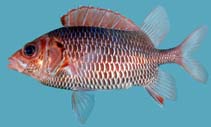 Sargocentron violaceum
Photo von Winterbottom, R.
Bilder | videos | Google Bild
Photo von Winterbottom, R.
Klassifizierung / Names Namen | Synonyme | Catalog of Fishes(Gattung, Arten) | ITIS | CoL | WoRMS | Cloffa
> Holocentriformes (Squirrelfishes, soldierfishes) > Holocentridae (Squirrelfishes, soldierfishes) > Holocentrinae
Etymology: Sargocentron: Greek, sargos = sargus + Greek, kentron = sting (Ref. 45335).
More on author: Bleeker.
Etymology: Sargocentron: Greek, sargos = sargus + Greek, kentron = sting (Ref. 45335).
More on author: Bleeker.
Umwelt: Milieu / Klimazone / Tiefenbereich / Verbreitungsgebiet Ökologie
seewasser riff-verbunden; tiefenbereich 0 - 100 m (Ref. 128797), usually 1 - 15 m (Ref. 27370). Tropical; 30°N - 24°S
Verbreitung Territorien | FAO Gebiete | Ökosysteme | Vorkommen | Punkt Karte | Einführungen | Faunafri
Indo-Pacific: Aldabra and the Laccadive Islands (Ref. 4201) to the Society Islands (Ref. 9710), north to Ryukyu Islands, south to the southern Great Barrier Reef; Palau to the eastern Caroline and Marshall Islands in Micronesia.
Größe / Gewicht / Alter
Kurzbeschreibung Bestimmungsschlüssel | Morphologie | Morphometrie
Rückenflossenstacheln (insgesamt) : 11; Rückenflossenweichstrahlen (insgesamt) : 12 - 15; Afterflossenstacheln: 4; Afterflossenweichstrahlen: 9. Body color brownish to purplish red; head primarily red; upper part of opercular membrane blackish; each scale with vertical silvery white line. Four to five oblique scale rows on cheek; body depth 2.3-2.7 in SL; head length (HL) 2.4-2.85 in SL; snout length 3.75-4.35 in HL; maxilla extending posteriorly from below front of pupil to below center of the eye, upper jaw length 2.7-2.85 in HL; premaxillary groove about a vertical at front edge of orbit; anterior end of nasal bone with 2 diverging spines; medial margin of nasal bone spineless (however, a Seychelles specimen 20.6 cm has one small spinule on the edge); 1-3 spinules on anterior and posterior margins of nasal fossa; suborbital bones' upper edge smooth anteriorly, becoming slightly serrate posteriorly (serrae as recumbent spinules); adults' preopercular spines long, 2.85-3.8 in HL (at least equal to orbit diameter). 2 opercular spines with the lower nearly as long or equal to the upper spine; 4th dorsal spine longest, .5-2.95 in HL; membranes of spinous dorsal fin not incised; 3rd anal spine 1.5-1.7 in HL (Ref. 27370). Has a high body similar to S. spiniferum, but differs in coloration and does not get as large.
Body shape (shape guide): fusiform / normal; Cross section: compressed.
Body shape (shape guide): fusiform / normal; Cross section: compressed.
Uncommon in atoll reef flats, lagoon patch reefs, and steep outer reef slopes. Solitary and secretive species, occasionally seen in small crevices in clear water habitats (Ref. 48635). Strictly nocturnal, feeds mainly on benthic crabs and shrimps. Spine of preopercle is venomous. Usually among rich coral growth (Ref 90102).
Lebenszyklus und Paarungsverhalten Geschlechtsreife | Fortpflanzung | Ablaichen | Eier | Fruchtbarkeit | Larven
Hauptreferenz
Laden Sie Ihre Referenzen hoch | Referenzen | Koordinator : Randall, John E. | Partner
Randall, J.E., 1998. Revision of the Indo-Pacific squirrelfishes (Beryciformes: Holocentridae: Holocentrinae) of the genus Sargocentron, with descriptions of four new species. Indo-Pac. Fish. (27):105 p. (Ref. 27370)
IUCN Rote Liste Status (Ref. 130435: Version 2025-2)
nicht bedroht (LC) ; Date assessed: 04 March 2015
CITES
Not Evaluated
Bedrohung für Menschen
Venomous (Ref. 2334)
Nutzung durch Menschen
FAO - Publication: search | FishSource | Das Meer um uns herum
Mehr Information
Trophische Ökologie
Lebensmittel (Beutetiere)
Nahrungszusammensetzung
Nahrungsaufnahme
Lebensmittelrationen
Räuber
Lebensmittel (Beutetiere)
Nahrungszusammensetzung
Nahrungsaufnahme
Lebensmittelrationen
Räuber
Populationsdynamik
Wachstumsparameter
Max. Alter/Größen
Länge-Gewicht-Rel.
Länge-Länge-Verhältnis.
Längenhäufigkeiten
Massenkonvertierung
Rekrutierung
Dichte
Wachstumsparameter
Max. Alter/Größen
Länge-Gewicht-Rel.
Länge-Länge-Verhältnis.
Längenhäufigkeiten
Massenkonvertierung
Rekrutierung
Dichte
Lebenszyklus
Fortpflanzung
Geschlechtsreife
Reifung/Kiemen rel.
Fruchtbarkeit
Ablaichen
Laichaggregationen
Eier
Eientwicklung
Larven
Larven Pop.Dyn.
Fortpflanzung
Geschlechtsreife
Reifung/Kiemen rel.
Fruchtbarkeit
Ablaichen
Laichaggregationen
Eier
Eientwicklung
Larven
Larven Pop.Dyn.
Anatomie
Kiemenoberfläche
Gehirn
Otolith
Kiemenoberfläche
Gehirn
Otolith
Physiologie
Körperliche Zusammensetzung
Nährstoffe
Sauerstoffverbrauch
Schwimmart
Schwimmgeschwindigkeit
Visuelle Pigmente
Fischgeräusche
Krankheiten und Parasiten
Toxizität (LC50s)
Körperliche Zusammensetzung
Nährstoffe
Sauerstoffverbrauch
Schwimmart
Schwimmgeschwindigkeit
Visuelle Pigmente
Fischgeräusche
Krankheiten und Parasiten
Toxizität (LC50s)
Genetik
Genom
Genetik
Heterozygotie
Vererbbarkeit
Genetische Vielfalt
Genom
Genetik
Heterozygotie
Vererbbarkeit
Genetische Vielfalt
Menschenbezogen
Aquakultur-Systeme
Aquakultur Profile
Zuchtlinien
Ciguatera-Fälle
Briefmarken, Münzen, Verschiedenes.
Aquakultur-Systeme
Aquakultur Profile
Zuchtlinien
Ciguatera-Fälle
Briefmarken, Münzen, Verschiedenes.
Tools
E-Book | Feldführer | Bestimmungsschlüssel | Längenhäufigkeits Tool | Lebensdaten Tool | Punkt Karte |
Catch-MSY |
Zusatzinformationen
Download XML
Zusammenfassung | Punktdaten | Namen | Photos
Internet Quellen
AFORO (otoliths) | Aquatic Commons | BHL | Cloffa | Websites from users | FishWatcher Einträge suchen | CISTI | Catalog of Fishes: Gattung, Arten | DiscoverLife | ECOTOX | FAO - Publication: search | Faunafri | Fishipedia | Fishtrace | GloBI | Google Books | Google Scholar | Google | IGFA World Record | OneZoom | Open Tree of Life | Otolith Atlas of Taiwan Fishes | Öffentliche Aquarien | PubMed | Reef Life Survey | Socotra Atlas | TreeBase | Tree of Life | Wikipedia: Gehe zu, Suchen | World Records Freshwater Fishing | Zoologischer Rekord
Schätzungen auf der Grundlage von Modellen
Bevorzugte Temperatur (Ref. 123201): 25.4 - 29.3, mean 28.5 °C (based on 2812 cells).
Phylogenetischer Diversitätsindex (Ref. 82804): PD50 = 0.5000 [Uniqueness, from 0.5 = low to 2.0 = high].
Bayesian length-weight: a=0.01660 (0.00788 - 0.03495), b=2.97 (2.80 - 3.14), in cm total length, based on LWR estimates for this Genus-body shape (Ref. 93245).
Trophische Ebene (Ref. 69278): 3.6 ±0.59 se; based on food items.
Widerstandsfähigkeit (Ref. 120179): mittel, Verdopplung der Population dauert 1,4 - 4,4 Jahre. (Preliminary K or Fecundity.).
Nährstoffe (Ref. 124155): Calcium = 36.9 [15.0, 137.7] mg/100g; Iron = 0.432 [0.170, 1.218] mg/100g; Protein = 18.7 [17.6, 19.9] %; Omega3 = 0.128 [0.057, 0.285] g/100g; Selenium = 32.5 [20.2, 58.3] μg/100g; VitaminA = 64.4 [25.9, 163.6] μg/100g; Zinc = 1.53 [0.64, 2.83] mg/100g (wet weight);