Parachromis managuensis, Jaguar guapote : fisheries, aquaculture, gamefish, aquarium

Parachromis managuensis (Günther, 1867)

Jaguar guapote
Uploaden van uw Foto's en video's
Afbeeldingen | Postzegels, munten, diversen. | Google afbeelding

Classificatie / Namen Lokale namen | Synoniemen | Catalog of Fishes(Genus, Soort(en)) | ITIS | CoL | WoRMS | Cloffa

> Cichliformes (Cichlids, convict blennies) > Cichlidae (Cichlids) > Cichlasomatinae
Etymology: Parachromis: Greek, para = the side of + Greek, chromis = a fish, perhaps a perch (Ref. 45335).
More on author: Günther.

Issue
Reviewed in Kullander & Hartel, 1997, with redescription and photo, and lectotype designation of P. gulosus. Heros managuensis described in more detail in Günther 1868:463, pl. 77 (fig. 3). Reviewed by Bussing (1998: 367), with key, diagnosis, geographical distribution, and figures.

Milieu: milieu / Klimaatzone / Diepte / verspreidingsgebied Ecologie

; zoet water benthopelagisch; pH range: 7.0 - 8.7; dH range: 10 - 15; diepte 3 - 10 m (Ref. 80549). Tropical; 25°C - 36°C (Ref. 36880); 37°N - 9°N

Verspreiding Gebieden | FAO regio's | Ecosystemen | Voorkomen | Verspreidingskaart | Introducties | Faunafri

Central America: Atlantic slope from the Ulua River (Honduras) to the Matina River (Costa Rica).

Grootte / Gewicht / Leeftijd

Maturiteit: Lm ?  range ? - ? cm
Max length : 55.0 cm TL mannelijk / geslacht onbekend; (Ref. 40637); max. gepubliceerd gewicht: 1.6 kg (Ref. 40637)

Korte beschrijving Determinatiesleutels | Morfologie | Morfometrie

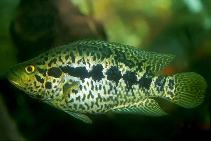
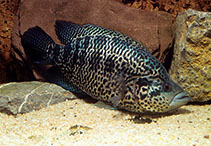
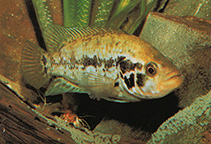
Dorsale stekels (totaal) : 17 - 18; Dorsale zachte stralen (totaal) : 10 - 11; Anale stekels: 6 - 8; Anale zachte stralen: 11 - 12. This species is distinguished by its large mouth, projecting lower jaw, prominent enlarged canine teeth, black spots on fins and body, a more or less continuous black stripe between the eye and opercular margin, another between the eye and the lower angle of the opercle; a row of black blotches along the middle of the side. Distinguished from other members of the genus by having the preopercle expanded at the angle. Body color silvery or golden-green to purple; back moss green, sides with purple iridescence, belly whitish or yellowish; dorsal, anal and caudal fins with numerous black spots, interspaces whitish, yellowish or with blue iridescence; a black blotch on the caudal-fin base. Breeding females with stronger crimson hue to the gill cover.
Body shape (shape guide): fusiform / normal; Cross section: oval.

Biologie     Verklarende woordenlijst (bv. epibenthic)

Inhabits lakes, preferring turbid waters and mud bottoms of the highly eutrophic lakes (Ref. 7335). Found in springs and ponds over detritus and sand bottom (Ref. 5723). Commonly found in very warm, oxygen depleted inundation lakes (Ref. 8978). Highly predaceous, feeding mainly on small fishes and macroinvertebrates (Ref. 7335; 44091). Oviparous, spawns in batches (Ref. Highly esteemed as food fish (Ref. 44091). Maximum length 63 cm TL (Ref. 5723).

Levenscyclus en paargedrag Maturiteit | Voortplanting | Paaien | Eieren | Fecunditeit | Larven

Deposits up to 5,000 eggs on rocks and other hard substrates; both parents guard the eggs and resulting fry (Ref. 44091). Reported to deposit up to 10,496 eggs (Ref. 80549).

Hoofdreferentie Upload uw referenties | Referenties | Coördinator : Kullander, Sven O. | Medewerkers

Kullander, S.O., 2003. Cichlidae (Cichlids). p. 605-654. In R.E. Reis, S.O. Kullander and C.J. Ferraris, Jr. (eds.) Checklist of the Freshwater Fishes of South and Central America. Porto Alegre: EDIPUCRS, Brasil. (Ref. 36377)

Status op de Rode Lijst van het IUCN (Ref. 130435: Version 2025-2)

  Niet bedreigd (LC) ; Date assessed: 05 February 2020

CITES

Not Evaluated

CMS (Ref. 116361)

Not Evaluated

Gevaar voor de mens

  Potential pest


Gebruik door de mens

Visserij: commercieel; Aquacultuur: commercieel; sportvis: ja; Aquarium: Commercieel
FAO - Aquacultuursystemen: productie; visserij: aanvoer; Publication: search | FishSource |

Meer informatie

Trofische ecologie
Voedsel (prooien)
Dieetsamenstelling
Voedselconsumptie
Voedselrantsoenen
Predatoren
Ecologie
Ecologie
Populatiedynamica
Groeiparameters
Max. leeftijden / maten
Lengte-gewicht rel.
Lengte-lengte rel.
Lengtefrequenties
Massaconversie
Rekrutering
Abundantie
Levenscyclus
Voortplanting
Maturiteit
Rijpheid/kieuwen rel.
Fecunditeit
Paaien
Paaibestanden
Eieren
Ontwikkeling van de eieren
Larven
Larvale populatiedynamiek
Verspreiding
Gebieden
FAO regio's
Ecosystemen
Voorkomen
Introducties
BRUVS - Video's
Anatomie
Kieuwoppervlak
Hersenen
Otoliet
Fysiologie
Lichaamssamenstelling
Voedingsstoffen
Zuurstofverbruik
Type zwemmen
Zwemsnelheid
Visuele pigmenten
Vis geluid
Ziekten en parasieten
Toxiciteit (LC50)
Genetica
genoom
Genetica
Heterozygositeit
Erfelijkheid
Genetische diversiteit
Menselijk gerelateerd
Aquacultuursystemen
Aquacultuurprofielen
Kweeklijnen
Ciguatera gevallen
Postzegels, munten, diversen.
Outreach
Medewerkers
Referenties
Referenties

Tools

Speciale rapporten

Download XML

Internetbronnen

AFORO (otoliths) | Exoten/Invasieve soorten database | Aquatic Commons | BHL | Cloffa | Websites from users | Bekijk FishWatcher | CISTI | Catalog of Fishes: Genus, Soort(en) | DiscoverLife | ECOTOX | FAO - Aquacultuursystemen: productie; visserij: aanvoer; Publication: search | Faunafri | Fishipedia | Fishtrace | GloBI | Google Books | Google Scholar | Google | IGFA World Record | Nationale databanken | OneZoom | Open Tree of Life | Otolith Atlas of Taiwan Fishes | Publieke aquaria | PubMed | Reef Life Survey | Socotra Atlas | TreeBase | Tree of Life | Wikipedia: ga naar, zoek | World Records Freshwater Fishing | Zoological Record

Schattingen op basis van modellen

Fylogenetische diversiteitsindex (Ref. 82804):  PD50 = 0.5312   [Uniqueness, from 0.5 = low to 2.0 = high].
Bayesian length-weight: a=0.02089 (0.01332 - 0.03278), b=3.06 (2.93 - 3.19), in cm total length, based on LWR estimates for this species & (Sub)family-body (Ref. 93245).
Trofisch niveau (Ref. 69278):  4.0   ±0.59 se; based on food items.
Weerstandsvermogen (Ref. 120179):  Gemiddeld, minimale populatieverdubbelingstijd 1,4-4,4 jaar (Assuming tm=1-2; Fec=10,000).
Kwetsbaarheid van de visserij (Ref. 59153):  Moderate vulnerability (42 of 100). 🛈
Prijsklasse (Ref. 80766):   Unknown.