-

- Om denna sida
- Språk
- Återkoppling från användare
- Referens
- Uppladdningar
- Relaterade arter
-



Acanthurus achilles Shaw, 1803
Achilles tang
Lägg till din observation i Fish Watcher
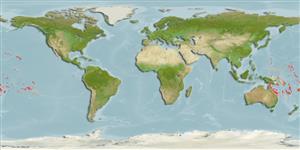
| Native range | All suitable habitat | Point map | Year 2050 |
|
| This map was computer-generated and has not yet been reviewed. |
| Acanthurus achilles AquaMaps Data sources: GBIF OBIS |
Ladda upp din foton och Videor
Bilder | Videor | Frimärken, mynt, diverse. | Google image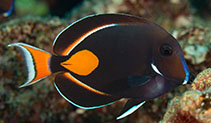 Acanthurus achilles
Bild av Malaer, P.
Bilder | Videor | Frimärken, mynt, diverse. | Google image
Bild av Malaer, P.
Klassificering / Namn Populärnamn | synonymer | Catalog of Fishes(Släkte, Arter) | ITIS | CoL | WoRMS | Cloffa
> Acanthuriformes (Surgeonfishes) > Acanthuridae (Surgeonfishes, tangs, unicornfishes) > Acanthurinae
Etymology: Acanthurus: Greek, akantha = thorn + Greek, oura = tail (Ref. 45335).
Eponymy: Achilles was the mythical Greek hero of the Trojan War. His only vulnerable spot was his heel (hence ‘Achilles’ heel’). The tang has a (roughly) heel-like mark on its body. (Ref. 128868), visit book page.
More on author: Shaw.
Etymology: Acanthurus: Greek, akantha = thorn + Greek, oura = tail (Ref. 45335).
Eponymy: Achilles was the mythical Greek hero of the Trojan War. His only vulnerable spot was his heel (hence ‘Achilles’ heel’). The tang has a (roughly) heel-like mark on its body. (Ref. 128868), visit book page.
More on author: Shaw.
Issue
Distribution to be checked.
Miljö: miljö / Klimatzon / djupintervall / distributionsområde Ekologi
marina revassocierade; djupintervall 0 - 10 m (Ref. 27115), usually 0 - 4 m (Ref. 9710). Tropical; 28°N - 26°S, 143°E - 109°W
Utbredning Territorier | FAO områden | Ekosystem | Förekomster | Prickkarta | Utplanteringar | Faunafri
Western Pacific: oceanic islands of Oceania to the Hawaiian and Pitcairn islands. Also known from Wake, Marcus, and Mariana islands. Eastern Central Pacific: southern tip of Baja California, Mexico (Ref. 9267) and other offshore islands.
Storlek / Vikt / Ålder
Kort beskrivning Bestämningsnycklar | Morfologi | Morfometri
Taggstrålar i ryggfenan (totalt) : 9; Mjukstrålar i ryggfenan (totalt) : 29 - 33; Taggstrålar i analfenan: 3; Mjukstrålar i analfenan: 26 - 29. Dark brown, nearly black in color. Erectile spine (sharp and forward-pointing) on each side of caudal peduncle which folds down into a groove. Mouth small, snout noticeably extended. Light blue ring around chin and presence of spot of same color on gill cover at angle of gill opening. Dorsal fin with soft part having longer base than spinous part. Juveniles lack the large orange spot on caudal area.
Body shape (shape guide): short and / or deep; Cross section: compressed.
Body shape (shape guide): short and / or deep; Cross section: compressed.
Occurs in clear seaward reefs, usually in groups (Ref. 9710). Benthopelagic (Ref. 58302). Feeds on filamentous and small fleshy algae (Ref. 9267). Monogamous (Ref. 52884). Spine in caudal peduncle may be venomous. Size of metamorphosis from postlarva stage to juvenile is 6 cm (Ref. 9267). This species sometimes hybridizes with A. nigricans (Ref. 9808).
Livscykel och parningsbeteende Könsmognad | Reproduktion | Lek | Ägg | Fekunditet | Larver
Monogamous mating is observed as both facultative and social (Ref. 52884).
Huvudreferens
Ladda upp dina referenser | referenser | Koordinator : Randall, John E. | Medarbetare
Randall, J.E., 1956. A revision of the surgeonfish genus Acanthurus. Pac. Sci. 10(2):159-235. (Ref. 1920)
Status på IUCN:s rödlista (Ref. 130435: Version 2025-2)
Least Concern (LC) ; Date assessed: 03 May 2010
CITES
Not Evaluated
Hot mot människor
Traumatogenic (Ref. 4690)
Mänskliga användningsområden
Fiskeri: kommersiell; Akvarium: Kommersiell
FAO - Publication: search | FishSource | Havet omkring oss
Ytterligare information
Populationsdynamik
Tillväxtparametrar
Max. åldrar / storlekar
Längd-vikt rel.
Längd-längd rel.
Längd-frekvenser
Massakonvertering
Rekrytering
Abundans
Tillväxtparametrar
Max. åldrar / storlekar
Längd-vikt rel.
Längd-längd rel.
Längd-frekvenser
Massakonvertering
Rekrytering
Abundans
Livscykel
Reproduktion
Könsmognad
Mognad/Gills rel.
Fekunditet
Lek
Lekande aggregat
Ägg
Utveckling av ägg
Larver
Larvdynamik
Reproduktion
Könsmognad
Mognad/Gills rel.
Fekunditet
Lek
Lekande aggregat
Ägg
Utveckling av ägg
Larver
Larvdynamik
Fysiologi
Kroppssammansättning
Näringsämnen
Syreförbrukning
Typ av simning
Simhastighet
Visuella pigment
Ljud från fisk
Sjukdomar & Parasiter
Toxicitet (LC50)
Kroppssammansättning
Näringsämnen
Syreförbrukning
Typ av simning
Simhastighet
Visuella pigment
Ljud från fisk
Sjukdomar & Parasiter
Toxicitet (LC50)
Genetik
Genom
Genetik
Heterozygositet
Ärftlighet
Genetisk mångfald
Genom
Genetik
Heterozygositet
Ärftlighet
Genetisk mångfald
Människorelaterad
Vattenbrukssystem
Vattenbruksprofiler
Avelslinjer
Ciguatera-fall
Frimärken, mynt, diverse.
Vattenbrukssystem
Vattenbruksprofiler
Avelslinjer
Ciguatera-fall
Frimärken, mynt, diverse.
Verktyg
Organisk frågesport | E-bok | Fälthandbok | Bestämningsnycklar | Längdfördelnings-verktyg | Livshistorie-verktyg | Prickkarta |
Fångst-MSY |
Särskilda rapporter
Kontrollera för underhåll av akvarium | Kontrollera om det finns faktablad om arter | Kontrollera om det finns faktablad om vattenbruk
Ladda ner XML
Internet-källor
AFORO (otoliths) | Aquatic Commons | BHL | Cloffa | Websites from users | Check FishWatcher | CISTI | Catalog of Fishes: Släkte, Arter | DiscoverLife | ECOTOX | FAO - Publication: search | Faunafri | Fishipedia | Fishtrace | GloBI | Google Books | Google Scholar | Google | IGFA World Record | OneZoom | Open Tree of Life | Otolith Atlas of Taiwan Fishes | Offentliga akvarier | PubMed | Reef Life Survey | Socotra Atlas | TreeBase | Tree of Life | Wikipedia: Go, sök | World Records Freshwater Fishing | Zoobank | Zoologiskt register
Uppskattningar baserade på modeller
Önskad temperatur (Ref. 123201): 25.8 - 28.3, mean 27.4 °C (based on 404 cells).
Index för fylogenetisk mångfald (Ref. 82804): PD50 = 0.5000 [Uniqueness, from 0.5 = low to 2.0 = high].
Bayesian length-weight: a=0.01995 (0.00906 - 0.04395), b=3.01 (2.83 - 3.19), in cm total length, based on all LWR estimates for this body shape (Ref. 93245).
Trofisk nivå (Ref. 69278): 2.0 ±0.00 se; based on food items.
Resiliens (Ref. 120179): Hög, lägsta populationsfördubblingstid mindre än 15 månader (Preliminary K or Fecundity.).
Näringsämnen (Ref. 124155): Calcium = 77.7 [33.7, 236.7] mg/100g; Iron = 0.837 [0.317, 2.103] mg/100g; Protein = 18.2 [16.9, 19.4] %; Omega3 = 0.0938 [, ] g/100g; Selenium = 13 [4, 39] μg/100g; VitaminA = 45.8 [10.8, 181.2] μg/100g; Zinc = 3.17 [0.99, 6.04] mg/100g (wet weight);