-

- Acerca de esta página
- Idiomas
- Opiniones de los usuarios
- Citación
- Carga
- Especies relacionadas
-



Pseudobatos productus (Ayres, 1854)
Shovelnose guitarfish
Añada su observación en Fish Watcher
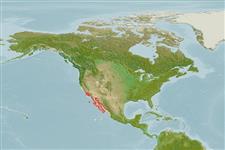
| Native range | All suitable habitat | Point map | Year 2050 |
|
| This map was computer-generated and has not yet been reviewed. |
| Pseudobatos productus AquaMaps Data sources: GBIF OBIS |
Sube tu fotos y Vídeos
Imágenes | Google image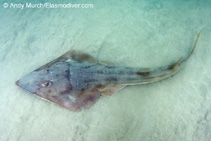 Pseudobatos productus
Foto de Murch, A.
Imágenes | Google image
Foto de Murch, A.
Clasificación / Nombres Nombres comunes | Sinónimos | Catalog of Fishes(Género, Especie) | ITIS | CoL | WoRMS | Cloffa
Elasmobranquios (tiburones y rayas) (sharks and rays) > Rhinopristiformes (Shovelnose rays) > Rhinobatidae (Guitarfishes)
More on author: Ayres.
More on author: Ayres.
Entorno: milieu / zona climática / rango de profundidad / gama de distribución Ecología
marino; salobre demersal; rango de profundidad 1 - 91 m (Ref. 48844), usually 1 - 13 m (Ref. 48844). Tropical; 38°N - 18°N, 123°W - 106°W (Ref. 114953)
Distribución Territorios | Áreas FAO | Ecosistemas | Ocurrencias, apariciones | Mapa de puntos | Introducciones | Faunafri
Eastern Pacific: endemic to the eastern Pacific from San Francisco, USA to the Gulf of California, and possibly to Mazatlan, Mexico (Ref. 48844).
Longitud en la primera madurez / Tamaño / Peso / Edad
Madurez: Lm ?, range 57 - ? cm
Max length : 119 cm TL macho / no sexado; (Ref. 48844); 170.0 cm TL (female); peso máximo publicado: 9.8 kg (Ref. 40637); peso máximo publicado: 9.8 kg; edad máxima reportada: 16 años (Ref. 48844)
Max length : 119 cm TL macho / no sexado; (Ref. 48844); 170.0 cm TL (female); peso máximo publicado: 9.8 kg (Ref. 40637); peso máximo publicado: 9.8 kg; edad máxima reportada: 16 años (Ref. 48844)
Descripción breve Claves de identificación | Morfología | Morfometría
Broad disc is greater in length than width; a relatively smooth dorsal surface except for a single row of thorns around the eyes and extending along the back and tail; a long, pointed snout with a rounded tip; small, rounded, pebble-like teeth; a first dorsal fin that originates closer to the pelvic fin base than to the caudal fin origin; a thick tail and a moderately large caudal fin without a distinct lower lobe. Tooth count: 102-112/98-117. Spiral valve count: 8-10.
Body shape (shape guide): elongated.
Body shape (shape guide): elongated.
Found on sand or mud bottoms of bays, seagrass beds, estuaries, and near rocky reefs. Nomadic and gregarious. Found singly or in aggregations (Ref. 12951). Burrows in sand during the day, feeds on crabs, worms, clams and small fishes at night (Ref. 12951). Ovoviviparous, with 6 to 28 pups in a litter (Ref. 48844). Females mature by 7 years at 87-99 cm TL; males reaches 91-110 cm TL; birth size at 20-24 cm TL (Ref. 114953).
Etymology: The genus comes from the Greek word rhine, meaning shark, and the Latin word batis, meaning ray, in reference to its body form being intermediate between that of a shark and a ray. The species name comes Latin, meaning produced, in reference to its pointed snout (Ref. 48844).
Ciclo vital y comportamiento de apareamiento Madurez | Reproducción | Puesta | Huevos | Fecundidad | Larva
Exhibit ovoviparity (aplacental viviparity), with embryos feeding initially on yolk, then receiving additional nourishment from the mother by indirect absorption of uterine fluid enriched with mucus, fat or protein through specialised structures (Ref. 50449).
Adults of both sexes congregate during the breeding season in shallow bays and estuaries and likewise leave when the pupping season is over after mating (Ref. 48844). Gestation lasts for about 12 months (Ref. 48844).
Referencia principal
Suba sus referencias | Referencias | Coordinador : McEachran, John | Colaboradores
Eschmeyer, W.N., E.S. Herald and H. Hammann, 1983. A field guide to Pacific coast fishes of North America. Boston (MA, USA): Houghton Mifflin Company. xii+336 p. (Ref. 2850)
Situación en la Lista Roja de la UICN (Ref. 130435: Version 2025-2)
Near Threatened (NT) ; Date assessed: 17 December 2014
Amenaza para el ser humano
Harmless (Ref. 2850)
Usos humanos
Pesquerías: comercial; pesca deportiva: si
FAO - Publication: search | FishSource |
Más información
Ecología Trófica
Alimentos (presas)
Composición de la dieta
consumo de alimento
Raciones de comida
Despredadores
Alimentos (presas)
Composición de la dieta
consumo de alimento
Raciones de comida
Despredadores
Dinámica de la población
Coeficiente del crecimiento para
Edades / tallas máximas
Longitud-peso rel.
Longitud-longitud rel.
Longitud-frecuencias
Conversión de masas
Reclutamiento
Abundancia
Coeficiente del crecimiento para
Edades / tallas máximas
Longitud-peso rel.
Longitud-longitud rel.
Longitud-frecuencias
Conversión de masas
Reclutamiento
Abundancia
Ciclo de vida
Reproducción
Madurez
Madurez/Gills rel.
Fecundidad
Puesta
Agregaciones de desove
Huevos
Desarrollo de los huevos
Larva
Dinámica larvaria
Reproducción
Madurez
Madurez/Gills rel.
Fecundidad
Puesta
Agregaciones de desove
Huevos
Desarrollo de los huevos
Larva
Dinámica larvaria
Distribución
Territorios
Áreas FAO
Ecosistemas
Ocurrencias, apariciones
Introducciones
BRUVS - Vídeos
Territorios
Áreas FAO
Ecosistemas
Ocurrencias, apariciones
Introducciones
BRUVS - Vídeos
Fisiología
Composición corporal
Nutrientes
Consumo del oxígeno
Tipo de natación
Velocidad de natación
Pigmentos visuales
Sonido de peces
Enfermedades y parásitos
Toxicidad (CL50)
Composición corporal
Nutrientes
Consumo del oxígeno
Tipo de natación
Velocidad de natación
Pigmentos visuales
Sonido de peces
Enfermedades y parásitos
Toxicidad (CL50)
Relacionados con el ser humano
Sistemas de acuicultura
Perfiles de acuicultura
Razas
Ciguatera cases
Sellos, monedas, varios
Sistemas de acuicultura
Perfiles de acuicultura
Razas
Ciguatera cases
Sellos, monedas, varios
Herramientas
Libro electrónico | Guía de campo | Asistente para frecuencias de tallas | Herramienta de ciclo de vida | Mapa de puntos |
Catch-MSY |
Informes especiales
Comprobar el mantenimiento del acuario | Buscar fichas sobre especies | Consulte las hojas informativas sobre acuicultura
Descargar XML
Fuentes de Internet
AFORO (otoliths) | Aquatic Commons | BHL | Cloffa | Websites from users | Check FishWatcher | CISTI | Catalog of Fishes: Género, Especie | DiscoverLife | ECOTOX | FAO - Publication: search | Faunafri | Fishipedia | Fishtrace | GloBI | Google Books | Google Scholar | Google | IGFA World Record | OneZoom | Open Tree of Life | Otolith Atlas of Taiwan Fishes | Acuarios públicos | PubMed | Reef Life Survey | Socotra Atlas | TreeBase | Árbol de la vida | Wikipedia: Go, búsqueda | World Records Freshwater Fishing | Expediente Zoológico
Estimaciones basadas en modelos
Temperatura preferida (Referencia 123201): 15.3 - 25.9, mean 22.4 °C (based on 149 cells).
Índice de diversidad filogenética (Referencia 82804): PD50 = 0.5020 [Uniqueness, from 0.5 = low to 2.0 = high].
Bayesian length-weight: a=0.00209 (0.00137 - 0.00319), b=3.10 (2.97 - 3.23), in cm total length, based on LWR estimates for this species & Genus-body shape (Ref. 93245).
Nivel trófico (Referencia 69278): 3.6 ±0.3 se; based on diet studies.
Generation time: 11.0 ( na - na) years. Estimated as median ln(3)/K based on 2 growth studies.
Resiliencia (Referencia 120179): Bajo, población duplicada en un tiempo mínimo de 4.5-14 años (tm=7; tmax=11; K=0.1; Fec = 6).
Nutrientes (Ref. 124155): Calcium = 32.6 [8.1, 140.3] mg/100g; Iron = 0.666 [0.163, 1.807] mg/100g; Protein = 18.8 [16.7, 20.7] %; Omega3 = 0.146 [0.065, 0.333] g/100g; Selenium = 50.9 [14.7, 138.9] μg/100g; VitaminA = 12.1 [5.5, 26.8] μg/100g; Zinc = 1.03 [0.51, 1.86] mg/100g (wet weight);