-

- Om denna sida
- Språk
- Återkoppling från användare
- Referens
- Uppladdningar
- Relaterade arter
-



Alopias superciliosus Lowe, 1841
Bigeye thresher
Lägg till din observation i Fish Watcher
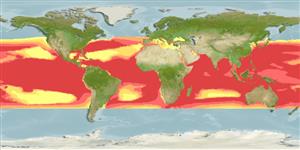
| Native range | All suitable habitat | Point map | Year 2050 |
|
| This map was computer-generated and has not yet been reviewed. |
| Alopias superciliosus AquaMaps Data sources: GBIF OBIS |
Klassificering / Namn Populärnamn | synonymer | Catalog of Fishes(Släkte, Arter) | ITIS | CoL | WoRMS | Cloffa
Elasmobranchii (hajar och rockor) (sharks and rays) > Lamniformes (Mackerel sharks) > Alopiidae (Thresher sharks)
Etymology: Alopias: From alopex, Greek for fox, referring to the ancient vernacular “fox shark,” from its supposed cunning (ancients believed that when it took a bait, it swallowed the hook until it got to the cord, which it bit off and so escaped) (See ETYFish); superciliosus: super (L.), over and above; ciliosus (L.), haughty or having a raised eyebrow, referring to enormous upward- looking eyes set high on head and/or marked groove over eyes (See ETYFish).
More on author: Lowe.
Etymology: Alopias: From alopex, Greek for fox, referring to the ancient vernacular “fox shark,” from its supposed cunning (ancients believed that when it took a bait, it swallowed the hook until it got to the cord, which it bit off and so escaped) (See ETYFish); superciliosus: super (L.), over and above; ciliosus (L.), haughty or having a raised eyebrow, referring to enormous upward- looking eyes set high on head and/or marked groove over eyes (See ETYFish).
More on author: Lowe.
Miljö: miljö / Klimatzon / djupintervall / distributionsområde Ekologi
marina pelagic-oceanic; havsvandrande (Ref. 87829); djupintervall 0 - 730 m (Ref. 89423), usually 0 - 100 m (Ref. 43278). Subtropical; 46°N - 40°S, 180°W - 180°E (Ref. 54278)
Utbredning Territorier | FAO områden | Ekosystem | Förekomster | Prickkarta | Utplanteringar | Faunafri
Circumglobal; tropical and temperate seas. Highly migratory species.
Längd vid första mognad / Storlek / Vikt / Ålder
Könsmognad: Lm 253.0, range 154 - 341 cm
Max length : 488 cm TL hane/ej könsbestämd; (Ref. 40637); common length : 350 cm TL hane/ej könsbestämd; (Ref. 5217); publicerad maxvikt: 363.8 kg (Ref. 40637); rapporterad maxålder: 20 år (Ref. 28081)
Max length : 488 cm TL hane/ej könsbestämd; (Ref. 40637); common length : 350 cm TL hane/ej könsbestämd; (Ref. 5217); publicerad maxvikt: 363.8 kg (Ref. 40637); rapporterad maxålder: 20 år (Ref. 28081)
Kort beskrivning Bestämningsnycklar | Morfologi | Morfometri
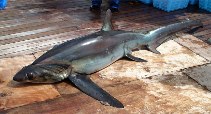
Taggstrålar i ryggfenan (totalt) : 0; Taggstrålar i analfenan: 0. A large thresher with very large eyes, an indented forehead, a broad caudal tip, and curved broad-tipped pectoral fins; 1st dorsal fin further back than in other threshers (Ref. 5578). Upper lobe of caudal fin very long and strap-like almost or quite equal to length of rest of shark; lower lobe short but well developed (Ref. 13570). Purplish grey above, cream below, posterior edges of pectoral and pelvic fins and sometimes first dorsal fin dusky; light color of abdomen not expanded over pectoral-fin bases (Ref. 13570).
Body shape (shape guide): fusiform / normal; Cross section: circular.
Body shape (shape guide): fusiform / normal; Cross section: circular.
Occurs in coastal waters over continental shelves, sometimes close inshore in shallow waters, and on the high seas far from land (Ref. 247, 43278, 58302). Oceanic, pelagic and near bottom at 1->500 m (Ref. 58302). Depth range to at least 500 m (Ref. 247). Feeds on pelagic fishes (lancetfishes, herring, mackerel and small billfishes (Ref. 43278)) and bottom fishes e.g. hake (Ref. 43278)) and squids (Ref. 247). Ovoviviparous, embryos feeding on yolk sac and other ova produced by the mother (Ref. 43278, 50449). Stuns its prey with its long caudal fin (Ref. 247). Utilized for human consumption, liver oil for vitamins, skin for leather, and fins for shark-fin soup (Ref. 247). Marketed fresh and may be broiled, baked or grilled, but unsuitable for steaming, boiling or frying; meat may be salted and dried (Ref. 9987). Also Ref. 33743.
Livscykel och parningsbeteende Könsmognad | Reproduktion | Lek | Ägg | Fekunditet | Larver
Exhibit ovoviparity (aplacental viviparity), with embryos feeding on other ova produced by the mother (oophagy) after the yolk sac is absorbed (Ref. 50449). With 2-4 young per litter (usually 2) (Ref. 247). Size at birth between 64-106 cm (Ref. 247); 100-140 cm TL (Ref.58048). No fixed mating or birthing season. Distinct pairing with embrace (Ref. 205).
Huvudreferens
Ladda upp dina referenser | referenser | Koordinator : Compagno, Leonard J.V. | Medarbetare
Compagno, L.J.V., 1984. FAO Species Catalogue. Vol. 4. Sharks of the world. An annotated and illustrated catalogue of shark species known to date. Part 1 - Hexanchiformes to Lamniformes. FAO Fish. Synop. 125(4/1):1-249. Rome, FAO. (Ref. 247)
Status på IUCN:s rödlista (Ref. 130435: Version 2025-2)
Sårbar (VU) (A2bd); Date assessed: 06 November 2018
Hot mot människor
Harmless (Ref. 247)
Mänskliga användningsområden
Fiskeri: kommersiell; sportfisk: ja
FAO - fiskeri: landningar, artprofil; Publication: search | FishSource | Havet omkring oss
Ytterligare information
Populationsdynamik
Tillväxtparametrar
Max. åldrar / storlekar
Längd-vikt rel.
Längd-längd rel.
Längd-frekvenser
Massakonvertering
Rekrytering
Abundans
Tillväxtparametrar
Max. åldrar / storlekar
Längd-vikt rel.
Längd-längd rel.
Längd-frekvenser
Massakonvertering
Rekrytering
Abundans
Livscykel
Reproduktion
Könsmognad
Mognad/Gills rel.
Fekunditet
Lek
Lekande aggregat
Ägg
Utveckling av ägg
Larver
Larvdynamik
Reproduktion
Könsmognad
Mognad/Gills rel.
Fekunditet
Lek
Lekande aggregat
Ägg
Utveckling av ägg
Larver
Larvdynamik
Fysiologi
Kroppssammansättning
Näringsämnen
Syreförbrukning
Typ av simning
Simhastighet
Visuella pigment
Ljud från fisk
Sjukdomar & Parasiter
Toxicitet (LC50)
Kroppssammansättning
Näringsämnen
Syreförbrukning
Typ av simning
Simhastighet
Visuella pigment
Ljud från fisk
Sjukdomar & Parasiter
Toxicitet (LC50)
Människorelaterad
Vattenbrukssystem
Vattenbruksprofiler
Avelslinjer
Ciguatera-fall
Frimärken, mynt, diverse.
Vattenbrukssystem
Vattenbruksprofiler
Avelslinjer
Ciguatera-fall
Frimärken, mynt, diverse.
Verktyg
E-bok | Fälthandbok | Bestämningsnycklar | Längdfördelnings-verktyg | Livshistorie-verktyg | Prickkarta |
Fångst-MSY |
Särskilda rapporter
Kontrollera för underhåll av akvarium | Kontrollera om det finns faktablad om arter | Kontrollera om det finns faktablad om vattenbruk
Ladda ner XML
Internet-källor
AFORO (otoliths) | Aquatic Commons | BHL | Cloffa | Websites from users | Check FishWatcher | CISTI | Catalog of Fishes: Släkte, Arter | DiscoverLife | ECOTOX | FAO - fiskeri: landningar, artprofil; Publication: search | Faunafri | Fishipedia | Fishtrace | GloBI | Google Books | Google Scholar | Google | IGFA World Record | Nationella databaser | OneZoom | Open Tree of Life | Otolith Atlas of Taiwan Fishes | PubMed | Reef Life Survey | Socotra Atlas | TreeBase | Tree of Life | Wikipedia: Go, sök | World Records Freshwater Fishing | Zoologiskt register
Uppskattningar baserade på modeller
Önskad temperatur (Ref. 123201): 19.2 - 29, mean 27.1 °C (based on 6320 cells).
Index för fylogenetisk mångfald (Ref. 82804): PD50 = 0.7500 [Uniqueness, from 0.5 = low to 2.0 = high].
Bayesian length-weight: a=0.01096 (0.00596 - 0.02017), b=2.90 (2.73 - 3.07), in cm total length, based on LWR estimates for this species & (Sub)family-body (Ref. 93245).
Trofisk nivå (Ref. 69278): 4.5 ±0.0 se; based on diet studies.
Resiliens (Ref. 120179): Låg, lägsta populationsfördubblingstid 4,5-14 år (tm=7; tmax=20; K=0.088; Fec=2-4).
Prior r = 0.23, 95% CL = 0.15 - 0.34, Based on 1 data-limited stock assessment.
Näringsämnen (Ref. 124155): Calcium = 6.7 [1.9, 34.8] mg/100g; Iron = 0.696 [0.174, 2.034] mg/100g; Protein = 20.5 [18.1, 22.8] %; Omega3 = 0.371 [0.150, 0.897] g/100g; Selenium = 35.9 [11.2, 103.6] μg/100g; VitaminA = 6.18 [2.01, 19.71] μg/100g; Zinc = 0.32 [0.16, 0.59] mg/100g (wet weight);