-

- À propos de cette page
- Langues
- Commentaires des utilisateurs
- Citation
- Téléchargements
- Espèces associées
-



Alopias superciliosus Lowe, 1841
Bigeye thresher
Ajouter votre observation dans Fish Watcher
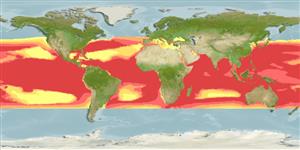
| Native range | All suitable habitat | Point map | Year 2050 |
|
| This map was computer-generated and has not yet been reviewed. |
| Alopias superciliosus AquaMaps Data sources: GBIF OBIS |
Classification / Noms Noms communs | Synonymes | Catalog of Fishes(Genre, Espèce) | ITIS | CoL | WoRMS | Cloffa
Élasmobranches (requins et raies) (sharks and rays) > Lamniformes (Mackerel sharks) > Alopiidae (Thresher sharks)
Etymology: Alopias: From alopex, Greek for fox, referring to the ancient vernacular “fox shark,” from its supposed cunning (ancients believed that when it took a bait, it swallowed the hook until it got to the cord, which it bit off and so escaped) (See ETYFish); superciliosus: super (L.), over and above; ciliosus (L.), haughty or having a raised eyebrow, referring to enormous upward- looking eyes set high on head and/or marked groove over eyes (See ETYFish).
More on author: Lowe.
Etymology: Alopias: From alopex, Greek for fox, referring to the ancient vernacular “fox shark,” from its supposed cunning (ancients believed that when it took a bait, it swallowed the hook until it got to the cord, which it bit off and so escaped) (See ETYFish); superciliosus: super (L.), over and above; ciliosus (L.), haughty or having a raised eyebrow, referring to enormous upward- looking eyes set high on head and/or marked groove over eyes (See ETYFish).
More on author: Lowe.
Environnement : milieu / zone climatique / profondeur / gamme de distribution Écologie
marin pelagic-oceanic; océanodrome (Ref. 87829); profondeur 0 - 730 m (Ref. 89423), usually 0 - 100 m (Ref. 43278). Subtropical; 46°N - 40°S, 180°W - 180°E (Ref. 54278)
Distribution Territoires | Zones FAO | Écosystèmes | Occurrences | Carte par point | Introductions | Faunafri
Circumglobal; tropical and temperate seas. Highly migratory species.
Longueur à la première maturité / Taille / Poids / Âge
Maturité: Lm 253.0, range 154 - 341 cm
Max length : 488 cm TL mâle / non sexé; (Ref. 40637); common length : 350 cm TL mâle / non sexé; (Ref. 5217); poids max. publié: 363.8 kg (Ref. 40637); âge max. reporté: 20 années (Ref. 28081)
Max length : 488 cm TL mâle / non sexé; (Ref. 40637); common length : 350 cm TL mâle / non sexé; (Ref. 5217); poids max. publié: 363.8 kg (Ref. 40637); âge max. reporté: 20 années (Ref. 28081)
Description synthétique Clés d'identification | Morphologie | Morphométrie
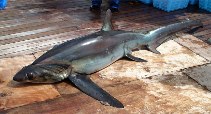
Épines dorsales (Total) : 0; Épines anales: 0. A large thresher with very large eyes, an indented forehead, a broad caudal tip, and curved broad-tipped pectoral fins; 1st dorsal fin further back than in other threshers (Ref. 5578). Upper lobe of caudal fin very long and strap-like almost or quite equal to length of rest of shark; lower lobe short but well developed (Ref. 13570). Purplish grey above, cream below, posterior edges of pectoral and pelvic fins and sometimes first dorsal fin dusky; light color of abdomen not expanded over pectoral-fin bases (Ref. 13570).
Body shape (shape guide): fusiform / normal; Cross section: circular.
Body shape (shape guide): fusiform / normal; Cross section: circular.
Occurs in coastal waters over continental shelves, sometimes close inshore in shallow waters, and on the high seas far from land (Ref. 247, 43278, 58302). Oceanic, pelagic and near bottom at 1->500 m (Ref. 58302). Depth range to at least 500 m (Ref. 247). Feeds on pelagic fishes (lancetfishes, herring, mackerel and small billfishes (Ref. 43278)) and bottom fishes e.g. hake (Ref. 43278)) and squids (Ref. 247). Ovoviviparous, embryos feeding on yolk sac and other ova produced by the mother (Ref. 43278, 50449). Stuns its prey with its long caudal fin (Ref. 247). Utilized for human consumption, liver oil for vitamins, skin for leather, and fins for shark-fin soup (Ref. 247). Marketed fresh and may be broiled, baked or grilled, but unsuitable for steaming, boiling or frying; meat may be salted and dried (Ref. 9987). Also Ref. 33743.
Cycle de vie et comportement reproducteur Maturité | Reproduction | Frai | Œufs | Fécondité | Larves
Exhibit ovoviparity (aplacental viviparity), with embryos feeding on other ova produced by the mother (oophagy) after the yolk sac is absorbed (Ref. 50449). With 2-4 young per litter (usually 2) (Ref. 247). Size at birth between 64-106 cm (Ref. 247); 100-140 cm TL (Ref.58048). No fixed mating or birthing season. Distinct pairing with embrace (Ref. 205).
Référence principale
Téléchargez vos références | Références | Coordinateur : Compagno, Leonard J.V. | Collaborateurs
Compagno, L.J.V., 1984. FAO Species Catalogue. Vol. 4. Sharks of the world. An annotated and illustrated catalogue of shark species known to date. Part 1 - Hexanchiformes to Lamniformes. FAO Fish. Synop. 125(4/1):1-249. Rome, FAO. (Ref. 247)
Statut dans la liste rouge de l'IUCN (Ref. 130435: Version 2025-2)
Vulnérable (VU) (A2bd); Date assessed: 06 November 2018
Menace pour l'homme
Harmless (Ref. 247)
Utilisations par l'homme
Pêcheries: commercial; pêche sportive: oui
FAO - pêcheries: débarquements, Résumé espèce; Publication: search | FishSource | Sea Around Us
Plus d'informations
Écologie trophique
Aliments (proies)
Composition du régime alimentaire
Consommation alimentaire
Rations alimentaires
Prédateurs
Aliments (proies)
Composition du régime alimentaire
Consommation alimentaire
Rations alimentaires
Prédateurs
Dynamique des populations
Paramètres de croissance
Âges / tailles maximales
Longueur-poids rel.
Rel. longueur-longueur.
Fréquences de longueurs
Conversion de masse
Recrutement
Abondance
Paramètres de croissance
Âges / tailles maximales
Longueur-poids rel.
Rel. longueur-longueur.
Fréquences de longueurs
Conversion de masse
Recrutement
Abondance
Cycle de vie
Reproduction
Maturité
Maturité/épines rel.
Fécondité
Frai
Agrégats de frai
Œufs
Développement de l'œuf
Larves
Dynamique des populations larvaires
Reproduction
Maturité
Maturité/épines rel.
Fécondité
Frai
Agrégats de frai
Œufs
Développement de l'œuf
Larves
Dynamique des populations larvaires
Physiologie
Composition corporelle
Nutriments
Consommation d'oxygène
Type de natation
Vitesse de nage
Pigments visuels
Son de poisson
Maladies et parasites
Toxicité (CL50)
Composition corporelle
Nutriments
Consommation d'oxygène
Type de natation
Vitesse de nage
Pigments visuels
Son de poisson
Maladies et parasites
Toxicité (CL50)
Liées à l'homme
Systèmes d'aquaculture
Profils d'aquaculture
Souches
Cas de ciguatera
Timbres, pièces de monnaie, divers
Systèmes d'aquaculture
Profils d'aquaculture
Souches
Cas de ciguatera
Timbres, pièces de monnaie, divers
Outils
E-book | Guide de terrain | Clés d'identification | Générateur de fréquences de longueur | Outil de dynamique de population | Carte par point |
Capture-MSY |
Articles particuliers
Télécharger en XML
Sources Internet
AFORO (otoliths) | Aquatic Commons | BHL | Cloffa | Websites from users | FishWatcher | CISTI | Catalog of Fishes: Genre, Espèce | DiscoverLife | ECOTOX | FAO - pêcheries: débarquements, Résumé espèce; Publication: search | Faunafri | Fishipedia | Fishtrace | GloBI | Google Books | Google Scholar | Google | IGFA World Record | Bases de données nationales | OneZoom | Open Tree of Life | Otolith Atlas of Taiwan Fishes | PubMed | Reef Life Survey | Socotra Atlas | TreeBase | Arbre de Vie | Wikipedia: aller à, chercher | World Records Freshwater Fishing | Zoological Record
Estimations basées sur des modèles
Température préférée (Réf. 123201): 19.2 - 29, mean 27.1 °C (based on 6320 cells).
Indice de diversité phylogénétique (Réf. 82804): PD50 = 0.7500 [Uniqueness, from 0.5 = low to 2.0 = high].
Bayesian length-weight: a=0.01096 (0.00596 - 0.02017), b=2.90 (2.73 - 3.07), in cm total length, based on LWR estimates for this species & (Sub)family-body (Ref. 93245).
Niveau trophique (Réf. 69278): 4.5 ±0.0 se; based on diet studies.
Résilience (Réf. 120179): Faible, temps minimum de doublement de population : 4,5 à 14 années (tm=7; tmax=20; K=0.088; Fec=2-4).
Prior r = 0.23, 95% CL = 0.15 - 0.34, Based on 1 data-limited stock assessment.
Nutriments (Ref. 124155): Calcium = 6.7 [1.9, 34.8] mg/100g; Iron = 0.696 [0.174, 2.034] mg/100g; Protein = 20.5 [18.1, 22.8] %; Omega3 = 0.371 [0.150, 0.897] g/100g; Selenium = 35.9 [11.2, 103.6] μg/100g; VitaminA = 6.18 [2.01, 19.71] μg/100g; Zinc = 0.32 [0.16, 0.59] mg/100g (wet weight);