-

- À propos de cette page
- Langues
- Commentaires des utilisateurs
- Citation
- Téléchargements
- Espèces associées
-



Limnothrissa miodon (Boulenger, 1906)
Lake Tanganyika sardine
Envoyez vos Photos et vidéos
Images | Images Google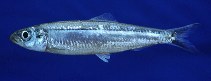 Limnothrissa miodon
Photo de Mohamed, A.D.
Images | Images Google
Photo de Mohamed, A.D.
Classification / Noms Noms communs | Synonymes | Catalog of Fishes(Genre, Espèce) | ITIS | CoL | WoRMS | Cloffa
> Clupeiformes (Herrings) > Dorosomatidae (Gizzard shads and sardinellas)
Etymology: Limnothrissa: Greek, limne = swamp + Greek, thrissa, es = shad (Ref. 45335).
More on author: Boulenger.
Etymology: Limnothrissa: Greek, limne = swamp + Greek, thrissa, es = shad (Ref. 45335).
More on author: Boulenger.
Environnement : milieu / zone climatique / profondeur / gamme de distribution Écologie
; eau douce pélagique; non migrateur; profondeur 10 - 60 m (Ref. 27631). Tropical; 21°C - 29°C (Ref. 5392); 3°S - 18°S
Distribution Territoires | Zones FAO | Écosystèmes | Occurrences | Carte par point | Introductions | Faunafri
Africa: endemic to Lake Tanganyika (Ref. 188, 28136, 107916), but introduced into several other lakes, like Lake Kivu, Lake Kariba and Cahora Bassa reservoir (Ref. 188, 7248, 28136, 52193, 107916). Also reported as Microthrissa stappersii from Lake Mweru (Ref. 246, 52958), but this is based on an erroneous type locality of the species (Ref. 26733).
Longueur à la première maturité / Taille / Poids / Âge
Maturité: Lm 6.8 range ? - ? cm
Max length : 17.0 cm SL mâle / non sexé; (Ref. 36901); common length : 10.0 cm SL mâle / non sexé; (Ref. 4967); poids max. publié: 40.00 g (Ref. 36901)
Max length : 17.0 cm SL mâle / non sexé; (Ref. 36901); common length : 10.0 cm SL mâle / non sexé; (Ref. 4967); poids max. publié: 40.00 g (Ref. 36901)
Description synthétique Clés d'identification | Morphologie | Morphométrie
Épines dorsales (Total) : 0; Rayons mous dorsaux (Total) : 13 - 18; Épines anales: 0; Rayons mous anaux: 15 - 19; Vertèbres: 41 - 44. Diagnosis: Body fairly slender, depth about 22-24% of standard length; pre-pelvic scutes not strongly keeled, beginning behind base of last pectoral fin ray; maxilla blade over 4 times as long as its shaft, its lower toothed edge continued forward to meet hind tip of pre-maxilla; second supra-maxilla asymmetrical, lower half larger; lower gillrakers long and slender, 35-40; a distinct silver stripe along flank (Ref. 188, 1878). Its synonym Limnothrissa stappersii is characterised by fewer lower gill rakers, 22-25, fewer anal fin rays, 15-17, and the absence of scutes, and represents possibly a juvenile form of L. miodon (Ref. 188, 26733). It resembles Stolothrissa tanganicae of Lake Tanganyika, which is more slender, has a small eye and a shorter maxilla blade not reaching forward to hind tip of premaxilla (Ref. 188).
Body shape (shape guide): fusiform / normal; Cross section: oval.
Body shape (shape guide): fusiform / normal; Cross section: oval.
Inhabits offshore areas of lake Tanganyika; also occurs at rivermouths, where the water is not too muddy and not very different physico-chemically from the Lake (Ref. 5393); lacustrine, forming large schools (Ref. 188, 7248), preferring open water (Ref. 13337). It has been successfully introduced to Lake Kivu, Lake Kariba and Cahora Bassa reservoir (Ref. 4967); found throughout Lake Kariba in both inshore habitats and open water to a depth of 20-35 m depending on the thermocline (Ref. 7248, 52193). Feeds on plankton, especially atyid shrimps, also copepods and prawns, but larger individuals apparently take larval Stolothrissa (Ref. 188). Cannibalism does occur (Ref. 13337). Breeds close to the shore throughout the rainy seasons, but with peaks in May/June and December/January (Ref. 188). Fire is used to attract the fish and caught by means of scoop nets (Ref. 36900). Used widely as bait by anglers, especially for tigerfish (Ref. 7248, 52193).
Cycle de vie et comportement reproducteur Maturité | Reproduction | Frai | Œufs | Fécondité | Larves
Breeds close to the shore during the rainy seasons, but with peaks in May/June and December/January (Ref. 188).
Référence principale
Téléchargez vos références | Références | Coordinateur | Collaborateurs
Whitehead, P.J.P., 1985. FAO Species Catalogue. Vol. 7. Clupeoid fishes of the world (suborder Clupeoidei). An annotated and illustrated catalogue of the herrings, sardines, pilchards, sprats, shads, anchovies and wolf-herrings. FAO Fish. Synop. 125(7/1):1-303. Rome: FAO. (Ref. 188)
Statut dans la liste rouge de l'IUCN (Ref. 130435: Version 2025-2)
Préoccupation mineure (LC) ; Date assessed: 04 March 2025
CITES
Not Evaluated
Menace pour l'homme
Potential pest (Ref. 13055)
Utilisations par l'homme
Pêcheries: commercial; appât: usually
FAO - Publication: search | FishSource |
Plus d'informations
Écologie trophique
Aliments (proies)
Composition du régime alimentaire
Consommation alimentaire
Rations alimentaires
Prédateurs
Aliments (proies)
Composition du régime alimentaire
Consommation alimentaire
Rations alimentaires
Prédateurs
Dynamique des populations
Paramètres de croissance
Âges / tailles maximales
Longueur-poids rel.
Rel. longueur-longueur.
Fréquences de longueurs
Conversion de masse
Recrutement
Abondance
Paramètres de croissance
Âges / tailles maximales
Longueur-poids rel.
Rel. longueur-longueur.
Fréquences de longueurs
Conversion de masse
Recrutement
Abondance
Cycle de vie
Reproduction
Maturité
Maturité/épines rel.
Fécondité
Frai
Agrégats de frai
Œufs
Développement de l'œuf
Larves
Dynamique des populations larvaires
Reproduction
Maturité
Maturité/épines rel.
Fécondité
Frai
Agrégats de frai
Œufs
Développement de l'œuf
Larves
Dynamique des populations larvaires
Anatomie
Surface branchiale
Cerveau
Otolithe
Surface branchiale
Cerveau
Otolithe
Physiologie
Composition corporelle
Nutriments
Consommation d'oxygène
Type de natation
Vitesse de nage
Pigments visuels
Son de poisson
Maladies et parasites
Toxicité (CL50)
Composition corporelle
Nutriments
Consommation d'oxygène
Type de natation
Vitesse de nage
Pigments visuels
Son de poisson
Maladies et parasites
Toxicité (CL50)
Liées à l'homme
Systèmes d'aquaculture
Profils d'aquaculture
Souches
Cas de ciguatera
Timbres, pièces de monnaie, divers
Systèmes d'aquaculture
Profils d'aquaculture
Souches
Cas de ciguatera
Timbres, pièces de monnaie, divers
Outils
E-book | Guide de terrain | Générateur de fréquences de longueur | Outil de dynamique de population | Carte par point |
Capture-MSY |
Articles particuliers
Télécharger en XML
Sources Internet
AFORO (otoliths) | Alien/Invasive Species database | Aquatic Commons | BHL | Cloffa | Websites from users | FishWatcher | CISTI | Catalog of Fishes: Genre, Espèce | DiscoverLife | ECOTOX | FAO - Publication: search | Faunafri | Fishipedia | Fishtrace | GloBI | Google Books | Google Scholar | Google | IGFA World Record | OneZoom | Open Tree of Life | Otolith Atlas of Taiwan Fishes | PubMed | Reef Life Survey | Socotra Atlas | TreeBase | Arbre de Vie | Wikipedia: aller à, chercher | World Records Freshwater Fishing | Zoological Record
Estimations basées sur des modèles
Indice de diversité phylogénétique (Réf. 82804): PD50 = 1.0000 [Uniqueness, from 0.5 = low to 2.0 = high].
Bayesian length-weight: a=0.00724 (0.00401 - 0.01308), b=3.00 (2.84 - 3.16), in cm total length, based on LWR estimates for this species & (Sub)family-body (Ref. 93245).
Niveau trophique (Réf. 69278): 1.6 ±0.0 se; based on diet studies.
Résilience (Réf. 120179): Haut, temps minimum de doublement de population inférieur à 15 mois (K=0.86-1.2).
Nutriments (Ref. 124155): Calcium = 367 [118, 1,086] mg/100g; Iron = 4.89 [2.26, 10.19] mg/100g; Protein = 18.5 [17.0, 19.9] %; Omega3 = 0.641 [0.187, 2.294] g/100g; Selenium = 117 [37, 355] μg/100g; VitaminA = 17.4 [4.2, 76.6] μg/100g; Zinc = 3.88 [2.16, 7.09] mg/100g (wet weight);