-

- このページについて
- 言語
- ユーザーからのフィードバック
- 引用
- アップロード
- 近縁種
-



Neosebastes bougainvillii (Cuvier, 1829)
Gulf gurnard perch
個人による観察記録の追加 Fish Watcher
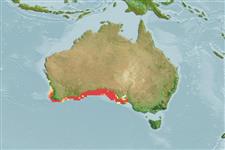
| Native range | All suitable habitat | Point map | Year 2050 |
|
| This map was computer-generated and has not yet been reviewed. |
| Neosebastes bougainvillii AquaMaps Data sources: GBIF OBIS |
分類 / 名前 共通名の | 類義語 | Catalog of Fishes(部類, 種) | ITIS | CoL | WoRMS | Cloffa
> Perciformes/Scorpaenoidei (Scorpionfishes) > Neosebastidae (Gurnard scorpionfishes)
Etymology: Neosebastes: Greek, neos = new + Greek, sebastes = august, venerable (Ref. 45335).
Eponymy: Admiral Baron Hyacinthe Yves Philippe Potentien de Bouganville (1781–1846) was a French naval officer in command of the corvette ‘Espérance’. [...] (Ref. 128868), visit book page.
More on author: Cuvier.
Etymology: Neosebastes: Greek, neos = new + Greek, sebastes = august, venerable (Ref. 45335).
Eponymy: Admiral Baron Hyacinthe Yves Philippe Potentien de Bouganville (1781–1846) was a French naval officer in command of the corvette ‘Espérance’. [...] (Ref. 128868), visit book page.
More on author: Cuvier.
環境:環境 / 気候帯 / 深さの範囲 / 分布範囲 生態学
海 関連する礁; 深さの範囲 10 - 100 m (Ref. 9563). Temperate; 29°S - 36°S
分布 領土 | 国連食糧農業機関の区域 | エコシステム | 事件 | 目的のマップ | 導入 | Faunafri
Eastern Indian Ocean: endemic to Australia.
サイズ / 重さ / 年齢
簡単な記述 検索表 | 形態学 | 形態計測学
背面の脊椎 (合計) : 8; 背鰭 (合計) : 8; 肛門の骨: 3; 臀鰭: 5. Diagnosis: Dorsal rays XIII, 8 (9 in 1 of 20 specimens), third spine longest. Anal rays III, 5. Pectoral rays 20 or 21 (mode 21; 18 in 1 of 20 specimens), distal margin bilobed. Pored lateral-line scales 33-38 (34); longitudinal scale series 62-69 (66); scale rows between base of last dorsal spine and lateral line 7 or 8 (8). Well-developed gill rakers on upper limb 0 or 1 (1), lower limb 5-7 (6), total 5-8 (7); rudimentary gill rakers on upper limb 3-5 (4), lower limb 3-6 (5). Swim bladder absent. Dorsal profile of snout not steep, forming angle of about 50-55° to horizontal axis of head and body. Nasal spine simple (sometimes with 2 points), directed upward or slightly backward, length of former greater than anterior nostril diameter. Posterior margin of premaxilla ascending process extending beyond level of middle of posterior nostril when mouth closed. Interorbital ridge distinct; no scales on midinterorbital space or posterior half of supraorbital, but large and prominent on anterior half of supraorbital above interorbital ridge and on distal margin of supraorbital bone. Interorbital space extremely deep, but only about one-eighth of orbit extending above dorsal profile of head. Preocular with a small simple spine, its length less than that of nasal spine. Supraocular ridge with 3-6 prominent pointed spines, not strongly canted laterally; middle part of supraocular ridge located about midway between interorbital ridge and orbit in dorsal view. Sphenotic with a large spine and 3-7 minute spines. Postorbital spine flattened and serrated. Long, narrow and extremely deep transversal occipital pit, not covered with scales; a cluster of irregular scales protruding along front and behind sides of occipital pit; occipital pit curved posteriorly behind orbit, not covered with scales. Nuchal and supracleithral spines simple. Pterotic spine usually simple (sometimes with 2 points), originating slightly posterior to nuchal spine, base slightly smaller than that of latter. Upper posttemporal spine flattened, smooth or serrated; lower posttemporal spine simple (rarely with 2 points). Posterior margin of maxilla not extending beyond a vertical at posterior margin of pupil. Maxilla with scales extending from below posterior edge of anterior lacrimal spine to posterior margin of maxilla. Underside of mandible with 3 distinct pores and longitudinal ridges on each side, including an inner ridge extending from under lower jaw lip to lower edge of opercle, an outer ridge extending to lower edge of preopercle, and a central ridge extending to posterior part of angular and bearing the third pore posteriorly; distinct lacrimal ridge with 1-4 points. Anterior lacrimal spine usually simple (anterior edge sometimes serrated), directed ventroposteriorly (rarely forward). Posterior lacrimal spine with 1 or 2 points, directed ventroposteriorly; length of anterior lacrimal spine 2 times or less in that of posterior lacrimal spine. Suborbital pit present, front rimmed by a vertical (sometimes oblique) ridge on lacrimal to ventroanterior margin of orbit; large scales on entire suborbital pit. Suborbital ridge with 3-6 pointed spines in line with lacrimal ridge, spines joined at bases, directed backward. no scales between ventral margin of orbit and suborbital ridge, or on eye membrane. Preopercle with 5 spines, 4 lower spines simple, lacking a median ridge, uppermost spine with a median ridge and with a spine (rarely 2 spines) distally; length of uppermost preopercular spine slightly greater than or approximately equal to pupil diameter. Upper opercular spine simple, no median ridge; lower opercular spine simple with a median ridge; tip of lower opercular spine usually not extending beyond (rarely extending slightly beyond) opercular margin (Ref. 54394).
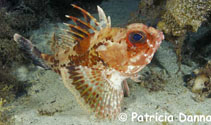
Body reddish brown, with large darker brown patch beneath dorsal fin anteriorly and smaller patches on dorsal half of body posteriorly; lower part of body with irregular orange spots; depth 35-39% SL. Head large 41-46%SL; eyes large 31-37%HL, protruding only slightly above dorsal profile. Caudal fin 13 (Ref. 33839). Lateral line almost straight, lacking the short curve at origin (Ref. 12723).
Body shape (shape guide): short and / or deep; Cross section: compressed.
Body shape (shape guide): short and / or deep; Cross section: compressed.
A temperate species found inshore on reefs (Ref. 7300).
ライフサイクルと交尾行動 成熟 | 繁殖 | 放精 | 卵 | 生産力 | 幼生
主な参考文献
参考文献のアップロード | 参考文献 | コーディネーター | 協力者
Motomura, H., 2003. Revision of the scorpionfish genus Neosebastes (Scorpaeniformes: Neosebastidae), with descriptions of five new species. Indo-Pac. Fish. (37):46 p. (Ref. 54394)
CITES
Not Evaluated
人間に対する脅威
Venomous (Ref. 9563)
人間の用途
FAO - Publication: search | FishSource |
より多くの情報
養殖生態
食料品(獲物)
餌の構成
摂食量
食料配給
捕食動物
食料品(獲物)
餌の構成
摂食量
食料配給
捕食動物
生態学
生態学
生態学
人口動態
成長のパラメーター
最大年齢/サイズ
長さ-重量比。
長短関係。
体長組成
質量変換
補充
豊度
成長のパラメーター
最大年齢/サイズ
長さ-重量比。
長短関係。
体長組成
質量変換
補充
豊度
ライフサイクル
繁殖
成熟
成熟度/エラ
生産力
放精
産卵群
卵
卵の開発
幼生
幼生の動力
繁殖
成熟
成熟度/エラ
生産力
放精
産卵群
卵
卵の開発
幼生
幼生の動力
解剖学
カマ
脳
オトリス
カマ
脳
オトリス
生理学
体組成
栄養素
酸素消費
水泳タイプ
泳ぐ速さ
視覚色素
フィッシュ・サウンド
病気と寄生虫
毒性(LC50)
体組成
栄養素
酸素消費
水泳タイプ
泳ぐ速さ
視覚色素
フィッシュ・サウンド
病気と寄生虫
毒性(LC50)
遺伝子の
ゲノム
遺伝子の
ヘテロ接合性
遺伝
遺伝的多様性
ゲノム
遺伝子の
ヘテロ接合性
遺伝
遺伝的多様性
用具
特記事項
XMLをダウンロードして下さい
インターネットの情報源
AFORO (otoliths) | Aquatic Commons | BHL | Cloffa | Websites from users | Check FishWatcher | CISTI | Catalog of Fishes: 部類, 種 | DiscoverLife | ECOTOX | FAO - Publication: search | Faunafri | Fishipedia | Fishtrace | GloBI | Google Books | Google Scholar | Google | IGFA World Record | OneZoom | Open Tree of Life | Otolith Atlas of Taiwan Fishes | PubMed | Reef Life Survey | Socotra Atlas | TreeBase | 生命の木 | Wikipedia: 行く, 検索する | World Records Freshwater Fishing | 動物に関する記録
モデルに基づく推定値
好ましい温度 (参照 123201): 17 - 18.7, mean 18 °C (based on 106 cells).
系統多様性指数 (参照 82804): PD50 = 0.5002 [Uniqueness, from 0.5 = low to 2.0 = high].
Bayesian length-weight: a=0.01995 (0.00906 - 0.04395), b=3.01 (2.83 - 3.19), in cm total length, based on all LWR estimates for this body shape (Ref. 93245).
栄養段階 (参照 69278): 3.8 ±0.4 se; based on size and trophs of closest relatives
栄養素 (Ref. 124155): Calcium = 15.3 [6.3, 32.1] mg/100g; Iron = 0.203 [0.095, 0.400] mg/100g; Protein = 17.8 [16.2, 19.4] %; Omega3 = 0.402 [0.165, 1.321] g/100g; Selenium = 9.84 [4.39, 23.28] μg/100g; VitaminA = 36.4 [8.2, 176.0] μg/100g; Zinc = 0.537 [0.343, 0.847] mg/100g (wet weight);