-

- À propos de cette page
- Langues
- Commentaires des utilisateurs
- Citation
- Téléchargements
- Espèces associées
-



Neosebastes bougainvillii (Cuvier, 1829)
Gulf gurnard perch
Ajouter votre observation dans Fish Watcher
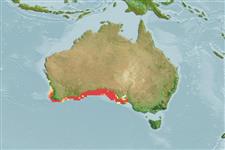
| Native range | All suitable habitat | Point map | Year 2050 |
|
| This map was computer-generated and has not yet been reviewed. |
| Neosebastes bougainvillii AquaMaps Data sources: GBIF OBIS |
Envoyez vos Photos et vidéos
Images | Images Google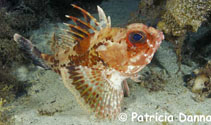 Neosebastes bougainvillii
Photo de Danna, P.
Images | Images Google
Photo de Danna, P.
Classification / Noms Noms communs | Synonymes | Catalog of Fishes(Genre, Espèce) | ITIS | CoL | WoRMS | Cloffa
> Perciformes/Scorpaenoidei (Scorpionfishes) > Neosebastidae (Gurnard scorpionfishes)
Etymology: Neosebastes: Greek, neos = new + Greek, sebastes = august, venerable (Ref. 45335).
Eponymy: Admiral Baron Hyacinthe Yves Philippe Potentien de Bouganville (1781–1846) was a French naval officer in command of the corvette ‘Espérance’. [...] (Ref. 128868), visit book page.
More on author: Cuvier.
Etymology: Neosebastes: Greek, neos = new + Greek, sebastes = august, venerable (Ref. 45335).
Eponymy: Admiral Baron Hyacinthe Yves Philippe Potentien de Bouganville (1781–1846) was a French naval officer in command of the corvette ‘Espérance’. [...] (Ref. 128868), visit book page.
More on author: Cuvier.
Environnement : milieu / zone climatique / profondeur / gamme de distribution Écologie
marin récifal; profondeur 10 - 100 m (Ref. 9563). Temperate; 29°S - 36°S
Distribution Territoires | Zones FAO | Écosystèmes | Occurrences | Carte par point | Introductions | Faunafri
Eastern Indian Ocean: endemic to Australia.
Taille / Poids / Âge
Description synthétique Clés d'identification | Morphologie | Morphométrie
Épines dorsales (Total) : 8; Rayons mous dorsaux (Total) : 8; Épines anales: 3; Rayons mous anaux: 5. Diagnosis: Dorsal rays XIII, 8 (9 in 1 of 20 specimens), third spine longest. Anal rays III, 5. Pectoral rays 20 or 21 (mode 21; 18 in 1 of 20 specimens), distal margin bilobed. Pored lateral-line scales 33-38 (34); longitudinal scale series 62-69 (66); scale rows between base of last dorsal spine and lateral line 7 or 8 (8). Well-developed gill rakers on upper limb 0 or 1 (1), lower limb 5-7 (6), total 5-8 (7); rudimentary gill rakers on upper limb 3-5 (4), lower limb 3-6 (5). Swim bladder absent. Dorsal profile of snout not steep, forming angle of about 50-55° to horizontal axis of head and body. Nasal spine simple (sometimes with 2 points), directed upward or slightly backward, length of former greater than anterior nostril diameter. Posterior margin of premaxilla ascending process extending beyond level of middle of posterior nostril when mouth closed. Interorbital ridge distinct; no scales on midinterorbital space or posterior half of supraorbital, but large and prominent on anterior half of supraorbital above interorbital ridge and on distal margin of supraorbital bone. Interorbital space extremely deep, but only about one-eighth of orbit extending above dorsal profile of head. Preocular with a small simple spine, its length less than that of nasal spine. Supraocular ridge with 3-6 prominent pointed spines, not strongly canted laterally; middle part of supraocular ridge located about midway between interorbital ridge and orbit in dorsal view. Sphenotic with a large spine and 3-7 minute spines. Postorbital spine flattened and serrated. Long, narrow and extremely deep transversal occipital pit, not covered with scales; a cluster of irregular scales protruding along front and behind sides of occipital pit; occipital pit curved posteriorly behind orbit, not covered with scales. Nuchal and supracleithral spines simple. Pterotic spine usually simple (sometimes with 2 points), originating slightly posterior to nuchal spine, base slightly smaller than that of latter. Upper posttemporal spine flattened, smooth or serrated; lower posttemporal spine simple (rarely with 2 points). Posterior margin of maxilla not extending beyond a vertical at posterior margin of pupil. Maxilla with scales extending from below posterior edge of anterior lacrimal spine to posterior margin of maxilla. Underside of mandible with 3 distinct pores and longitudinal ridges on each side, including an inner ridge extending from under lower jaw lip to lower edge of opercle, an outer ridge extending to lower edge of preopercle, and a central ridge extending to posterior part of angular and bearing the third pore posteriorly; distinct lacrimal ridge with 1-4 points. Anterior lacrimal spine usually simple (anterior edge sometimes serrated), directed ventroposteriorly (rarely forward). Posterior lacrimal spine with 1 or 2 points, directed ventroposteriorly; length of anterior lacrimal spine 2 times or less in that of posterior lacrimal spine. Suborbital pit present, front rimmed by a vertical (sometimes oblique) ridge on lacrimal to ventroanterior margin of orbit; large scales on entire suborbital pit. Suborbital ridge with 3-6 pointed spines in line with lacrimal ridge, spines joined at bases, directed backward. no scales between ventral margin of orbit and suborbital ridge, or on eye membrane. Preopercle with 5 spines, 4 lower spines simple, lacking a median ridge, uppermost spine with a median ridge and with a spine (rarely 2 spines) distally; length of uppermost preopercular spine slightly greater than or approximately equal to pupil diameter. Upper opercular spine simple, no median ridge; lower opercular spine simple with a median ridge; tip of lower opercular spine usually not extending beyond (rarely extending slightly beyond) opercular margin (Ref. 54394).
Body reddish brown, with large darker brown patch beneath dorsal fin anteriorly and smaller patches on dorsal half of body posteriorly; lower part of body with irregular orange spots; depth 35-39% SL. Head large 41-46%SL; eyes large 31-37%HL, protruding only slightly above dorsal profile. Caudal fin 13 (Ref. 33839). Lateral line almost straight, lacking the short curve at origin (Ref. 12723).
Body shape (shape guide): short and / or deep; Cross section: compressed.
Body shape (shape guide): short and / or deep; Cross section: compressed.
A temperate species found inshore on reefs (Ref. 7300).
Cycle de vie et comportement reproducteur Maturité | Reproduction | Frai | Œufs | Fécondité | Larves
Référence principale
Téléchargez vos références | Références | Coordinateur | Collaborateurs
Motomura, H., 2003. Revision of the scorpionfish genus Neosebastes (Scorpaeniformes: Neosebastidae), with descriptions of five new species. Indo-Pac. Fish. (37):46 p. (Ref. 54394)
CITES
Not Evaluated
Menace pour l'homme
Venomous (Ref. 9563)
Utilisations par l'homme
FAO - Publication: search | FishSource |
Plus d'informations
Écologie trophique
Aliments (proies)
Composition du régime alimentaire
Consommation alimentaire
Rations alimentaires
Prédateurs
Aliments (proies)
Composition du régime alimentaire
Consommation alimentaire
Rations alimentaires
Prédateurs
Écologie
Écologie
Écologie
Dynamique des populations
Paramètres de croissance
Âges / tailles maximales
Longueur-poids rel.
Rel. longueur-longueur.
Fréquences de longueurs
Conversion de masse
Recrutement
Abondance
Paramètres de croissance
Âges / tailles maximales
Longueur-poids rel.
Rel. longueur-longueur.
Fréquences de longueurs
Conversion de masse
Recrutement
Abondance
Cycle de vie
Reproduction
Maturité
Maturité/épines rel.
Fécondité
Frai
Agrégats de frai
Œufs
Développement de l'œuf
Larves
Dynamique des populations larvaires
Reproduction
Maturité
Maturité/épines rel.
Fécondité
Frai
Agrégats de frai
Œufs
Développement de l'œuf
Larves
Dynamique des populations larvaires
Anatomie
Surface branchiale
Cerveau
Otolithe
Surface branchiale
Cerveau
Otolithe
Physiologie
Composition corporelle
Nutriments
Consommation d'oxygène
Type de natation
Vitesse de nage
Pigments visuels
Son de poisson
Maladies et parasites
Toxicité (CL50)
Composition corporelle
Nutriments
Consommation d'oxygène
Type de natation
Vitesse de nage
Pigments visuels
Son de poisson
Maladies et parasites
Toxicité (CL50)
Génétique
génôme
Génétique
Hétérozygotie
Héritabilité
Diversité génétique
génôme
Génétique
Hétérozygotie
Héritabilité
Diversité génétique
Liées à l'homme
Systèmes d'aquaculture
Profils d'aquaculture
Souches
Cas de ciguatera
Timbres, pièces de monnaie, divers
Systèmes d'aquaculture
Profils d'aquaculture
Souches
Cas de ciguatera
Timbres, pièces de monnaie, divers
Outils
E-book | Guide de terrain | Générateur de fréquences de longueur | Outil de dynamique de population | Carte par point |
Capture-MSY |
Articles particuliers
Télécharger en XML
Sources Internet
AFORO (otoliths) | Aquatic Commons | BHL | Cloffa | Websites from users | FishWatcher | CISTI | Catalog of Fishes: Genre, Espèce | DiscoverLife | ECOTOX | FAO - Publication: search | Faunafri | Fishipedia | Fishtrace | GloBI | Google Books | Google Scholar | Google | IGFA World Record | OneZoom | Open Tree of Life | Otolith Atlas of Taiwan Fishes | PubMed | Reef Life Survey | Socotra Atlas | TreeBase | Arbre de Vie | Wikipedia: aller à, chercher | World Records Freshwater Fishing | Zoological Record
Estimations basées sur des modèles
Température préférée (Réf. 123201): 17 - 18.7, mean 18 °C (based on 106 cells).
Indice de diversité phylogénétique (Réf. 82804): PD50 = 0.5002 [Uniqueness, from 0.5 = low to 2.0 = high].
Bayesian length-weight: a=0.01995 (0.00906 - 0.04395), b=3.01 (2.83 - 3.19), in cm total length, based on all LWR estimates for this body shape (Ref. 93245).
Niveau trophique (Réf. 69278): 3.8 ±0.4 se; based on size and trophs of closest relatives
Nutriments (Ref. 124155): Calcium = 15.3 [6.3, 32.1] mg/100g; Iron = 0.203 [0.095, 0.400] mg/100g; Protein = 17.8 [16.2, 19.4] %; Omega3 = 0.402 [0.165, 1.321] g/100g; Selenium = 9.84 [4.39, 23.28] μg/100g; VitaminA = 36.4 [8.2, 176.0] μg/100g; Zinc = 0.537 [0.343, 0.847] mg/100g (wet weight);