-

- Over deze pagina
- Talen
- Feedback van gebruikers
- Citatie
- Uploads
- Verwante soorten
-



Pleuronectes platessa Linnaeus, 1758
European plaice
Waarneming toevoegen in Fish Watcher
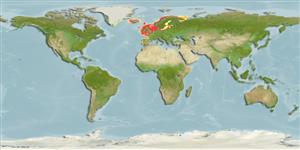
| Native range | All suitable habitat | Point map | Year 2050 |
|
| This map was computer-generated and has not yet been reviewed. |
| Pleuronectes platessa AquaMaps Data sources: GBIF OBIS |
Uploaden van uw Foto's en video's
Afbeeldingen | video's | Postzegels, munten, diversen. | Google afbeelding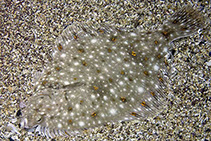 Pleuronectes platessa
Afbeelding van Greenfield, J.
Afbeeldingen | video's | Postzegels, munten, diversen. | Google afbeelding
Afbeelding van Greenfield, J.
Classificatie / Namen Lokale namen | Synoniemen | Catalog of Fishes(Genus, Soort(en)) | ITIS | CoL | WoRMS | Cloffa
> Pleuronectiformes (Flatfishes) > Pleuronectidae (Righteye flounders) > Pleuronectinae
Etymology: Pleuronectes: Greek, pleura = side, ribe + Greek, nekton = swimmer (Ref. 45335).
More on author: Linnaeus.
Etymology: Pleuronectes: Greek, pleura = side, ribe + Greek, nekton = swimmer (Ref. 45335).
More on author: Linnaeus.
Milieu: milieu / Klimaatzone / Diepte / verspreidingsgebied Ecologie
marien; brak water demersaal; oceanodroom (Ref. 51243); diepte 0 - 200 m (Ref. 35388), usually 10 - 50 m (Ref. 35388). Temperate; 2°C - 15°C (Ref. 5504); 72°N - 36°N, 47°W - 45°E
Verspreiding Gebieden | FAO regio's | Ecosystemen | Voorkomen | Verspreidingskaart | Introducties | Faunafri
Northern Sea. Reports from the Mediterranean Sea appear to be misidentifications of
P. flesus. It may have been present in some areas of the Mediterranean in the past, as a result of climatic changes related to the ice age, but at present times seem to be absent (Ref. 89040).
Lengte bij maturiteit / Grootte / Gewicht / Leeftijd
Maturiteit: Lm 32.7, range 24 - 42 cm
Max length : 100.0 cm SL mannelijk / geslacht onbekend; (Ref. 4705); common length : 40.0 cm TL mannelijk / geslacht onbekend; (Ref. 3397); max. gepubliceerd gewicht: 7.0 kg (Ref. 173); max. gerapporteerde leeftijd: 50 Jaren (Ref. 173)
Max length : 100.0 cm SL mannelijk / geslacht onbekend; (Ref. 4705); common length : 40.0 cm TL mannelijk / geslacht onbekend; (Ref. 3397); max. gepubliceerd gewicht: 7.0 kg (Ref. 173); max. gerapporteerde leeftijd: 50 Jaren (Ref. 173)
Korte beschrijving Determinatiesleutels | Morfologie | Morfometrie
Dorsale stekels (totaal) : 0; Dorsale zachte stralen (totaal) : 65 - 79; Anale stekels: 0; Anale zachte stralen: 48 - 59. Smooth with small scales. Bony ridge behind the eyes. Upper side brown or greenish brown with irregularly distributed bright red or orange spots. The underside is white. Lateral line straight, slightly curved above pectoral fin. Dorsal fin reaching eye. More than 30 vertebrae.
Body shape (shape guide): short and / or deep; Cross section: compressed.
Body shape (shape guide): short and / or deep; Cross section: compressed.
Adults live on mixed bottoms, the older the deeper the occurrence; small individuals are usually seen on bathing beaches (Ref. 9988). Occurs on mud and sand bottom from a few meters down to about 100 m, at sea, estuaries and rarely entering freshwaters (Ref. 59043). Reported as resident intertidal species with homing behavior (Ref. 32612). Feed mainly on thin-shelled mollusks and polychaetes. Batch spawner (Ref. 51846). The most important flatfish for fisheries in Europe. Utilized fresh and frozen; eaten steamed, fried, boiled, microwaved and baked (Ref. 9988). Active at night in the very shallow water while day time is spent buried in the sand. Stationary for long periods, tagging experiments have shown that their spawning migrations can be long. Changes in the environmental conditions have been disadvantageous. Populations in Kattegat and Danish belts decreased in 1980's and early 1990's due to discharge of nutritive salts. Wadden sea is still an excellent nursery ground (Ref.35388).
Levenscyclus en paargedrag Maturiteit | Voortplanting | Paaien | Eieren | Fecunditeit | Larven
Adult spawn when the temperature is around 6 °C (Ref. 4705).
Hoofdreferentie
Upload uw referenties | Referenties | Coördinator : Amaoka, Kunio | Medewerkers
Vinnikov, K.A., R.C. Thomson and T.A. Munroe, 2018. Revised classification of the righteye flounders (Teleostei: Pleuronectidae) based on multilocus phylogeny with complete taxon sampling. Molecular phylogenetics and evolution, 125:147-162. (Ref. 122998)
Status op de Rode Lijst van het IUCN (Ref. 130435: Version 2025-2)
Niet bedreigd (LC) ; Date assessed: 02 June 2022
CITES
Not Evaluated
Gevaar voor de mens
Harmless
Gebruik door de mens
Visserij: van groot commercieel belang; Aquacultuur: commercieel; sportvis: ja; Aquarium: Publieke aquaria
FAO - visserij: aanvoer, soortsprofiel; Publication: search | FIRMS - Stock assessments | FishSource | Sea Around Us
Meer informatie
Trofische ecologie
Voedsel (prooien)
Dieetsamenstelling
Voedselconsumptie
Voedselrantsoenen
Predatoren
Voedsel (prooien)
Dieetsamenstelling
Voedselconsumptie
Voedselrantsoenen
Predatoren
Levenscyclus
Voortplanting
Maturiteit
Rijpheid/kieuwen rel.
Fecunditeit
Paaien
Paaibestanden
Eieren
Ontwikkeling van de eieren
Larven
Larvale populatiedynamiek
Voortplanting
Maturiteit
Rijpheid/kieuwen rel.
Fecunditeit
Paaien
Paaibestanden
Eieren
Ontwikkeling van de eieren
Larven
Larvale populatiedynamiek
Fysiologie
Lichaamssamenstelling
Voedingsstoffen
Zuurstofverbruik
Type zwemmen
Zwemsnelheid
Visuele pigmenten
Vis geluid
Ziekten en parasieten
Toxiciteit (LC50)
Lichaamssamenstelling
Voedingsstoffen
Zuurstofverbruik
Type zwemmen
Zwemsnelheid
Visuele pigmenten
Vis geluid
Ziekten en parasieten
Toxiciteit (LC50)
Menselijk gerelateerd
Aquacultuursystemen
Aquacultuurprofielen
Kweeklijnen
Ciguatera gevallen
Postzegels, munten, diversen.
Aquacultuursystemen
Aquacultuurprofielen
Kweeklijnen
Ciguatera gevallen
Postzegels, munten, diversen.
Tools
E-boek | Veldgids | Determinatiesleutels | Lengtefrequentie Tool | Levenscyclus tool | Verspreidingskaart |
Vangst-MSY |
Speciale rapporten
Bekijk gegevens voor het houden in een aquarium | Bekijk Fact Sheets voor de soort | Bekijk Aquacultuur Fact Sheets
Download XML
Internetbronnen
AFORO (otoliths) | Aquatic Commons | BHL | Cloffa | Websites from users | Bekijk FishWatcher | CISTI | Catalog of Fishes: Genus, Soort(en) | DiscoverLife | DORIS | ECOTOX | FAO - visserij: aanvoer, soortsprofiel; Publication: search | Faunafri | Fishipedia | Fishtrace | GloBI | Google Books | Google Scholar | Google | IGFA World Record | Nationale databanken | OneZoom | Open Tree of Life | OsteoBase: skull, spine | Otolith Atlas of Taiwan Fishes | Publieke aquaria | PubMed | Reef Life Survey | Socotra Atlas | TreeBase | Tree of Life | Wikipedia: ga naar, zoek | World Records Freshwater Fishing | Zoobank | Zoological Record
Schattingen op basis van modellen
Gewenste temperatuur (Ref. 123201): 6.8 - 12.4, mean 10.2 °C (based on 658 cells).
Fylogenetische diversiteitsindex (Ref. 82804): PD50 = 0.7500 [Uniqueness, from 0.5 = low to 2.0 = high].
Bayesian length-weight: a=0.00776 (0.00684 - 0.00880), b=3.07 (3.03 - 3.11), in cm total length, based on LWR estimates for this species (Ref. 93245).
Trofisch niveau (Ref. 69278): 3.2 ±0.3 se; based on diet studies.
Generation time: 9.2 (7.1 - 11.6) years. Estimated as median ln(3)/K based on 17 growth studies.
Weerstandsvermogen (Ref. 120179): Gemiddeld, minimale populatieverdubbelingstijd 1,4-4,4 jaar (K=0.06-0.34; tm=2-6; tmax=30; Fec=50,000).
Prior r = 0.50, 95% CL = 0.33 - 0.75, Based on 28 full stock assessments.
Voedingsstoffen (Ref. 124155): Calcium = 25.4 [8.2, 51.7] mg/100g; Iron = 0.202 [0.084, 0.542] mg/100g; Protein = 17.3 [15.3, 19.8] %; Omega3 = 0.249 [0.118, 0.544] g/100g; Selenium = 29.6 [10.5, 80.9] μg/100g; VitaminA = 6.73 [1.77, 26.29] μg/100g; Zinc = 0.475 [0.263, 0.968] mg/100g (wet weight); based on nutrient studies.