-

- Über diese Seite
- Sprachen
- Rückmeldungen der Nutzer
- Zitat
- Uploads
-
Verwandte Arten
- Arten in
Planiliza - Arten in
Mugilidae - - Klassifizierung -
- Mugilidae
- Mugiliformes
- Teleostei
- Chordata
- Animalia
- Arten in
-



Planiliza haematocheilus (Temminck & Schlegel, 1845)
So-iuy mullet
Hochladen Photos und videos
Bilder | Google Bild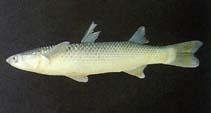 Planiliza haematocheilus
Photo von Kim, I.-S.
Bilder | Google Bild
Photo von Kim, I.-S.
Klassifizierung / Names Namen | Synonyme | Catalog of Fishes(Gattung, Arten) | ITIS | CoL | WoRMS | Cloffa
Issue
In genus Planiliza (Durand et al., 2015: Ref. 114224).
Umwelt: Milieu / Klimazone / Tiefenbereich / Verbreitungsgebiet Ökologie
seewasser; süßwasser; brackwasser pelagic-neritic; katadrom (Ref. 46888); tiefenbereich 5 - 10 m (Ref. 559). Temperate; 53°N - 18°N, 105°E - 146°E
Verbreitung Territorien | FAO Gebiete | Ökosysteme | Vorkommen | Punkt Karte | Einführungen | Faunafri
Northwest Pacific: Hokkaido southward to Kyushu, Japan; Amur River southward to Xiamen through the Korean Peninsula (Ref. 41299). Reported from Vietnam (Ref. 9706). Introduced in the Aegean Sea (Ref. 113897), Black Sea and the Mediterranean (Ref. 101091).
Länge bei der ersten Reifung / Größe / Gewicht / Alter
Geschlechtsreife: Lm ?, range 48 - ? cm
Max length : 80.0 cm TL Männchen/unbestimmt; (Ref. 56557); common length : 50.0 cm TL Männchen/unbestimmt; (Ref. 9137); max. veröff. Gewicht: 5.0 kg (Ref. 56557)
Max length : 80.0 cm TL Männchen/unbestimmt; (Ref. 56557); common length : 50.0 cm TL Männchen/unbestimmt; (Ref. 9137); max. veröff. Gewicht: 5.0 kg (Ref. 56557)
Kurzbeschreibung Bestimmungsschlüssel | Morphologie | Morphometrie
Body shape (shape guide): fusiform / normal.
Adults inhabit shallow coastal waters as well as freshwater regions of rivers (Ref. 41299). Very common in the rivers discharging into Peter the Great Bay; enter freshwater. Juveniles spend their first year in freshwater then migrate to sea to breed (Ref. 59043). Large concentrations of fry-of-the-year measuring 3.1-6.2 cm in the mouths of rivers in August. Length in the Black Sea is usually 20-30 cm but may reach 43 cm; length in the Atlantic Ocean may reach 50 cm (Ref. 2058). Omnivorous (Ref. 9137). Oviparous, eggs are pelagic and non-adhesive (Ref. 205). Alien Invasive: In Azov Sea, it is now the most abundant mugilid species. Along shores of Black Sea, its expansion corresponds to a sharp decline of native species of Mugilidae, which it apparently replaces (Ref. 59043).
Lebenszyklus und Paarungsverhalten Geschlechtsreife | Fortpflanzung | Ablaichen | Eier | Fruchtbarkeit | Larven
Juveniles spend their first year in freshwater then migrate to sea to breed (Ref. 59043). Also Ref. 205.
Hauptreferenz
Laden Sie Ihre Referenzen hoch | Referenzen | Koordinator : Harrison, Ian | Partner
Masuda, H. and G.R. Allen, 1993. Meeresfische der Welt - Groß-Indopazifische Region. Tetra Verlag, Herrenteich, Melle. 528 p. (Ref. 9137)
CITES
Not Evaluated
Bedrohung für Menschen
Harmless
Nutzung durch Menschen
Fischereien: kommerziell
FAO - Fischereien: landungen; Publication: search | FishSource | Das Meer um uns herum
Mehr Information
Trophische Ökologie
Lebensmittel (Beutetiere)
Nahrungszusammensetzung
Nahrungsaufnahme
Lebensmittelrationen
Räuber
Lebensmittel (Beutetiere)
Nahrungszusammensetzung
Nahrungsaufnahme
Lebensmittelrationen
Räuber
Populationsdynamik
Wachstumsparameter
Max. Alter/Größen
Länge-Gewicht-Rel.
Länge-Länge-Verhältnis.
Längenhäufigkeiten
Massenkonvertierung
Rekrutierung
Dichte
Wachstumsparameter
Max. Alter/Größen
Länge-Gewicht-Rel.
Länge-Länge-Verhältnis.
Längenhäufigkeiten
Massenkonvertierung
Rekrutierung
Dichte
Lebenszyklus
Fortpflanzung
Geschlechtsreife
Reifung/Kiemen rel.
Fruchtbarkeit
Ablaichen
Laichaggregationen
Eier
Eientwicklung
Larven
Larven Pop.Dyn.
Fortpflanzung
Geschlechtsreife
Reifung/Kiemen rel.
Fruchtbarkeit
Ablaichen
Laichaggregationen
Eier
Eientwicklung
Larven
Larven Pop.Dyn.
Anatomie
Kiemenoberfläche
Gehirn
Otolith
Kiemenoberfläche
Gehirn
Otolith
Physiologie
Körperliche Zusammensetzung
Nährstoffe
Sauerstoffverbrauch
Schwimmart
Schwimmgeschwindigkeit
Visuelle Pigmente
Fischgeräusche
Krankheiten und Parasiten
Toxizität (LC50s)
Körperliche Zusammensetzung
Nährstoffe
Sauerstoffverbrauch
Schwimmart
Schwimmgeschwindigkeit
Visuelle Pigmente
Fischgeräusche
Krankheiten und Parasiten
Toxizität (LC50s)
Genetik
Genom
Genetik
Heterozygotie
Vererbbarkeit
Genetische Vielfalt
Genom
Genetik
Heterozygotie
Vererbbarkeit
Genetische Vielfalt
Menschenbezogen
Aquakultur-Systeme
Aquakultur Profile
Zuchtlinien
Ciguatera-Fälle
Briefmarken, Münzen, Verschiedenes.
Aquakultur-Systeme
Aquakultur Profile
Zuchtlinien
Ciguatera-Fälle
Briefmarken, Münzen, Verschiedenes.
Tools
Zusatzinformationen
Download XML
Zusammenfassung | Punktdaten | Namen | Photos
Internet Quellen
AFORO (otoliths) | Alien/Invasive Species database | Aquatic Commons | BHL | Cloffa | Websites from users | FishWatcher Einträge suchen | CISTI | Catalog of Fishes: Gattung, Arten | DiscoverLife | ECOTOX | FAO - Fischereien: landungen; Publication: search | Faunafri | Fishipedia | Fishtrace | GloBI | Google Books | Google Scholar | Google | IGFA World Record | Nationale Datenbanken | OneZoom | Open Tree of Life | Otolith Atlas of Taiwan Fishes | PubMed | Reef Life Survey | Socotra Atlas | TreeBase | Tree of Life | Wikipedia: Gehe zu, Suchen | World Records Freshwater Fishing | Zoologischer Rekord
Schätzungen auf der Grundlage von Modellen
Bevorzugte Temperatur (Ref. 123201): 20.2 - 25, mean 22.4 °C (based on 103 cells).
Phylogenetischer Diversitätsindex (Ref. 82804): PD50 = 0.5001 [Uniqueness, from 0.5 = low to 2.0 = high].
Bayesian length-weight: a=0.00933 (0.00620 - 0.01405), b=2.95 (2.83 - 3.07), in cm total length, based on LWR estimates for this species & Genus-body shape (Ref. 93245).
Trophische Ebene (Ref. 69278): 2.5 ±0.19 se; based on food items.
Generation time: 8.1 ( na - na) years. Estimated as median ln(3)/K based on 2 growth studies.
Widerstandsfähigkeit (Ref. 120179): niedrig, Verdopplung der Population dauert 4,5 - 14 Jahre. (0.13-0.23; tm=2-5;).
Nährstoffe (Ref. 124155): Calcium = 34.5 [13.5, 102.8] mg/100g; Iron = 0.427 [0.194, 0.861] mg/100g; Protein = 18.9 [17.2, 20.5] %; Omega3 = 0.703 [0.309, 1.611] g/100g; Selenium = 8.06 [3.41, 19.24] μg/100g; VitaminA = 10.2 [2.5, 43.4] μg/100g; Zinc = 0.846 [0.550, 1.305] mg/100g (wet weight);