-

- Über diese Seite
- Sprachen
- Rückmeldungen der Nutzer
- Zitat
- Uploads
- Verwandte Arten
-



Hochladen Photos und videos
Bilder | Google Bild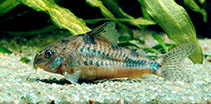 Corydoras paleatus
Photo von Muséum-Aquarium de Nancy/D. Terver
Bilder | Google Bild
Photo von Muséum-Aquarium de Nancy/D. Terver
Klassifizierung / Names Namen | Synonyme | Catalog of Fishes(Gattung, Arten) | ITIS | CoL | WoRMS | Cloffa
> Siluriformes (Catfishes) > Callichthyidae (Callichthyid armored catfishes) > Corydoradinae
Etymology: Corydoras: Greek, kory = helmet + greek, doras = skin (Ref. 45335).
More on author: Jenyns.
Etymology: Corydoras: Greek, kory = helmet + greek, doras = skin (Ref. 45335).
More on author: Jenyns.
Umwelt: Milieu / Klimazone / Tiefenbereich / Verbreitungsgebiet Ökologie
; süßwasser demersal; pH range: 6.0 - 8.0; dH range: 5 - 19. Subtropical; 18°C - 23°C (Ref. 30491)
Verbreitung Territorien | FAO Gebiete | Ökosysteme | Vorkommen | Punkt Karte | Einführungen | Faunafri
South America: Argentina, Brazil, and Uruguay.
Größe / Gewicht / Alter
Geschlechtsreife: Lm ? range ? - ? cm
Max length : 6.6 cm SL Männchen/unbestimmt; (Ref. 111771); 7.1 cm SL (female); max. veröff. Gewicht: 11.20 g (Ref. 111771); max. veröff. Gewicht: 11.20 g
Max length : 6.6 cm SL Männchen/unbestimmt; (Ref. 111771); 7.1 cm SL (female); max. veröff. Gewicht: 11.20 g (Ref. 111771); max. veröff. Gewicht: 11.20 g
Kurzbeschreibung Bestimmungsschlüssel | Morphologie | Morphometrie
Rückenflossenstacheln (insgesamt) : 2; Rückenflossenweichstrahlen (insgesamt) : 8 - 9; Afterflossenweichstrahlen: 6 - 7; Wirbelzahl: 21 - 22. This species is distinguished from its congeners, except C. armatus and C. microcephalus, by having perpendicularly directed serrations along the entire posterior margin of the pectoral spines (vs. serrations pointing towards pectoral spine origin, or directed towards pectoral-spine tip, or perpendicularly directed serrations, if present, bifid or restricted to proximal region of pectoral spine); differs from C. armatus by the absence of contact between infraorbital 2 and compound pterotic (vs. presence); differs from C. microcephalus by the presence of a longitudinal series of three large black blotches along midline of flank (vs. four or five midline blotches in C. microcephalus); differs from C. cohui, C. diphyes, C. flaveolus, C. froehlichi, C. gryphus, C. habrosus, C. lacrimostigmata, C. longipinnis, C. lymnades by having the anterior region of the dorsal fin black (vs. with black spots or bars); differs from C. carlae, C. garbei, C. difluviatilis by having hyaline or black pectoral fin (vs. with black spots or bars); differs from C. reynoldsi, C. tukano, C. weitzmani by the absence of a conspicuous coloration pattern in the region of the eye (vs. presence of a transversal black stripe across the eye); differs from C. gladysae, C. micracanthus, C. petracinii by having a dorsal spine that is relatively long, with adpressed distal tip slightly surpassing the base of the last branched dorsal-ray (vs. conspicuously short, with adpressed distal tip not reaching the base of the last branched dorsal-ray); differs from C. ehrhardti by having transversal black bars on caudal-fin lobes (vs. caudal-fin lobes hyaline or brownish); differs from C. steindachneri by having a fold in the middle portion of the lower lip (vs. absence) (Ref. 129023).
Cross section: compressed.
Cross section: compressed.
Facultative air-breathing (Ref. 126274); Found in ponds (Ref. 11229). Feeds on worms, crustaceans, insects and plant matter (Ref. 7020). Aquarium keeping: in groups of 5 or more individuals; minimum aquarium size 60 cm (Ref. 51539).
Lebenszyklus und Paarungsverhalten Geschlechtsreife | Fortpflanzung | Ablaichen | Eier | Fruchtbarkeit | Larven
The female holds 2-4 eggs between her pelvic fins, where the male fertilizes them for about 30 seconds. Only then the female swims to a suitable spot, where she attaches the very sticky eggs. The pair repeats this process until about 100 eggs have been fertilized and attached (Ref. 1672).
Hauptreferenz
Laden Sie Ihre Referenzen hoch | Referenzen | Koordinator : Reis, Roberto E. | Partner
Tencatt, L.F.C., M.R. de Britto and C.S. Pavanelli, 2016. Revisionary study of the armored catfish Corydoras paleatus (Jenyns, 1842) (Siluriformes: Callichthyidae) over 180 years after its discovery by Darwin, with description of a new species. Neotropical Ichthyology 14(1):75-94. (Ref. 129023)
IUCN Rote Liste Status (Ref. 130435: Version 2025-2)
nicht bedroht (LC) ; Date assessed: 15 October 2020
CITES
Not Evaluated
Bedrohung für Menschen
Harmless
Nutzung durch Menschen
Fischereien: nicht kommerziell; Aquarium: hoch kommerziell
FAO - Publication: search | FishSource |
Mehr Information
Trophische Ökologie
Lebensmittel (Beutetiere)
Nahrungszusammensetzung
Nahrungsaufnahme
Lebensmittelrationen
Räuber
Lebensmittel (Beutetiere)
Nahrungszusammensetzung
Nahrungsaufnahme
Lebensmittelrationen
Räuber
Populationsdynamik
Wachstumsparameter
Max. Alter/Größen
Länge-Gewicht-Rel.
Länge-Länge-Verhältnis.
Längenhäufigkeiten
Massenkonvertierung
Rekrutierung
Dichte
Wachstumsparameter
Max. Alter/Größen
Länge-Gewicht-Rel.
Länge-Länge-Verhältnis.
Längenhäufigkeiten
Massenkonvertierung
Rekrutierung
Dichte
Lebenszyklus
Fortpflanzung
Geschlechtsreife
Reifung/Kiemen rel.
Fruchtbarkeit
Ablaichen
Laichaggregationen
Eier
Eientwicklung
Larven
Larven Pop.Dyn.
Fortpflanzung
Geschlechtsreife
Reifung/Kiemen rel.
Fruchtbarkeit
Ablaichen
Laichaggregationen
Eier
Eientwicklung
Larven
Larven Pop.Dyn.
Anatomie
Kiemenoberfläche
Gehirn
Otolith
Kiemenoberfläche
Gehirn
Otolith
Physiologie
Körperliche Zusammensetzung
Nährstoffe
Sauerstoffverbrauch
Schwimmart
Schwimmgeschwindigkeit
Visuelle Pigmente
Fischgeräusche
Krankheiten und Parasiten
Toxizität (LC50s)
Körperliche Zusammensetzung
Nährstoffe
Sauerstoffverbrauch
Schwimmart
Schwimmgeschwindigkeit
Visuelle Pigmente
Fischgeräusche
Krankheiten und Parasiten
Toxizität (LC50s)
Menschenbezogen
Aquakultur-Systeme
Aquakultur Profile
Zuchtlinien
Ciguatera-Fälle
Briefmarken, Münzen, Verschiedenes.
Aquakultur-Systeme
Aquakultur Profile
Zuchtlinien
Ciguatera-Fälle
Briefmarken, Münzen, Verschiedenes.
Tools
Bio-Quiz | E-Book | Feldführer | Längenhäufigkeits Tool | Lebensdaten Tool | Punkt Karte |
Catch-MSY |
Zusatzinformationen
Download XML
Zusammenfassung | Punktdaten | Namen | Photos
Internet Quellen
AFORO (otoliths) | Alien/Invasive Species database | Aquatic Commons | BHL | Cloffa | Websites from users | FishWatcher Einträge suchen | CISTI | Catalog of Fishes: Gattung, Arten | DiscoverLife | ECOTOX | FAO - Publication: search | Faunafri | Fishipedia | Fishtrace | GloBI | Google Books | Google Scholar | Google | IGFA World Record | Nationale Datenbanken | OneZoom | Open Tree of Life | Otolith Atlas of Taiwan Fishes | Öffentliche Aquarien | PubMed | Reef Life Survey | Socotra Atlas | TreeBase | Tree of Life | Wikipedia: Gehe zu, Suchen | World Records Freshwater Fishing | Zoologischer Rekord
Schätzungen auf der Grundlage von Modellen
Phylogenetischer Diversitätsindex (Ref. 82804): PD50 = 0.5000 [Uniqueness, from 0.5 = low to 2.0 = high].
Bayesian length-weight: a=0.02344 (0.01606 - 0.03422), b=2.97 (2.89 - 3.05), in cm total length, based on LWR estimates for this species (Ref. 93245).
Trophische Ebene (Ref. 69278): 2.9 ±0.34 se; based on food items.
Widerstandsfähigkeit (Ref. 120179): mittel, Verdopplung der Population dauert 1,4 - 4,4 Jahre. (Fec is at least about 100 eggs (Ref. 1672)).