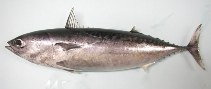
Auxis thazard, Frigate tuna : fisheries, gamefish

Auxis thazard (Lacepède, 1800)

Frigate tuna
Waarneming toevoegen in Fish Watcher
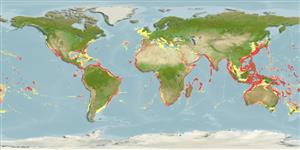
Native range | All suitable habitat | Point map | Year 2050
This map was computer-generated and has not yet been reviewed.
Auxis thazard   AquaMaps   Data sources: GBIF OBIS
Uploaden van uw Foto's en video's
Afbeeldingen | Postzegels, munten, diversen. | Google afbeelding

Classificatie / Namen Lokale namen | Synoniemen | Catalog of Fishes(Genus, Soort(en)) | ITIS | CoL | WoRMS | Cloffa

> Scombriformes (Mackerels) > Scombridae (Mackerels, tunas, bonitos) > Scombrinae
Etymology: Auxis: Greek, auxis = a variety of tunna (Ref. 45335).
More on author: Lacepède.

Milieu: milieu / Klimaatzone / Diepte / verspreidingsgebied Ecologie

marien pelagic-neritic; oceanodroom (Ref. 71039); diepte 50 - ? m (Ref. 9340). Subtropical; 27°C - 28°C; 61°N - 51°S, 180°W - 180°E

Verspreiding Gebieden | FAO regio's | Ecosystemen | Voorkomen | Verspreidingskaart | Introducties | Faunafri

Atlantic,Mediterranean, Indian and Pacific (Western Central). Eastern Pacific population recognized as subspecies Auxis thazard brachydorax (Ref. 32349). Many authors have used the name Auxis thazard as including Auxis rochei in the belief that there was only a single worldwide species of Auxis. Highly migratory species.

Lengte bij maturiteit / Grootte / Gewicht / Leeftijd

Maturiteit: Lm 29.5, range 29 - ? cm
Max length : 65.0 cm FL mannelijk / geslacht onbekend; (Ref. 29114); common length : 60.0 cm TL mannelijk / geslacht onbekend; (Ref. 47377); max. gepubliceerd gewicht: 1.7 kg (Ref. 40637); max. gerapporteerde leeftijd: 5 Jaren (Ref. 29114)

Korte beschrijving Determinatiesleutels | Morfologie | Morfometrie

Dorsale stekels (totaal) : 10 - 12; Dorsale zachte stralen (totaal) : 10 - 13; Anale stekels: 0; Anale zachte stralen: 10 - 14. This species is distinguished by the following characters: a robust body, elongated and rounded; teeth small and conical, in a single series; total gill rakers on first gill arch 36-42; dorsal fins 2, D1 X-XII, separated from the second by a large interspace (at least equal to length of first dorsal-fin base), second dorsal fin followed by 8 finlets; anal fin followed by 7 finlets; pectoral fins short, but reaching past vertical line from anterior margin of scaleless area above corselet; a large single-pointed flap (interpelvic process) between pelvic fins; body naked except for the corselet, which is well developed and narrow in its posterior part (no more than 5 scales wide under second dorsal-fin origin); a strong central keel on each side of caudal-fin base between 2 smaller keels. Colour of back bluish, turning to deep purple or almost black on the head; a pattern of 15 or more narrow, oblique to nearly horizontal, dark wavy lines in scaleless area above lateral line; belly white; pectoral and pelvic fins purple, inner sides black (Ref 9684).
Body shape (shape guide): fusiform / normal; Cross section: oval.

Biologie     Verklarende woordenlijst (bv. epibenthic)

Adults are epipelagic in neritic and oceanic waters (Ref. 9340). They feed on small fish, squids, planktonic crustaceans (megalops), and stomatopod larvae (Ref. 5213). Because of their abundance, they are considered an important element of the food web, particularly as forage for other species of commercial interest. They are preyed upon by larger fishes, including other tunas (Ref. 9987). Marketed fresh and frozen (Ref. 9340) and also utilized dried or salted, smoked and canned (Ref. 9987).

Levenscyclus en paargedrag Maturiteit | Voortplanting | Paaien | Eieren | Fecunditeit | Larven

In correlation with temperature and other environmental changes, the spawning season varies with areas, but in some places it may even extend throughout the year.

Hoofdreferentie Upload uw referenties | Referenties | Coördinator : Collette, Bruce B. | Medewerkers

Collette, B.B. and C.R. Aadland, 1996. Revision of the frigate tunas (Scombridae, Auxis), with descriptions of two new subspecies from the eastern Pacific. Fish. Bull. 94(3):423-441. (Ref. 32349)

Status op de Rode Lijst van het IUCN (Ref. 130435: Version 2025-2)

  Niet bedreigd (LC) ; Date assessed: 01 March 2022

CITES

Not Evaluated

CMS (Ref. 116361)

Not Evaluated

Gevaar voor de mens

  Harmless


Gebruik door de mens

Visserij: van groot commercieel belang; sportvis: ja
FAO - visserij: aanvoer, soortsprofiel; Publication: search | FIRMS - Stock assessments | FishSource | Sea Around Us

Meer informatie

Trofische ecologie
Voedsel (prooien)
Dieetsamenstelling
Voedselconsumptie
Voedselrantsoenen
Predatoren
Ecologie
Ecologie
Populatiedynamica
Groeiparameters
Max. leeftijden / maten
Lengte-gewicht rel.
Lengte-lengte rel.
Lengtefrequenties
Massaconversie
Rekrutering
Abundantie
Levenscyclus
Voortplanting
Maturiteit
Rijpheid/kieuwen rel.
Fecunditeit
Paaien
Paaibestanden
Eieren
Ontwikkeling van de eieren
Larven
Larvale populatiedynamiek
Anatomie
Kieuwoppervlak
Hersenen
Otoliet
Fysiologie
Lichaamssamenstelling
Voedingsstoffen
Zuurstofverbruik
Type zwemmen
Zwemsnelheid
Visuele pigmenten
Vis geluid
Ziekten en parasieten
Toxiciteit (LC50)
Genetica
genoom
Genetica
Heterozygositeit
Erfelijkheid
Genetische diversiteit
Menselijk gerelateerd
Aquacultuursystemen
Aquacultuurprofielen
Kweeklijnen
Ciguatera gevallen
Postzegels, munten, diversen.
Outreach
Medewerkers
Referenties
Referenties

Tools

Speciale rapporten

Download XML

Internetbronnen

AFORO (otoliths) | Aquatic Commons | BHL | Cloffa | Websites from users | Bekijk FishWatcher | CISTI | Catalog of Fishes: Genus, Soort(en) | DiscoverLife | ECOTOX | FAO - visserij: aanvoer, soortsprofiel; Publication: search | Faunafri | Fishipedia | Fishtrace | GloBI | Google Books | Google Scholar | Google | IGFA World Record | Nationale databanken | OneZoom | Open Tree of Life | Otolith Atlas of Taiwan Fishes | PubMed | Reef Life Survey | Socotra Atlas | TreeBase | Tree of Life | Wikipedia: ga naar, zoek | World Records Freshwater Fishing | Zoological Record

Schattingen op basis van modellen

Gewenste temperatuur (Ref. 123201): 13.8 - 27.1, mean 22 °C (based on 986 cells).
Fylogenetische diversiteitsindex (Ref. 82804):  PD50 = 0.5625   [Uniqueness, from 0.5 = low to 2.0 = high].
Bayesian length-weight: a=0.00977 (0.00849 - 0.01125), b=3.07 (3.03 - 3.11), in cm total length, based on LWR estimates for this species (Ref. 93245).
Trofisch niveau (Ref. 69278):  4.4   ±0.4 se; based on diet studies.
Generation time: 1.5 (1.3 - 1.9) years. Estimated as median ln(3)/K based on 18 growth studies.
Weerstandsvermogen (Ref. 120179):  Gemiddeld, minimale populatieverdubbelingstijd 1,4-4,4 jaar (K=0.8; tmax=5; tm=2.5; Fec=200,000 to >1 million).
Prior r = 0.57, 95% CL = 0.37 - 0.85, Based on 4 data-limited stock assessments.
Kwetsbaarheid van de visserij (Ref. 59153):  Low to moderate vulnerability (28 of 100). 🛈
Kwetsbaarheid voor het klimaat (Ref. 125649):  Low to moderate vulnerability (28 of 100). 🛈
Prijsklasse (Ref. 80766):   Very high.
Voedingsstoffen (Ref. 124155):  Calcium = 200 [57, 445] mg/100g; Iron = 2.61 [0.96, 6.35] mg/100g; Protein = 21.6 [19.6, 23.5] %; Omega3 = 0.324 [0.153, 0.683] g/100g; Selenium = 65.1 [25.8, 204.4] μg/100g; VitaminA = 21.9 [4.9, 83.8] μg/100g; Zinc = 1.2 [0.4, 2.2] mg/100g (wet weight); based on nutrient studies.