-

- Über diese Seite
- Sprachen
- Rückmeldungen der Nutzer
- Zitat
- Uploads
-
Verwandte Arten
- Arten in
Tylochromis - Arten in
Cichlidae - - Klassifizierung -
- Pseudocrenilabrinae
- Cichlidae
- Cichliformes
- Teleostei
- Chordata
- Animalia
- Arten in
-



Tylochromis aristoma Stiassny, 1989
Hochladen Photos und videos
Google Bild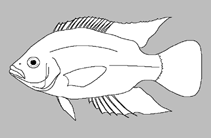 No image available for this species;
drawing shows typical species in Cichlidae.
Google Bild
drawing shows typical species in Cichlidae.
Klassifizierung / Names Namen | Synonyme | Catalog of Fishes(Gattung, Arten) | ITIS | CoL | WoRMS | Cloffa
> Cichliformes (Cichlids, convict blennies) > Cichlidae (Cichlids) > Pseudocrenilabrinae
Etymology: Tylochromis: Greek, tylos = callus + Greek, chromis = a fish, perhaps a perch (Ref. 45335); aristoma: ari = Greek for well-developed, stoma = Greek for mouth (Ref. 52307). Named in reference to the prominent lower jaw and large-mouthed appearance of the adult (Ref. 52346).
Etymology: Tylochromis: Greek, tylos = callus + Greek, chromis = a fish, perhaps a perch (Ref. 45335); aristoma: ari = Greek for well-developed, stoma = Greek for mouth (Ref. 52307). Named in reference to the prominent lower jaw and large-mouthed appearance of the adult (Ref. 52346).
Umwelt: Milieu / Klimazone / Tiefenbereich / Verbreitungsgebiet Ökologie
; süßwasser benthopelagisch. Tropical
Verbreitung Territorien | FAO Gebiete | Ökosysteme | Vorkommen | Punkt Karte | Einführungen | Faunafri
Africa: restricted to the Ruki River drainage (middle Congo River basin), in Democratic Republic of the Congo (Ref. 52346, 93897).
Größe / Gewicht / Alter
Kurzbeschreibung Bestimmungsschlüssel | Morphologie | Morphometrie
Rückenflossenstacheln (insgesamt) : 13 - 16; Rückenflossenweichstrahlen (insgesamt) : 12 - 14; Afterflossenweichstrahlen: 7; Wirbelzahl: 28 - 29. Diagnosis: deep bodied, robust species with a relatively large mouth (compared to its congeners), but juveniles slender (Ref. 52307). Slender gracile lower jaw and narrow elongate keel (Ref. 52346). Dorsum strongly curved from nape to caudal peduncle but ventrum more or less flattened; long snout with a straight and steep predorsal profile passing uninterrupted to origin of dorsal fin, where body depth is largest; lower jaw extremely prominent; lips well-formed but not overly thickened or fleshy; entire premaxillary oral flap present; buccal teeth capped with brown or black enameloid; in juveniles all teeth small and fine with little differentiation in tooth size between inner and outer rows; in adult (male) teeth coarse and enlarged; upper branch of lateral line terminates in advance of end of dorsal fin; dorsal, ventral and medial lateral line branches on caudal fin well developed and almost reach to periphery; dorsal fin spines increase in length to 4th-5th and are then more or less of equal length; anal fin rounded; caudal fin roundly emarginate and densely scaled; pectoral fin relatively elongate and usually reaches level of first soft anal ray; first branched pelvic ray produced and filamentous (Ref. 52346).
Coloration: adult male: upper lip and front of head black (Ref. 52307, 52346). Just anterior to a short black nape stripe a patch of red/gold is present (Ref. 52346). Cheeks, operculum and breast silvery-white with greenish iridescent parts (Ref. 52307). Just behind nape band a broad pale blue/green band extends obliquely down to base of pelvic fins (Ref. 52346). Behind this oblique band body dark (golden) bronze which becomes more greenish towards caudal peduncle (Ref. 52307, 52346). Darker pigmentation on flank scales; dorsal, pelvic and anal fins dark reddish brown, with numerous rows of small greenish dots (Ref. 52307). Caudal fin light brown centrally, with more reddish parts in distal (outer) regions and many small black lines (Ref. 52307, 52346). (Preserved) juveniles: ground coloration light brown with dark smokey grey upper lip and front of head; nape band strongly marked but not reaching down onto operculum; diffuse opercular blotch present on lower portion of operculum; 6 vertical stripes extend down well below midline and onto belly and ventrum (especially in the smallest specimens) (Ref. 52346).
Seems to feed primarily upon plants and insect larvae; maternal mouthbrooder that does not pair-bond (Ref. 52307).
Lebenszyklus und Paarungsverhalten Geschlechtsreife | Fortpflanzung | Ablaichen | Eier | Fruchtbarkeit | Larven
Hauptreferenz
Laden Sie Ihre Referenzen hoch | Referenzen | Koordinator : Kullander, Sven O. | Partner
Stiassny, M.L.J., 1991. Tylochromis. p. 526-533. In J. Daget, J.-P. Gosse, G.G. Teugels and D.F.E. Thys van den Audenaerde (eds.) Check-list of the freshwater fishes of Africa (CLOFFA). ISNB, Brussels; MRAC, Tervuren; and ORSTOM, Paris. Vol. 4. (Ref. 5714)
IUCN Rote Liste Status (Ref. 130435: Version 2025-2)
nicht bedroht (LC) ; Date assessed: 16 February 2009
CITES
Not Evaluated
Bedrohung für Menschen
Harmless
Nutzung durch Menschen
FAO - Publication: search | FishSource |
Mehr Information
Trophische Ökologie
Lebensmittel (Beutetiere)
Nahrungszusammensetzung
Nahrungsaufnahme
Lebensmittelrationen
Räuber
Lebensmittel (Beutetiere)
Nahrungszusammensetzung
Nahrungsaufnahme
Lebensmittelrationen
Räuber
Populationsdynamik
Wachstumsparameter
Max. Alter/Größen
Länge-Gewicht-Rel.
Länge-Länge-Verhältnis.
Längenhäufigkeiten
Massenkonvertierung
Rekrutierung
Dichte
Wachstumsparameter
Max. Alter/Größen
Länge-Gewicht-Rel.
Länge-Länge-Verhältnis.
Längenhäufigkeiten
Massenkonvertierung
Rekrutierung
Dichte
Lebenszyklus
Fortpflanzung
Geschlechtsreife
Reifung/Kiemen rel.
Fruchtbarkeit
Ablaichen
Laichaggregationen
Eier
Eientwicklung
Larven
Larven Pop.Dyn.
Fortpflanzung
Geschlechtsreife
Reifung/Kiemen rel.
Fruchtbarkeit
Ablaichen
Laichaggregationen
Eier
Eientwicklung
Larven
Larven Pop.Dyn.
Anatomie
Kiemenoberfläche
Gehirn
Otolith
Kiemenoberfläche
Gehirn
Otolith
Physiologie
Körperliche Zusammensetzung
Nährstoffe
Sauerstoffverbrauch
Schwimmart
Schwimmgeschwindigkeit
Visuelle Pigmente
Fischgeräusche
Krankheiten und Parasiten
Toxizität (LC50s)
Körperliche Zusammensetzung
Nährstoffe
Sauerstoffverbrauch
Schwimmart
Schwimmgeschwindigkeit
Visuelle Pigmente
Fischgeräusche
Krankheiten und Parasiten
Toxizität (LC50s)
Genetik
Genom
Genetik
Heterozygotie
Vererbbarkeit
Genetische Vielfalt
Genom
Genetik
Heterozygotie
Vererbbarkeit
Genetische Vielfalt
Menschenbezogen
Aquakultur-Systeme
Aquakultur Profile
Zuchtlinien
Ciguatera-Fälle
Briefmarken, Münzen, Verschiedenes.
Aquakultur-Systeme
Aquakultur Profile
Zuchtlinien
Ciguatera-Fälle
Briefmarken, Münzen, Verschiedenes.
Tools
Zusatzinformationen
Download XML
Zusammenfassung | Punktdaten | Namen | Photos
Internet Quellen
AFORO (otoliths) | Aquatic Commons | BHL | Cloffa | Websites from users | FishWatcher Einträge suchen | CISTI | Catalog of Fishes: Gattung, Arten | DiscoverLife | ECOTOX | FAO - Publication: search | Faunafri | Fishipedia | Fishtrace | GloBI | Google Books | Google Scholar | Google | IGFA World Record | OneZoom | Open Tree of Life | Otolith Atlas of Taiwan Fishes | PubMed | Reef Life Survey | Socotra Atlas | TreeBase | Tree of Life | Wikipedia: Gehe zu, Suchen | World Records Freshwater Fishing | Zoobank | Zoologischer Rekord
Schätzungen auf der Grundlage von Modellen
Phylogenetischer Diversitätsindex (Ref. 82804): PD50 = 0.5000 [Uniqueness, from 0.5 = low to 2.0 = high].
Bayesian length-weight: a=0.01000 (0.00244 - 0.04107), b=3.04 (2.81 - 3.27), in cm total length, based on all LWR estimates for this body shape (Ref. 93245).
Trophische Ebene (Ref. 69278): 2.7 ±0.3 se; based on size and trophs of closest relatives
Widerstandsfähigkeit (Ref. 120179): hoch, Verdopplung der Population dauert weniger als 15 Monate. (Preliminary K or Fecundity.).
Nährstoffe (Ref. 124155): Calcium = 150 [73, 263] mg/100g; Iron = 1.45 [0.78, 2.89] mg/100g; Protein = 17.7 [16.1, 19.2] %; Omega3 = 0.367 [0.132, 1.062] g/100g; Selenium = 73 [26, 166] μg/100g; VitaminA = 36.3 [9.4, 114.1] μg/100g; Zinc = 2.14 [1.39, 3.31] mg/100g (wet weight);