-

- Over deze pagina
- Talen
- Feedback van gebruikers
- Citatie
- Uploads
- Verwante soorten
-



Carcharhinus sealei (Pietschmann, 1913)
Blackspot shark
Waarneming toevoegen in Fish Watcher
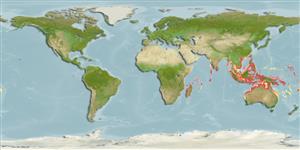
| Native range | All suitable habitat | Point map | Year 2050 |
|
| This map was computer-generated and has not yet been reviewed. |
| Carcharhinus sealei AquaMaps Data sources: GBIF OBIS |
Uploaden van uw Foto's en video's
Afbeeldingen | Google afbeelding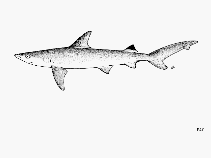 Carcharhinus sealei
Afbeelding van FAO
Afbeeldingen | Google afbeelding
Afbeelding van FAO
Classificatie / Namen Lokale namen | Synoniemen | Catalog of Fishes(Genus, Soort(en)) | ITIS | CoL | WoRMS | Cloffa
Elasmobranchii (haaien en roggen) (sharks and rays) > Carcharhiniformes (Ground sharks) > Carcharhinidae (Requiem sharks)
Etymology: Carcharhinus: karcharos (Gr.), sharp or jagged; rhinus, an ancient name for sharks, from rhine (Gr.), rasp, both words alluding to a shark's jagged, rasp-like skin (See ETYFish); sealei: In honor of American ichthyologist Alvin Seale (1871-1958), Stanford University, who described this shark in 1910 but used a preoccupied name (C. borneensis) (See ETYFish).
Eponymy: Alvin Seale (1871–1958) was an ichthyologist and designer of aquaria. [...] (Ref. 128868), visit book page.
Etymology: Carcharhinus: karcharos (Gr.), sharp or jagged; rhinus, an ancient name for sharks, from rhine (Gr.), rasp, both words alluding to a shark's jagged, rasp-like skin (See ETYFish); sealei: In honor of American ichthyologist Alvin Seale (1871-1958), Stanford University, who described this shark in 1910 but used a preoccupied name (C. borneensis) (See ETYFish).
Eponymy: Alvin Seale (1871–1958) was an ichthyologist and designer of aquaria. [...] (Ref. 128868), visit book page.
Milieu: milieu / Klimaatzone / Diepte / verspreidingsgebied Ecologie
marien rifbewoner; diepte 0 - 40 m (Ref. 244). Tropical; 24°N - 30°S
Verspreiding Gebieden | FAO regio's | Ecosystemen | Voorkomen | Verspreidingskaart | Introducties | Faunafri
Indo-West Pacific: reported to occur throughout the area, from Kenya to Indonesia; north to China. Distribution west of the Indo-Malay Peninsual needs validation.
Lengte bij maturiteit / Grootte / Gewicht / Leeftijd
Maturiteit: Lm 71.5, range 68 - 75 cm
Max length : 100.0 cm TL mannelijk / geslacht onbekend; (Ref. 3678); 84.6 cm TL (female)
Max length : 100.0 cm TL mannelijk / geslacht onbekend; (Ref. 3678); 84.6 cm TL (female)
Korte beschrijving Determinatiesleutels | Morfologie | Morfometrie
A small species which is distinguished by the following characters: snout moderately long and bluntly pointed; upper anterior teeth oblique and blade-like, coarsely serrated laterally, lateral margin deeply notched and with several large and smooth basal cusplets; lower anterior teeth narrower, slightly oblique, lateral margins usually not notched and with several large basal serrae, mostly smooth; total tooth row 24-28/22-27 or 47-55; interdorsal space often without a ridge on midline, 19.0-22.4% TL; first dorsal fin is moderately tall and falcate, origin about opposite pectoral-fin free rear tip, length 14.7-16.0% TL, 1.3-1.7 times height, inner margin 2.1-2.7 in base; second dorsal fin is much smaller, broadly triangular, height 31-37% of first dorsal fin height, its origin slightly posterior to anal-fin origin; anal fin falcate, height 0.9-1.2 times second dorsal height, base 1.0-1.3 times second dorsal-fin base; body colour pale brownish to grey dorsally, whitish ventrally; second dorsal fin with a black blotch covering most of fin and often extending slightly onto upper surface of body, usually diffuse-edged and poorly defined from ground colour of fin; other fins are plain or with pale outer margins; total vertebral 146-163; monospondylous precaudal 42-48; diplospondylous precaudal 26-38; diplospondylous caudal 74-81; precaudal 71-82 (Ref. 89954).
Body shape (shape guide): fusiform / normal; Cross section: oval.
Body shape (shape guide): fusiform / normal; Cross section: oval.
Found on the continental and insular shelves, from the surf line and intertidal region to deeper water (Ref. 244). Feeds on small bony fishes (including sea horses), prawns, and squid (Ref. 9997). Viviparous (Ref. 50449). Specimens caught with size ranging from 37.0-67.4 cm TL were found to be immature, males apparently begin to mature around 71.0 cm TL and birth size is between 32.0 and 37.0 cm TL (Ref. 89954). Often caught by shore anglers (Ref. 5485). Utilized as a food fish (Ref. 244).
Levenscyclus en paargedrag Maturiteit | Voortplanting | Paaien | Eieren | Fecunditeit | Larven
Viviparous, with a yok-sac placenta; 1-2 pups per litter (Ref. 244); after a gestation period of ~ 9 months(Ref.58048). 33-45 cm TL at birth (Ref. 9997). Distinct pairing with embrace (Ref. 205).
Hoofdreferentie
Upload uw referenties | Referenties | Coördinator : Compagno, Leonard J.V. | Medewerkers
White, W.T., 2012. A redescription of Carcharhinus dussumieri and C. sealei, with resurrection of C. coatesi and C. tjutjot as valid species (Chondrichthyes: Carcharhinidae). Zootaxa 3241:1-34. (Ref. 89954)
Status op de Rode Lijst van het IUCN (Ref. 130435: Version 2025-2)
Kwetsbaar (VU) (A2d); Date assessed: 19 May 2020
Gevaar voor de mens
Harmless (Ref. 5485)
Gebruik door de mens
Visserij: commercieel; sportvis: ja
FAO - Publication: search | FishSource |
Meer informatie
Trofische ecologie
Voedsel (prooien)
Dieetsamenstelling
Voedselconsumptie
Voedselrantsoenen
Predatoren
Voedsel (prooien)
Dieetsamenstelling
Voedselconsumptie
Voedselrantsoenen
Predatoren
Populatiedynamica
Groeiparameters
Max. leeftijden / maten
Lengte-gewicht rel.
Lengte-lengte rel.
Lengtefrequenties
Massaconversie
Rekrutering
Abundantie
Groeiparameters
Max. leeftijden / maten
Lengte-gewicht rel.
Lengte-lengte rel.
Lengtefrequenties
Massaconversie
Rekrutering
Abundantie
Levenscyclus
Voortplanting
Maturiteit
Rijpheid/kieuwen rel.
Fecunditeit
Paaien
Paaibestanden
Eieren
Ontwikkeling van de eieren
Larven
Larvale populatiedynamiek
Voortplanting
Maturiteit
Rijpheid/kieuwen rel.
Fecunditeit
Paaien
Paaibestanden
Eieren
Ontwikkeling van de eieren
Larven
Larvale populatiedynamiek
Anatomie
Kieuwoppervlak
Hersenen
Otoliet
Kieuwoppervlak
Hersenen
Otoliet
Fysiologie
Lichaamssamenstelling
Voedingsstoffen
Zuurstofverbruik
Type zwemmen
Zwemsnelheid
Visuele pigmenten
Vis geluid
Ziekten en parasieten
Toxiciteit (LC50)
Lichaamssamenstelling
Voedingsstoffen
Zuurstofverbruik
Type zwemmen
Zwemsnelheid
Visuele pigmenten
Vis geluid
Ziekten en parasieten
Toxiciteit (LC50)
Menselijk gerelateerd
Aquacultuursystemen
Aquacultuurprofielen
Kweeklijnen
Ciguatera gevallen
Postzegels, munten, diversen.
Aquacultuursystemen
Aquacultuurprofielen
Kweeklijnen
Ciguatera gevallen
Postzegels, munten, diversen.
Tools
E-boek | Veldgids | Determinatiesleutels | Lengtefrequentie Tool | Levenscyclus tool | Verspreidingskaart |
Vangst-MSY |
Speciale rapporten
Bekijk gegevens voor het houden in een aquarium | Bekijk Fact Sheets voor de soort | Bekijk Aquacultuur Fact Sheets
Download XML
Internetbronnen
AFORO (otoliths) | Aquatic Commons | BHL | Cloffa | Websites from users | Bekijk FishWatcher | CISTI | Catalog of Fishes: Genus, Soort(en) | DiscoverLife | ECOTOX | FAO - Publication: search | Faunafri | Fishipedia | Fishtrace | GloBI | Google Books | Google Scholar | Google | IGFA World Record | Nationale databanken | OneZoom | Open Tree of Life | Otolith Atlas of Taiwan Fishes | PubMed | Reef Life Survey | Socotra Atlas | TreeBase | Tree of Life | Wikipedia: ga naar, zoek | World Records Freshwater Fishing | Zoological Record
Schattingen op basis van modellen
Gewenste temperatuur (Ref. 123201): 24.9 - 29.1, mean 28.2 °C (based on 1150 cells).
Fylogenetische diversiteitsindex (Ref. 82804): PD50 = 0.5000 [Uniqueness, from 0.5 = low to 2.0 = high].
Bayesian length-weight: a=0.00417 (0.00204 - 0.00851), b=3.07 (2.91 - 3.23), in cm total length, based on LWR estimates for this species & Genus-body shape (Ref. 93245).
Trofisch niveau (Ref. 69278): 4.2 ±0.4 se; based on diet studies.
Weerstandsvermogen (Ref. 120179): Zeer laag, minimale populatieverdubbelingstijd meer dan 14 jaar (Fec=1).
Voedingsstoffen (Ref. 124155): Calcium = 11.3 [2.2, 59.9] mg/100g; Iron = 0.466 [0.118, 1.294] mg/100g; Protein = 22.1 [19.4, 24.4] %; Omega3 = 0.109 [0.045, 0.251] g/100g; Selenium = 22.9 [6.0, 62.6] μg/100g; VitaminA = 72.1 [27.9, 181.4] μg/100g; Zinc = 0.669 [0.319, 1.284] mg/100g (wet weight);