-

- Over deze pagina
- Talen
- Feedback van gebruikers
- Citatie
- Uploads
- Verwante soorten
-



Canthigaster coronata (Vaillant & Sauvage, 1875)
Crowned puffer
Waarneming toevoegen in Fish Watcher
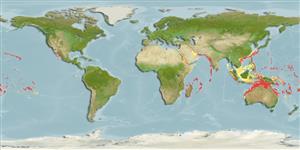
| Native range | All suitable habitat | Point map | Year 2050 |
|
| This map was computer-generated and has not yet been reviewed. |
| Canthigaster coronata AquaMaps Data sources: GBIF OBIS |
Uploaden van uw Foto's en video's
Afbeeldingen | video's | Postzegels, munten, diversen. | Google afbeelding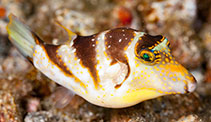 Canthigaster coronata
Afbeelding van Malaer, P.
Afbeeldingen | video's | Postzegels, munten, diversen. | Google afbeelding
Afbeelding van Malaer, P.
Classificatie / Namen Lokale namen | Synoniemen | Catalog of Fishes(Genus, Soort(en)) | ITIS | CoL | WoRMS | Cloffa
> Tetraodontiformes (Puffers and filefishes) > Tetraodontidae (Puffers) > Canthigasterinae
Etymology: Canthigaster: Greek, kanthos = the outer or inner corner of the eye, where the lids meet, 1646 + Greek, gaster = stomach (Ref. 45335).
More on authors: Vaillant & Sauvage.
Etymology: Canthigaster: Greek, kanthos = the outer or inner corner of the eye, where the lids meet, 1646 + Greek, gaster = stomach (Ref. 45335).
More on authors: Vaillant & Sauvage.
Milieu: milieu / Klimaatzone / Diepte / verspreidingsgebied Ecologie
marien rifbewoner; diepte 6 - 165 m (Ref. 83660). Tropical; 30°N - 30°S
Verspreiding Gebieden | FAO regio's | Ecosystemen | Voorkomen | Verspreidingskaart | Introducties | Faunafri
Former distribution of Hawaii and Tonga to the east coast of Africa and the Red Sea, is divided into three species: C. coronata, endemic to the Hawaiian Islands;
C. axiologus ranges from Japan to New South Wales, east to the Marshall Islands and Tonga; and C. cyanospilota from the Indian Ocean and Red Sea (type locality, Gulf of Aqaba) (Ref. 83660).
Grootte / Gewicht / Leeftijd
Maturiteit: Lm ? range ? - ? cm
Max length : 11.3 cm SL mannelijk / geslacht onbekend; (Ref. 137577)
Max length : 11.3 cm SL mannelijk / geslacht onbekend; (Ref. 137577)
Korte beschrijving Determinatiesleutels | Morfologie | Morfometrie
Dorsale stekels (totaal) : 0; Dorsale zachte stralen (totaal) : 9 - 11; Anale stekels: 0; Anale zachte stralen: 9 - 10. This species is characterized by the following: D 9-11 (usually 10, rarely 9); A 9-10 (usually 10); pectoral rays 15-18 (usually 17); gill rakers 7-9; body depth between origins of dorsal and anal fins 2.8-3.25 in SL; head length (HL) 2.3-2.55 in SL; interorbital width 3.9-4.45 in HL; gill opening 3.7-4.75 in HL; anal fin origin below or anterior to rear base of dorsal fin, preanal length 1.35-1.4 in SL; longest dorsal ray 2.2-2.5 in HL; preserved colour pale grey to pale tan with 3 triangular dark brown saddle-like bars dorsally on body, progressively more oblique posteriorly, the first extending narrowly to ventral edge of gill opening, the second to level of lower edge of pectoral-fin base and enclosing base of dorsal fin posteriorly, and the last ending at upper base of caudal fin; a dark brown band run across posterior interorbital and anterior occiput; a dark brown spot below base of pectoral fin; head and body with many small pale spots (most about half pupil diameter), faint or absent on paler parts of body but very evident on edges, within dark bars, and on head where ground colour darker; around eye are narrow pale bands and spots; pale lips encircled with a narrow dusky band; a thin dark brown line midventrally on abdomen and chest present or absent (may be broken to long segments); pale fins, with upper and lower margins of caudal fin with a broad brown band, darker at base; when fresh, noteworthy are the many small yellow spots, and the lack of blue spots - blue only between yellow markings around eye (Ref. 83660).
Body shape (shape guide): short and / or deep; Cross section: angular.
Body shape (shape guide): short and / or deep; Cross section: angular.
Found mostly below depths of 23 m, but occasionally seen in as little as 6 m (Ref. 3921). Benthopelagic (Ref. 58302). Usually found on sand or sand and rubble bottom or algal flats, often in the vicinity of coral reefs (Ref. 83660). Feed on a wide variety of benthic organisms: gastropods, sponges, algae, bivalves, polychaetes, tunicates, crabs, sea urchins, heart urchins, brittle stars, bryozoans, peanut worms, various small crustaceans and foraminiferans (Ref. 3921).
Levenscyclus en paargedrag Maturiteit | Voortplanting | Paaien | Eieren | Fecunditeit | Larven
Oviparous (Ref. 205).
Hoofdreferentie
Upload uw referenties | Referenties | Coördinator : Matsuura, Keiichi | Medewerkers
Randall, J.E., J.T. Williams and L.A. Rocha, 2008. The Indo-Pacific tetraodontid fish Canthigaster coronata, a complex of three species. Smithiana, Publ. Aquatic Biodiv. Bull. 9:3-13. (Ref. 83660)
Status op de Rode Lijst van het IUCN (Ref. 130435: Version 2025-2)
Niet bedreigd (LC) ; Date assessed: 08 June 2011
CITES
Not Evaluated
Gevaar voor de mens
Other
Gebruik door de mens
Visserij: commercieel; Aquarium: Commercieel
FAO - Publication: search | FishSource |
Meer informatie
Trofische ecologie
Voedsel (prooien)
Dieetsamenstelling
Voedselconsumptie
Voedselrantsoenen
Predatoren
Voedsel (prooien)
Dieetsamenstelling
Voedselconsumptie
Voedselrantsoenen
Predatoren
Populatiedynamica
Groeiparameters
Max. leeftijden / maten
Lengte-gewicht rel.
Lengte-lengte rel.
Lengtefrequenties
Massaconversie
Rekrutering
Abundantie
Groeiparameters
Max. leeftijden / maten
Lengte-gewicht rel.
Lengte-lengte rel.
Lengtefrequenties
Massaconversie
Rekrutering
Abundantie
Levenscyclus
Voortplanting
Maturiteit
Rijpheid/kieuwen rel.
Fecunditeit
Paaien
Paaibestanden
Eieren
Ontwikkeling van de eieren
Larven
Larvale populatiedynamiek
Voortplanting
Maturiteit
Rijpheid/kieuwen rel.
Fecunditeit
Paaien
Paaibestanden
Eieren
Ontwikkeling van de eieren
Larven
Larvale populatiedynamiek
Fysiologie
Lichaamssamenstelling
Voedingsstoffen
Zuurstofverbruik
Type zwemmen
Zwemsnelheid
Visuele pigmenten
Vis geluid
Ziekten en parasieten
Toxiciteit (LC50)
Lichaamssamenstelling
Voedingsstoffen
Zuurstofverbruik
Type zwemmen
Zwemsnelheid
Visuele pigmenten
Vis geluid
Ziekten en parasieten
Toxiciteit (LC50)
Genetica
genoom
Genetica
Heterozygositeit
Erfelijkheid
Genetische diversiteit
genoom
Genetica
Heterozygositeit
Erfelijkheid
Genetische diversiteit
Menselijk gerelateerd
Aquacultuursystemen
Aquacultuurprofielen
Kweeklijnen
Ciguatera gevallen
Postzegels, munten, diversen.
Aquacultuursystemen
Aquacultuurprofielen
Kweeklijnen
Ciguatera gevallen
Postzegels, munten, diversen.
Tools
Biologische quiz | E-boek | Veldgids | Lengtefrequentie Tool | Levenscyclus tool | Verspreidingskaart |
Vangst-MSY |
Speciale rapporten
Bekijk gegevens voor het houden in een aquarium | Bekijk Fact Sheets voor de soort | Bekijk Aquacultuur Fact Sheets
Download XML
Internetbronnen
AFORO (otoliths) | Aquatic Commons | BHL | Cloffa | Websites from users | Bekijk FishWatcher | CISTI | Catalog of Fishes: Genus, Soort(en) | DiscoverLife | ECOTOX | FAO - Publication: search | Faunafri | Fishipedia | Fishtrace | GloBI | Google Books | Google Scholar | Google | IGFA World Record | OneZoom | Open Tree of Life | Otolith Atlas of Taiwan Fishes | PubMed | Reef Life Survey | Socotra Atlas | TreeBase | Tree of Life | Wikipedia: ga naar, zoek | World Records Freshwater Fishing | Zoological Record
Schattingen op basis van modellen
Gewenste temperatuur (Ref. 123201): 23.8 - 28.3, mean 26.8 °C (based on 332 cells).
Fylogenetische diversiteitsindex (Ref. 82804): PD50 = 0.5000 [Uniqueness, from 0.5 = low to 2.0 = high].
Bayesian length-weight: a=0.03631 (0.01554 - 0.08482), b=2.88 (2.69 - 3.07), in cm total length, based on LWR estimates for this Genus-body shape (Ref. 93245).
Trofisch niveau (Ref. 69278): 3.5 ±0.0 se; based on diet studies.
Weerstandsvermogen (Ref. 120179): Hoog, minimale populatieverdubbelingstijd minder dan 15 maanden (Preliminary K or Fecundity.).
Voedingsstoffen (Ref. 124155): Calcium = 92.1 [40.6, 239.9] mg/100g; Iron = 0.898 [0.444, 2.136] mg/100g; Protein = 18.1 [15.9, 20.4] %; Omega3 = 0.157 [0.076, 0.315] g/100g; Selenium = 43.1 [19.6, 97.4] μg/100g; VitaminA = 61.8 [16.5, 251.5] μg/100g; Zinc = 1.47 [0.93, 2.24] mg/100g (wet weight);