-

- Over deze pagina
- Talen
- Feedback van gebruikers
- Citatie
- Uploads
- Verwante soorten
-



Enteromius paludinosus (Peters, 1852)
Straightfin barb
Uploaden van uw Foto's en video's
Afbeeldingen | Google afbeelding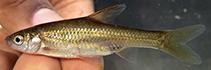 Enteromius paludinosus
Afbeelding van Katemo Manda, B.
Afbeeldingen | Google afbeelding
Afbeelding van Katemo Manda, B.
Classificatie / Namen Lokale namen | Synoniemen | Catalog of Fishes(Genus, Soort(en)) | ITIS | CoL | WoRMS | Cloffa
> Cypriniformes (Carps) > Cyprinidae (Minnows or carps) > Smiliogastrinae
Etymology: Enteromius: Greek, enteron = intestine + Greek, myo, mys = muscle (Ref. 45335).
More on author: Peters.
Etymology: Enteromius: Greek, enteron = intestine + Greek, myo, mys = muscle (Ref. 45335).
More on author: Peters.
Milieu: milieu / Klimaatzone / Diepte / verspreidingsgebied Ecologie
; zoet water benthopelagisch; pH range: 6.8 - 7.8; dH range: 5 - 25. Tropical; 19°C - 28°C (Ref. 13614); 10°S - 32°S
Verspreiding Gebieden | FAO regio's | Ecosystemen | Voorkomen | Verspreidingskaart | Introducties | Faunafri
Africa: ranges from Ethiopia in the north, through East and Central Africa, extending westwards into Angola and reaching the southern-most limits of its distribution in Vungu, KwaZulu-Natal, in South Africa (Ref. 2801, 52193). In the Congo basin known from Lake Mweru, Luapula, upper Lualaba, Lufira (Ref. 41590) and upper Lulua (Ref. 42554).
Lengte bij maturiteit / Grootte / Gewicht / Leeftijd
Maturiteit: Lm ?, range 5 - ? cm
Max length : 15.0 cm SL mannelijk / geslacht onbekend; (Ref. 52193)
Max length : 15.0 cm SL mannelijk / geslacht onbekend; (Ref. 52193)
Korte beschrijving Determinatiesleutels | Morfologie | Morfometrie
Dorsale stekels (totaal) : 3; Dorsale zachte stralen (totaal) : 7 - 8; Anale stekels: 0; Anale zachte stralen: 8 - 10. Diagnosis: Last unbranched ray of dorsal fin thorny, long and with posterior denticulation; barbels not well developed, anterior barbel very short, just reaching the posterior side of the maxilla, posterior barbel just reaching the middle of the eye (Ref. 27628). Dorsal side brown-silver coloured, ventral side silver, with a darker band on the flanks; fins not coloured (Ref. 27628).
Body shape (shape guide): fusiform / normal.
Body shape (shape guide): fusiform / normal.
Hardy, prefers quiet, well-vegetated waters in lakes, swamps, and marshes or marginal areas of larger rivers and slow-flowing streams (Ref. 7248, 52193). In shallow, inshore areas of Lake Victoria especially where bottom is sandy (Ref. 4903). Bottom feeder (Ref. 12526), it feeds on a wide variety of small organisms including insects, small snails and crustaceans, algae, diatoms, and detritus (Ref. 7248, 52193). Eaten by large predators like the sharptooth catfish, tigerfish, largemouth breams (Serranochromis species) and birds (Ref. 7248, 52193). Spawns amongst vegetation during summer (Ref. 7248, 52193), in river and streams during rainy season in Lake Victoria basin (Ref. 4903).
Levenscyclus en paargedrag Maturiteit | Voortplanting | Paaien | Eieren | Fecunditeit | Larven
Hoofdreferentie
Upload uw referenties | Referenties | Coördinator | Medewerkers
Skelton, P.H., 2001. A complete guide to the freshwater fishes of southern Africa. Cape Town (South Africa): Struik Publishers, 395 p. (Ref. 52193)
Status op de Rode Lijst van het IUCN (Ref. 130435: Version 2025-2)
Niet bedreigd (LC) ; Date assessed: 19 July 2018
CITES
Not Evaluated
Gevaar voor de mens
Harmless
Gebruik door de mens
Visserij: commercieel
FAO - Publication: search | FishSource |
Meer informatie
Trofische ecologie
Voedsel (prooien)
Dieetsamenstelling
Voedselconsumptie
Voedselrantsoenen
Predatoren
Voedsel (prooien)
Dieetsamenstelling
Voedselconsumptie
Voedselrantsoenen
Predatoren
Populatiedynamica
Groeiparameters
Max. leeftijden / maten
Lengte-gewicht rel.
Lengte-lengte rel.
Lengtefrequenties
Massaconversie
Rekrutering
Abundantie
Groeiparameters
Max. leeftijden / maten
Lengte-gewicht rel.
Lengte-lengte rel.
Lengtefrequenties
Massaconversie
Rekrutering
Abundantie
Levenscyclus
Voortplanting
Maturiteit
Rijpheid/kieuwen rel.
Fecunditeit
Paaien
Paaibestanden
Eieren
Ontwikkeling van de eieren
Larven
Larvale populatiedynamiek
Voortplanting
Maturiteit
Rijpheid/kieuwen rel.
Fecunditeit
Paaien
Paaibestanden
Eieren
Ontwikkeling van de eieren
Larven
Larvale populatiedynamiek
Anatomie
Kieuwoppervlak
Hersenen
Otoliet
Kieuwoppervlak
Hersenen
Otoliet
Fysiologie
Lichaamssamenstelling
Voedingsstoffen
Zuurstofverbruik
Type zwemmen
Zwemsnelheid
Visuele pigmenten
Vis geluid
Ziekten en parasieten
Toxiciteit (LC50)
Lichaamssamenstelling
Voedingsstoffen
Zuurstofverbruik
Type zwemmen
Zwemsnelheid
Visuele pigmenten
Vis geluid
Ziekten en parasieten
Toxiciteit (LC50)
Menselijk gerelateerd
Aquacultuursystemen
Aquacultuurprofielen
Kweeklijnen
Ciguatera gevallen
Postzegels, munten, diversen.
Aquacultuursystemen
Aquacultuurprofielen
Kweeklijnen
Ciguatera gevallen
Postzegels, munten, diversen.
Tools
Biologische quiz | E-boek | Veldgids | Determinatiesleutels | Lengtefrequentie Tool | Levenscyclus tool | Verspreidingskaart |
Vangst-MSY |
Speciale rapporten
Bekijk gegevens voor het houden in een aquarium | Bekijk Fact Sheets voor de soort | Bekijk Aquacultuur Fact Sheets
Download XML
Internetbronnen
AFORO (otoliths) | Aquatic Commons | BHL | Cloffa | Websites from users | Bekijk FishWatcher | CISTI | Catalog of Fishes: Genus, Soort(en) | DiscoverLife | ECOTOX | FAO - Publication: search | Faunafri | Fishipedia | Fishtrace | GloBI | Google Books | Google Scholar | Google | IGFA World Record | OneZoom | Open Tree of Life | Otolith Atlas of Taiwan Fishes | PubMed | Reef Life Survey | Socotra Atlas | TreeBase | Tree of Life | Wikipedia: ga naar, zoek | World Records Freshwater Fishing | Zoological Record
Schattingen op basis van modellen
Fylogenetische diversiteitsindex (Ref. 82804): PD50 = 0.5000 [Uniqueness, from 0.5 = low to 2.0 = high].
Bayesian length-weight: a=0.01175 (0.00731 - 0.01887), b=3.01 (2.88 - 3.14), in cm total length, based on LWR estimates for this species & Genus-body shape (Ref. 93245).
Trofisch niveau (Ref. 69278): 2.9 ±0.33 se; based on food items.
Generation time: 0.8 ( na - na) years. Estimated as median ln(3)/K based on 1 growth studies.
Weerstandsvermogen (Ref. 120179): Hoog, minimale populatieverdubbelingstijd minder dan 15 maanden (K=1.40; tm=1; Fec=255; assuming multiple spawning per year).
Voedingsstoffen (Ref. 124155): Calcium = 391 [232, 744] mg/100g; Iron = 2.67 [1.66, 4.28] mg/100g; Protein = 17.4 [16.5, 18.3] %; Omega3 = 0.649 [0.249, 1.696] g/100g; Selenium = 98.5 [38.1, 260.6] μg/100g; VitaminA = 51.9 [22.0, 122.3] μg/100g; Zinc = 2.7 [1.9, 3.9] mg/100g (wet weight);