Classification / Names
Noms communs | Synonymes | Catalog of Fishes(Genre, Espèce) | ITIS | CoL | WoRMS | Cloffa
>
Siluriformes (Catfishes) >
Trichomycteridae (Pencil or parasitic catfishes) > Trichomycterinae
Etymology: Cambeva: Probably derived from the Tupi-Guarani, is a popular name for trichomycterid fishes in southern and south-eastern Brazil (Ref. 119381); difficilis: Name 'difficilis' from the Latin word meaning 'difficult', in reference to the great difficulty it takes to collect this new species.
Environment: milieu / climate zone / profondeur / distribution range
Écologie
; eau douce démersal. Tropical
South America: Brazil.
Taille / Poids / Âge
Maturité: Lm ? range ? - ? cm
Max length : 8.1 cm SL mâle / non sexé; (Ref. 132480)
Description synthétique
Clés d'identification | Morphologie | Morphométrie
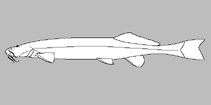
Rayons mous dorsaux (Total) : 12; Rayons mous anaux: 9. This species is distinguished from its congeners by the following set of characters: having small sub-incisiform odontodes on the basal portion of the opercular and interopercular patches; a unique color pattern of the caudal fin present, comprising a yellowish-white zone on the basal portion of the fin and posteriorly edged by a black zone, more conspicuous immediately after collection; short mesethmoid cornua, distally terminating in sharply pointed tips; a relatively short interopercle, its largest length about half of the longitudinal length of the hyomandibula; compact parurohyal, with a relatively short lateral process, a broad anterior head with an indistinct antero-lateral paired process, and without basal constriction; short barbels, with the nasal barbel reaching an area just posterior to the orbit; maxillary barbel reaching the posterior portion of the interopercular patch of odontodes; rictal barbel reaching the anterior portion of the interopercular patch of odontodes; pelvic fin bases medially separated by a broad interspace, about half of the pelvic fin base length; anal fin origin posterior to the dorsal fin base (Ref. 132480).
Body shape (shape guide): elongated; Cross section: flattened.
Life cycle and mating behavior
Maturité | Reproduction | Frai | Œufs | Fécondité | Larves
Costa, W.J.E.M., C.R.M. Feltrin, J.L.O. Mattos and A.M. Katz, 2024. Monophyly or Homoplasy? The relationships of a rare new species of Cambeva (Siluriformes: Trichomycteridae) from the Brazilian Atlantic Forest with a bicolored caudal pattern. Taxonomy 2024(4):341-353. (Ref. 132480)
Statut dans la liste rouge de l'IUCN (Ref. 130435: Version 2025-1)
Menace pour l'homme
Harmless
Utilisations par l'homme
Pêcheries: sans intérêt
Outils
Articles particuliers
Télécharger en XML
Sources Internet
Estimates based on models
Phylogenetic diversity index (Réf.
82804): PD
50 = 0.5001 [Uniqueness, from 0.5 = low to 2.0 = high].
Niveau trophique (Réf.
69278): 3.2 ±0.4 se; based on size and trophs of closest relatives
Fishing Vulnerability (Ref.
59153): Low vulnerability (10 of 100).
🛈