-

- À propos de cette page
- Langues
- Commentaires des utilisateurs
- Citation
- Téléchargements
- Espèces associées
-



Plectranthias raki Shepherd, Pinheiro, Najeeb, Rocha & Rocha, 2025
Maldivian perchlet
Envoyez vos Photos et vidéos
Images | Images Google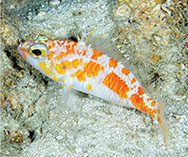 Plectranthias raki
Photo de Rocha, L.A.
Images | Images Google
Photo de Rocha, L.A.
Classification / Noms Noms communs | Synonymes | Catalog of Fishes(Genre, Espèce) | ITIS | CoL | WoRMS | Cloffa
> Perciformes/Serranoidei (Groupers) > Anthiadidae (Fairy basslets or Streamer basses)
Etymology: Plectranthias: Greek, plektron = anyhting to strike with, spur + Greek, anthias = a fish, Sparus aurata (Ref. 45335); raki: Named raki, meaning 'feeling shy to confront people'” in the Dhivehi language; referring to it being shy by nature and typically hides; noun in apposition.
Etymology: Plectranthias: Greek, plektron = anyhting to strike with, spur + Greek, anthias = a fish, Sparus aurata (Ref. 45335); raki: Named raki, meaning 'feeling shy to confront people'” in the Dhivehi language; referring to it being shy by nature and typically hides; noun in apposition.
Environnement : milieu / zone climatique / profondeur / gamme de distribution Écologie
marin démersal; profondeur 100 - 125 m (Ref. 132548). Tropical
Distribution Territoires | Zones FAO | Écosystèmes | Occurrences | Carte par point | Introductions | Faunafri
West Indian Ocean: Maldives.
Taille / Poids / Âge
Description synthétique Clés d'identification | Morphologie | Morphométrie
Épines dorsales (Total) : 10; Rayons mous dorsaux (Total) : 15; Épines anales: 3; Rayons mous anaux: 7; Vertèbres: 26. This species is distinguished from its congeners by the following set of characters: D X,15; A III,7; pectoral-fin rays 13|13 (13|12), all unbranched; principal caudal-fin rays 9 + 8; lateral line complete with 30-32 tubed scales; supraneural bones 3, predorsal formula 0/0 + 0/2/1 + 1/1/1/;
gill rakers 5 + 12; circumpeduncular scales 11-12; oblique rows of scales on cheek 8; longest dorsal spine the 4th or 5th; no fleshy tips on the dorsal-fin spines; no antrorse serrations on preopercle. Colouration: with a series of irregularly shaped patches of red-orange along dorsal two-thirds of body; patches divided into two indistinct rows by the lateral line; patches of red-orange dorsally and posteriorly, becoming more yellow-orange anteriorly and ventrally, golden yellow on opercle and maxilla; anal fin pointed, mostly white proximally, yellow distally, with two yellow spots approximately one-third orbit diameter at the base of third spine and fifth and sixth soft rays; two irregularly shaped yellow-orange spots, approximately one-third orbit diameter, at either side of centermost caudal-fin rays; small orange spot, approximately one-half orbit in diameter, at the base of pelvic fin (Ref.132548).
Cross section: compressed.
Cross section: compressed.
Observed to inhabits small holes of reef walls at several locations at approximately 100 to 125 m depth (Ref. 132548).
Cycle de vie et comportement reproducteur Maturité | Reproduction | Frai | Œufs | Fécondité | Larves
Référence principale
Téléchargez vos références | Références | Coordinateur | Collaborateurs
Shepherd, B., H.T. Pinheiro, A. Najeeb, C.R. Rocha and L.A. Rocha, 2025. Plectranthias raki (Teleostei, Serranidae), a new species of perchlet from mesophotic coral ecosystems of the Maldives. ZooKeys 1223:333-344. (Ref. 132548)
CITES
Not Evaluated
Menace pour l'homme
Harmless
Utilisations par l'homme
Pêcheries: sans intérêt
FAO - Publication: search | FishSource |
Plus d'informations
Écologie trophique
Aliments (proies)
Composition du régime alimentaire
Consommation alimentaire
Rations alimentaires
Prédateurs
Aliments (proies)
Composition du régime alimentaire
Consommation alimentaire
Rations alimentaires
Prédateurs
Dynamique des populations
Paramètres de croissance
Âges / tailles maximales
Longueur-poids rel.
Rel. longueur-longueur.
Fréquences de longueurs
Conversion de masse
Recrutement
Abondance
Paramètres de croissance
Âges / tailles maximales
Longueur-poids rel.
Rel. longueur-longueur.
Fréquences de longueurs
Conversion de masse
Recrutement
Abondance
Cycle de vie
Reproduction
Maturité
Maturité/épines rel.
Fécondité
Frai
Agrégats de frai
Œufs
Développement de l'œuf
Larves
Dynamique des populations larvaires
Reproduction
Maturité
Maturité/épines rel.
Fécondité
Frai
Agrégats de frai
Œufs
Développement de l'œuf
Larves
Dynamique des populations larvaires
Anatomie
Surface branchiale
Cerveau
Otolithe
Surface branchiale
Cerveau
Otolithe
Physiologie
Composition corporelle
Nutriments
Consommation d'oxygène
Type de natation
Vitesse de nage
Pigments visuels
Son de poisson
Maladies et parasites
Toxicité (CL50)
Composition corporelle
Nutriments
Consommation d'oxygène
Type de natation
Vitesse de nage
Pigments visuels
Son de poisson
Maladies et parasites
Toxicité (CL50)
Génétique
génôme
Génétique
Hétérozygotie
Héritabilité
Diversité génétique
génôme
Génétique
Hétérozygotie
Héritabilité
Diversité génétique
Liées à l'homme
Systèmes d'aquaculture
Profils d'aquaculture
Souches
Cas de ciguatera
Timbres, pièces de monnaie, divers
Systèmes d'aquaculture
Profils d'aquaculture
Souches
Cas de ciguatera
Timbres, pièces de monnaie, divers
Outils
E-book | Guide de terrain | Générateur de fréquences de longueur | Outil de dynamique de population | Carte par point |
Capture-MSY |
Articles particuliers
Télécharger en XML
Sources Internet
AFORO (otoliths) | Aquatic Commons | BHL | Cloffa | Websites from users | FishWatcher | CISTI | Catalog of Fishes: Genre, Espèce | DiscoverLife | ECOTOX | FAO - Publication: search | Faunafri | Fishipedia | Fishtrace | GloBI | Google Books | Google Scholar | Google | IGFA World Record | OneZoom | Open Tree of Life | Otolith Atlas of Taiwan Fishes | PubMed | Reef Life Survey | Socotra Atlas | TreeBase | Arbre de Vie | Wikipedia: aller à, chercher | World Records Freshwater Fishing | Zoobank | Zoological Record
Estimations basées sur des modèles
Indice de diversité phylogénétique (Réf. 82804): PD50 = 0.5000 [Uniqueness, from 0.5 = low to 2.0 = high].