-

- Über diese Seite
- Sprachen
- Rückmeldungen der Nutzer
- Zitat
- Uploads
-
Verwandte Arten
- Arten in
Sovvityazius - Arten in
Gobiidae - - Klassifizierung -
- Amblyopinae
- Gobiidae
- Gobiiformes
- Teleostei
- Chordata
- Animalia
- Arten in
-



Sovvityazius acer Prokofiev, 2015
Hochladen Photos und videos
Google Bild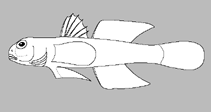 No image available for this species;
drawing shows typical species in Gobiidae.
Google Bild
drawing shows typical species in Gobiidae.
Klassifizierung / Names Namen | Synonyme | Catalog of Fishes(Gattung, Arten) | ITIS | CoL | WoRMS | Cloffa
> Gobiiformes (Gobies) > Gobiidae (Gobies) > Amblyopinae
Etymology: Sovvityazius: Named after the Soviet research vessel 'Vityaz' (abbreviation meaning, Soviet Knight”), type species collected during a survey of this vessel; acer: Name from Latin ‘acer’ meaning sharp sighted, referring to the eyes which are developed better than in other representatives of the subfamily.
Eponymy: ‘Vityaz’ was a famous Soviet research vessel (see Vityaz/Vitiaz). The genus’ name can be taken to mean ‘of the Soviet (vessel) Vityaz’, and the goby type specimens were collected from this ship. (Ref. 128868), visit book page.
Etymology: Sovvityazius: Named after the Soviet research vessel 'Vityaz' (abbreviation meaning, Soviet Knight”), type species collected during a survey of this vessel; acer: Name from Latin ‘acer’ meaning sharp sighted, referring to the eyes which are developed better than in other representatives of the subfamily.
Eponymy: ‘Vityaz’ was a famous Soviet research vessel (see Vityaz/Vitiaz). The genus’ name can be taken to mean ‘of the Soviet (vessel) Vityaz’, and the goby type specimens were collected from this ship. (Ref. 128868), visit book page.
Umwelt: Milieu / Klimazone / Tiefenbereich / Verbreitungsgebiet Ökologie
seewasser demersal; tiefenbereich ? - 50 m (Ref. 129446). Tropical
Verbreitung Territorien | FAO Gebiete | Ökosysteme | Vorkommen | Punkt Karte | Einführungen | Faunafri
Western Pacific: Philippines.
Größe / Gewicht / Alter
Kurzbeschreibung Bestimmungsschlüssel | Morphologie | Morphometrie
Rückenflossenstacheln (insgesamt) : 6; Rückenflossenweichstrahlen (insgesamt) : 26; Afterflossenstacheln: 0; Afterflossenweichstrahlen: 27; Wirbelzahl: 29. This species is distinguished by the following characters: body elongated (H 9.7-11.8 times in SL) but not eel-like; D 40-42 rays; A 38-40; oral fissure almost horizontal, with upper jaw slightly protruded over lower jaw; teeth on premaxillae in one row, uniformly sized, needle-shaped, and densely arranged and with tips slightly inclined posteriorly; teeth on lower jaw is similar, but 0-3 teeth located on each side near symphysis of dentals behind teeth of internal row; head depressed in dorsoventral direction, no sagittal crest, interorbital gap flattened, from 8-10 times in head length; eyes are exceptionally well developed in comparison to other representatives of subfamily, covered by skin, but with normal structure and their vertical diameter only one and half times less than interorbital gap; no barbels or dermal crests on head; P 17-20, symmetrical, with its rays totally connected by membrane and majority of its rays branched; V equal to or longer than P, 60-75% in head length, fully fused into a sucking disc, with rounded posterior
margin, its frenum is narrow but fully developed, without lobules; formula of dorsal pterygiophores 3 1221, a vacant gap between spined and soft parts of D present, two first pterygiophores of soft part of D each in its interneural space and two pterygiophores of A before first hemapophysis, with all pterygiophores having normal structure; pleural ribs from third to tenth centra normally developed, ad parapophyses on posterior precaudal centra weakly developed; vertebrae 10 + 19; absence ot hypural 5 and epurals 2; scales cycloid and well developed; intestine elongated and spirally twisted (Ref. 129446).
Cross section: circular.
Cross section: circular.
Collected from silty ground (Ref. 129446).
Lebenszyklus und Paarungsverhalten Geschlechtsreife | Fortpflanzung | Ablaichen | Eier | Fruchtbarkeit | Larven
Hauptreferenz
Laden Sie Ihre Referenzen hoch | Referenzen | Koordinator | Partner
Prokofiev, A.M., 2015. An overview of gobies of the subfamily Amblyopinae (Gobiidae) from the Western South China Sea (Vietnam and Indonesia) and Pacific waters of the Philippines. J. Ichthyol. 55:783-791. (Ref. 129446)
IUCN Rote Liste Status (Ref. 130435: Version 2025-2)
Daten mangelhaft (DD) ; Date assessed: 16 December 2023
CITES
Not Evaluated
Bedrohung für Menschen
Harmless
Nutzung durch Menschen
FAO - Publication: search | FishSource |
Mehr Information
Trophische Ökologie
Lebensmittel (Beutetiere)
Nahrungszusammensetzung
Nahrungsaufnahme
Lebensmittelrationen
Räuber
Lebensmittel (Beutetiere)
Nahrungszusammensetzung
Nahrungsaufnahme
Lebensmittelrationen
Räuber
Ökologie
Ökologie
Ökologie
Populationsdynamik
Wachstumsparameter
Max. Alter/Größen
Länge-Gewicht-Rel.
Länge-Länge-Verhältnis.
Längenhäufigkeiten
Massenkonvertierung
Rekrutierung
Dichte
Wachstumsparameter
Max. Alter/Größen
Länge-Gewicht-Rel.
Länge-Länge-Verhältnis.
Längenhäufigkeiten
Massenkonvertierung
Rekrutierung
Dichte
Lebenszyklus
Fortpflanzung
Geschlechtsreife
Reifung/Kiemen rel.
Fruchtbarkeit
Ablaichen
Laichaggregationen
Eier
Eientwicklung
Larven
Larven Pop.Dyn.
Fortpflanzung
Geschlechtsreife
Reifung/Kiemen rel.
Fruchtbarkeit
Ablaichen
Laichaggregationen
Eier
Eientwicklung
Larven
Larven Pop.Dyn.
Anatomie
Kiemenoberfläche
Gehirn
Otolith
Kiemenoberfläche
Gehirn
Otolith
Physiologie
Körperliche Zusammensetzung
Nährstoffe
Sauerstoffverbrauch
Schwimmart
Schwimmgeschwindigkeit
Visuelle Pigmente
Fischgeräusche
Krankheiten und Parasiten
Toxizität (LC50s)
Körperliche Zusammensetzung
Nährstoffe
Sauerstoffverbrauch
Schwimmart
Schwimmgeschwindigkeit
Visuelle Pigmente
Fischgeräusche
Krankheiten und Parasiten
Toxizität (LC50s)
Genetik
Genom
Genetik
Heterozygotie
Vererbbarkeit
Genetische Vielfalt
Genom
Genetik
Heterozygotie
Vererbbarkeit
Genetische Vielfalt
Menschenbezogen
Aquakultur-Systeme
Aquakultur Profile
Zuchtlinien
Ciguatera-Fälle
Briefmarken, Münzen, Verschiedenes.
Aquakultur-Systeme
Aquakultur Profile
Zuchtlinien
Ciguatera-Fälle
Briefmarken, Münzen, Verschiedenes.
Tools
Zusatzinformationen
Download XML
Zusammenfassung | Punktdaten | Namen | Photos
Internet Quellen
AFORO (otoliths) | Aquatic Commons | BHL | Cloffa | Websites from users | FishWatcher Einträge suchen | CISTI | Catalog of Fishes: Gattung, Arten | DiscoverLife | ECOTOX | FAO - Publication: search | Faunafri | Fishipedia | Fishtrace | GloBI | Google Books | Google Scholar | Google | IGFA World Record | OneZoom | Open Tree of Life | Otolith Atlas of Taiwan Fishes | PubMed | Reef Life Survey | Socotra Atlas | TreeBase | Tree of Life | Wikipedia: Gehe zu, Suchen | World Records Freshwater Fishing | Zoobank | Zoologischer Rekord
Schätzungen auf der Grundlage von Modellen
Phylogenetischer Diversitätsindex (Ref. 82804): PD50 = 1.0000 [Uniqueness, from 0.5 = low to 2.0 = high].
Bayesian length-weight: a=0.00447 (0.00196 - 0.01016), b=2.98 (2.78 - 3.18), in cm total length, based on LWR estimates for this (Sub)family-body shape (Ref. 93245).
Trophische Ebene (Ref. 69278): 3.3 ±0.4 se; based on size and trophs of closest relatives
Widerstandsfähigkeit (Ref. 120179): hoch, Verdopplung der Population dauert weniger als 15 Monate. (Preliminary K or Fecundity.).