-

- Acerca de esta página
- Idiomas
- Opiniones de los usuarios
- Citación
- Carga
-
Especies relacionadas
- Especies en
Coelorinchus - Especies en
Macrouridae - - Clasificación -
- Macrouridae
- Gadiformes
- Teleostei
- Chordata
- Animalia
- Especies en
-



Coelorinchus posteromaculatus Nakayama, Prokofiev & Kawai, 2020
Tailspotted grenadier
Sube tu fotos y Vídeos
Google image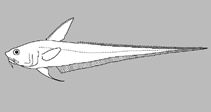 No image available for this species;
drawing shows typical species in Macrouridae.
Google image
drawing shows typical species in Macrouridae.
Clasificación / Nombres Nombres comunes | Sinónimos | Catalog of Fishes(Género, Especie) | ITIS | CoL | WoRMS | Cloffa
> Gadiformes (Cods) > Macrouridae (Grenadiers or rattails)
Etymology: Coelorinchus: Greek, koilos = a hollow + Greek, rhyngchos = jaw (Ref. 45335); posteromaculatus: Name from Latin 'posteromaculatus' for adjectives 'posterior' meaning further back or hinder and 'maculatus' meaning spotted; referring to the species’ characteristic dark blotch on the anterior part of the tail.
Etymology: Coelorinchus: Greek, koilos = a hollow + Greek, rhyngchos = jaw (Ref. 45335); posteromaculatus: Name from Latin 'posteromaculatus' for adjectives 'posterior' meaning further back or hinder and 'maculatus' meaning spotted; referring to the species’ characteristic dark blotch on the anterior part of the tail.
Entorno: milieu / zona climática / rango de profundidad / gama de distribución Ecología
marino batidemersal; rango de profundidad 100 - 323 m (Ref. 123275). Tropical
Distribución Territorios | Áreas FAO | Ecosistemas | Ocurrencias, apariciones | Mapa de puntos | Introducciones | Faunafri
Eastern Indian Ocean.
Tamaño / Peso / Edad
Descripción breve Claves de identificación | Morfología | Morfometría
This species is distinguished by the following characters: small, intense, longitudinally elongate, lateral, dark blotch on the anterior part of tail; light organ tubular and externally represented by long black streak covered with scales, extending from immediately in front of anus to chest just posterior to isthmus; underside of head is completely naked except for overlapping scales behind lateral nasal ridges; dorsal surface of snout broadly naked along each side of median rostral ridge; snout long, sharply pointed, its length 74–91% postrostral length (PRL), its dorsal profile gently concave in lateral view; terminal scute long, spearhead shaped, dorsoventrally flattened, with length 16–24% PRL when complete; lateral nasal ridge incompletely supported by nasal bone; anus abutting anal-fin origin; premaxillary teeth small, slender, conical in long, narrow, tapered band, and none distinctly enlarged; posterior margin of the tooth band almost reaching lateral corner of mouth; body scales covered with short, erect, slender spinules in widely divergent rows; spinules in each row completely free from one another, forming comb-like ridge; buttresses of spinules are poorly developed; second dorsal fin distinctly lower than anal fin; upper-jaw length 38–43% PRL; preoral length 65–82% PRL; length of gill slit 21–24% PRL; barbel length 9–14% PRL. Colouration: a slightly diagonal, narrow, dark stripe extending from upper margin of gill opening to below first dorsal-fin midbase or beyond; a faint, diagonal, dark stripe extending from pectoral-fin base to above anal-fin origin; median nasal bone is blackish; underside of head generally pale, without small, blackish, hair-like papillae; lips pale to dusky; front of premaxillary ascending process dusky to dark; oral cavity immaculate; gular and branchiostegal membranes heavily peppered; chest dark; first dorsal fin dusky to dark, with second spinous ray prominently blackish; pelvic fin dusky; pelvic fin heavily peppered (Ref. 123275).
Cross section: oval.
Cross section: oval.
Ciclo vital y comportamiento de apareamiento Madurez | Reproducción | Puesta | Huevos | Fecundidad | Larva
Referencia principal
Suba sus referencias | Referencias | Coordinador : Iwamoto, Tomio | Colaboradores
Nakayama, N., A.M. Prokofiev and T. Kawai, 2020. Coelorinchus posteromaculatus (Actinopterygii, Gadiformes, Macrouridae), a new species of grenadier from the eastern Indian Ocean. Ichthyol. Res. 67:465-472. (Ref. 123275)
CITES
Not Evaluated
Amenaza para el ser humano
Harmless
Usos humanos
Pesquerías: sin interés
FAO - Publication: search | FishSource |
Más información
Ecología Trófica
Alimentos (presas)
Composición de la dieta
consumo de alimento
Raciones de comida
Despredadores
Alimentos (presas)
Composición de la dieta
consumo de alimento
Raciones de comida
Despredadores
Ecología
Ecología
Ecología
Dinámica de la población
Coeficiente del crecimiento para
Edades / tallas máximas
Longitud-peso rel.
Longitud-longitud rel.
Longitud-frecuencias
Conversión de masas
Reclutamiento
Abundancia
Coeficiente del crecimiento para
Edades / tallas máximas
Longitud-peso rel.
Longitud-longitud rel.
Longitud-frecuencias
Conversión de masas
Reclutamiento
Abundancia
Ciclo de vida
Reproducción
Madurez
Madurez/Gills rel.
Fecundidad
Puesta
Agregaciones de desove
Huevos
Desarrollo de los huevos
Larva
Dinámica larvaria
Reproducción
Madurez
Madurez/Gills rel.
Fecundidad
Puesta
Agregaciones de desove
Huevos
Desarrollo de los huevos
Larva
Dinámica larvaria
Distribución
Territorios
Áreas FAO
Ecosistemas
Ocurrencias, apariciones
Introducciones
BRUVS - Vídeos
Territorios
Áreas FAO
Ecosistemas
Ocurrencias, apariciones
Introducciones
BRUVS - Vídeos
Anatomía
Superficie branquial
Cerebro
Otolito
Superficie branquial
Cerebro
Otolito
Fisiología
Composición corporal
Nutrientes
Consumo del oxígeno
Tipo de natación
Velocidad de natación
Pigmentos visuales
Sonido de peces
Enfermedades y parásitos
Toxicidad (CL50)
Composición corporal
Nutrientes
Consumo del oxígeno
Tipo de natación
Velocidad de natación
Pigmentos visuales
Sonido de peces
Enfermedades y parásitos
Toxicidad (CL50)
Genética
Genoma
Genética
Heterocigosidad
heritabilidad
Diversidad genética
Genoma
Genética
Heterocigosidad
heritabilidad
Diversidad genética
Relacionados con el ser humano
Sistemas de acuicultura
Perfiles de acuicultura
Razas
Ciguatera cases
Sellos, monedas, varios
Sistemas de acuicultura
Perfiles de acuicultura
Razas
Ciguatera cases
Sellos, monedas, varios
Herramientas
Libro electrónico | Guía de campo | Asistente para frecuencias de tallas | Herramienta de ciclo de vida | Mapa de puntos |
Catch-MSY |
Informes especiales
Comprobar el mantenimiento del acuario | Buscar fichas sobre especies | Consulte las hojas informativas sobre acuicultura
Descargar XML
Fuentes de Internet
AFORO (otoliths) | Aquatic Commons | BHL | Cloffa | Websites from users | Check FishWatcher | CISTI | Catalog of Fishes: Género, Especie | DiscoverLife | ECOTOX | FAO - Publication: search | Faunafri | Fishipedia | Fishtrace | GloBI | Google Books | Google Scholar | Google | IGFA World Record | OneZoom | Open Tree of Life | Otolith Atlas of Taiwan Fishes | PubMed | Reef Life Survey | Socotra Atlas | TreeBase | Árbol de la vida | Wikipedia: Go, búsqueda | World Records Freshwater Fishing | Zoobank | Expediente Zoológico
Estimaciones basadas en modelos
Índice de diversidad filogenética (Referencia 82804): PD50 = 0.5000 [Uniqueness, from 0.5 = low to 2.0 = high].
Bayesian length-weight: a=0.00245 (0.00126 - 0.00477), b=3.19 (3.02 - 3.36), in cm total length, based on LWR estimates for this Genus-body shape (Ref. 93245).
Nivel trófico (Referencia 69278): 3.4 ±0.5 se; based on size and trophs of closest relatives
Resiliencia (Referencia 120179): Medio, población duplicada en un tiempo mínimo de 1.4-4.4 años (Preliminary K or Fecundity.).