-

- Over deze pagina
- Talen
- Feedback van gebruikers
- Citatie
- Uploads
- Verwante soorten
-



Nothobranchius balamaensis Bragança & Chakona, 2022
Uploaden van uw Foto's en video's
Google afbeelding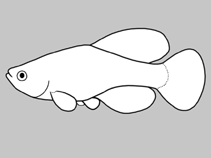 No image available for this species;
drawing shows typical species in Nothobranchiidae.
Google afbeelding
drawing shows typical species in Nothobranchiidae.
Classificatie / Namen Lokale namen | Synoniemen | Catalog of Fishes(Genus, Soort(en)) | ITIS | CoL | WoRMS | Cloffa
> Cyprinodontiformes (Rivulines, killifishes and live bearers) > Nothobranchiidae (African rivulines)
Etymology: Nothobranchius: Greek, nothos = false + Greek, brangchia = gill (Ref. 45335); balamaensis: The specific name, balamaensis, refers to the Balama region in the Cabo Delgado Province, Mozambique, where the type locality for the species is located (Ref. 127332).
Etymology: Nothobranchius: Greek, nothos = false + Greek, brangchia = gill (Ref. 45335); balamaensis: The specific name, balamaensis, refers to the Balama region in the Cabo Delgado Province, Mozambique, where the type locality for the species is located (Ref. 127332).
Milieu: milieu / Klimaatzone / Diepte / verspreidingsgebied Ecologie
; zoet water pelagisch. Tropical
Verspreiding Gebieden | FAO regio's | Ecosystemen | Voorkomen | Verspreidingskaart | Introducties | Faunafri
Africa: seasonal Naconha River, upper Montepuez River system, in north-eastern Mozambique (Ref. 127332).
Grootte / Gewicht / Leeftijd
Korte beschrijving Determinatiesleutels | Morfologie | Morfometrie
Dorsale stekels (totaal) : 0; Dorsale zachte stralen (totaal) : 16 - 17; Anale stekels: 0; Anale zachte stralen: 17 - 18. Diagnosis: Nothobranchius balamaensis is distinguished from all other members of the genus, except N. kirki, by the following unique combination of characters in males; body colouration bright iridescent light blue, with narrow brown-red to orange scale margins creating an irregular reticulated pattern; anal and caudal fins overall orange, darker in basal and proximal zones, grading through medial zone to lighter orange in distal zone and devoid of distinctive markings or banding; dorsal fin with marbled pattern in proximal region comprising irregular brown-red markings on yellow-orange background, distinct striated pattern parallel to fin rays in medial and distal zones with inter-ray membrane distinctive black between first 4-5 rays; anal fin shape mildly trapezoidal (Ref. 127332). Nothobranchius balamaensis differs from the closely related and most similar N. kirki by some elements of male colour pattern: anal fin devoid of markings or banding in proximal zone, vs. narrow light blue to white proximal band or series of irregular markings in N. kirki; dorsal fin with marbled proximal zone and prominently striated medial and distal zones, vs. marbled or vermicular pattern throughout proximal and medial zones with only a hint of striation pattern in distal zone of some specimens (Ref. 127332).
Found in pool in a seasonal stream course, less than 1 m in depth, with turbid and slow flowing water; riverbanks were covered by grass with remnants of Miombo vegetation (Ref. 127332).
Levenscyclus en paargedrag Maturiteit | Voortplanting | Paaien | Eieren | Fecunditeit | Larven
Hoofdreferentie
Upload uw referenties | Referenties | Coördinator | Medewerkers
Bragança, P.H.N., D.U. Bellstedt, P.D.W. Van der Merwe, F.P.D. Cotterill, B.R. Watters and A. Chakona, 2022. Nothobranchius balamaensis (Cyprinodontiformes: Nothobranchiidae), a new species of annual killifish from northern Mozambique. Zootaxa 5174(5):508-524. (Ref. 127332)
Status op de Rode Lijst van het IUCN (Ref. 130435: Version 2025-2)
Bedreigd (EN) (B1ab(iii)); Date assessed: 16 August 2022
CITES
Not Evaluated
Gevaar voor de mens
Harmless
Gebruik door de mens
FAO - Publication: search | FishSource |
Meer informatie
Trofische ecologie
Voedsel (prooien)
Dieetsamenstelling
Voedselconsumptie
Voedselrantsoenen
Predatoren
Voedsel (prooien)
Dieetsamenstelling
Voedselconsumptie
Voedselrantsoenen
Predatoren
Populatiedynamica
Groeiparameters
Max. leeftijden / maten
Lengte-gewicht rel.
Lengte-lengte rel.
Lengtefrequenties
Massaconversie
Rekrutering
Abundantie
Groeiparameters
Max. leeftijden / maten
Lengte-gewicht rel.
Lengte-lengte rel.
Lengtefrequenties
Massaconversie
Rekrutering
Abundantie
Levenscyclus
Voortplanting
Maturiteit
Rijpheid/kieuwen rel.
Fecunditeit
Paaien
Paaibestanden
Eieren
Ontwikkeling van de eieren
Larven
Larvale populatiedynamiek
Voortplanting
Maturiteit
Rijpheid/kieuwen rel.
Fecunditeit
Paaien
Paaibestanden
Eieren
Ontwikkeling van de eieren
Larven
Larvale populatiedynamiek
Anatomie
Kieuwoppervlak
Hersenen
Otoliet
Kieuwoppervlak
Hersenen
Otoliet
Fysiologie
Lichaamssamenstelling
Voedingsstoffen
Zuurstofverbruik
Type zwemmen
Zwemsnelheid
Visuele pigmenten
Vis geluid
Ziekten en parasieten
Toxiciteit (LC50)
Lichaamssamenstelling
Voedingsstoffen
Zuurstofverbruik
Type zwemmen
Zwemsnelheid
Visuele pigmenten
Vis geluid
Ziekten en parasieten
Toxiciteit (LC50)
Genetica
genoom
Genetica
Heterozygositeit
Erfelijkheid
Genetische diversiteit
genoom
Genetica
Heterozygositeit
Erfelijkheid
Genetische diversiteit
Menselijk gerelateerd
Aquacultuursystemen
Aquacultuurprofielen
Kweeklijnen
Ciguatera gevallen
Postzegels, munten, diversen.
Aquacultuursystemen
Aquacultuurprofielen
Kweeklijnen
Ciguatera gevallen
Postzegels, munten, diversen.
Tools
Speciale rapporten
Bekijk gegevens voor het houden in een aquarium | Bekijk Fact Sheets voor de soort | Bekijk Aquacultuur Fact Sheets
Download XML
Internetbronnen
AFORO (otoliths) | Aquatic Commons | BHL | Cloffa | Websites from users | Bekijk FishWatcher | CISTI | Catalog of Fishes: Genus, Soort(en) | DiscoverLife | ECOTOX | FAO - Publication: search | Faunafri | Fishipedia | Fishtrace | GloBI | Google Books | Google Scholar | Google | IGFA World Record | OneZoom | Open Tree of Life | Otolith Atlas of Taiwan Fishes | PubMed | Reef Life Survey | Socotra Atlas | TreeBase | Tree of Life | Wikipedia: ga naar, zoek | World Records Freshwater Fishing | Zoobank | Zoological Record
Schattingen op basis van modellen
Fylogenetische diversiteitsindex (Ref. 82804): PD50 = 0.5000 [Uniqueness, from 0.5 = low to 2.0 = high].
Bayesian length-weight: a=0.01122 (0.00472 - 0.02669), b=2.94 (2.74 - 3.14), in cm total length, based on LWR estimates for this (Sub)family-body shape (Ref. 93245).
Trofisch niveau (Ref. 69278): 3.1 ±0.4 se; based on size and trophs of closest relatives