-

- Über diese Seite
- Sprachen
- Rückmeldungen der Nutzer
- Zitat
- Uploads
- Verwandte Arten
-



Enneanectes quadra Victor, 2017
Squaretail triplefin
Beobachtung melden im Fish Watcher
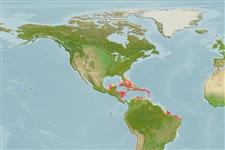
| Native range | All suitable habitat | Point map | Year 2050 |
|
| This map was computer-generated and has not yet been reviewed. |
| Enneanectes quadra AquaMaps Data sources: GBIF OBIS |
Hochladen Photos und videos
Bilder | Google Bild Enneanectes quadra
Photo von Victor, B.
Bilder | Google Bild
Photo von Victor, B.
Klassifizierung / Names Namen | Synonyme | Catalog of Fishes(Gattung, Arten) | ITIS | CoL | WoRMS | Cloffa
> Blenniiformes (Blennies) > Tripterygiidae (Triplefin blennies) > Tripterygiinae
Etymology: Enneanectes: Greek, ennea = nine times + Greek, nektos = that swimms (Ref. 45335); quadra: Name from Latin, meaning square; for the characteristic squared shape of the dark caudal-peduncle bar; noun in apposition.
Etymology: Enneanectes: Greek, ennea = nine times + Greek, nektos = that swimms (Ref. 45335); quadra: Name from Latin, meaning square; for the characteristic squared shape of the dark caudal-peduncle bar; noun in apposition.
Umwelt: Milieu / Klimazone / Tiefenbereich / Verbreitungsgebiet Ökologie
seewasser riff-verbunden; tiefenbereich 1 - 9 m (Ref. 116142). Tropical
Verbreitung Territorien | FAO Gebiete | Ökosysteme | Vorkommen | Punkt Karte | Einführungen | Faunafri
Weatern Atlantic: the Caribbean, from the Bahamas, the Virgin Islands (USA), Antigua, as well as in the western Caribbean: at Yucatán, Mexico (as a larva), Honduras, Belize, and the offshore islands of Providencia.
Größe / Gewicht / Alter
Kurzbeschreibung Bestimmungsschlüssel | Morphologie | Morphometrie
Rückenflossenstacheln (insgesamt) : 15; Rückenflossenweichstrahlen (insgesamt) : 7; Afterflossenstacheln: 2; Afterflossenweichstrahlen: 15. This species is distinguished by the following characters: orbital cirrus is dark and narrow, more than twice longer than wide, ending in a single point (rarely bifid); without scales on upper preopercle immediately behind eye, below sensory canal (one individual with one on one side); without dark spots along pored lateral-line; iris has 3 red, spoke-like bands at about 8, 10, and 1 o’clock with wide interspaces (as wide or wider than red spokes) and a red rear lower quadrant (when fresh); short snout with a reddish band from orbit across front half of upper and lower jaws, pale in preserved fish with only patches (not a complete band) of fine melanophores; presence of a short reddish bar extending from lower rim of orbit, when preserved only a short dark bar, not reaching past corner of jaw; usually a white patch immediately behind suborbital bar, when preserved only a scattering of fine melanophores; preopercle and opercle pale, except for reddish and dark patch at orbital rim at 5 o’clock and a bar along posterior margin of preopercle; rear body not red; anal fin barred, 6 to 8 dark patches corresponding to each body bar and mid-interspace; caudal-peduncle dark bar typically about square (same width throughout with corners squared) or slightly wider than high, extending onto caudal-fin ray insertions; caudal fin mostly unmarked, almost clear on preserved specimens, with faint melanin outlining ray shafts (Ref. 116142).
Body shape (shape guide): elongated; Cross section: oval.
Characters shared with Enneanectes jordani are the following: D III+XII+7; A II,15; pectoral-fin rays 15; short first dorsal fin when adpressed not reaching second-spine base of second dorsal fin (often not reaching fin origin); 13 modal pored lateral-line scales and about 19 or 20 scales in notched midline row; scaled belly and pectoral-fin base with two scales above rear of pored lateral-line, the upper scale much smaller [both characters of scaled-belly subgroup]; body bars 5 with the last body bar on caudal peduncle much darker; anterior orbital flange with fine spines (Ref. 116142).
Body shape (shape guide): elongated; Cross section: oval.
Lebenszyklus und Paarungsverhalten Geschlechtsreife | Fortpflanzung | Ablaichen | Eier | Fruchtbarkeit | Larven
Hauptreferenz
Laden Sie Ihre Referenzen hoch | Referenzen | Koordinator : Fricke, Ronald | Partner
Victor, B.C., 2017. The status of Enneanectes jordani and a new species of triplefin blenny from the Greater Caribbean (Teleostei: Tripterygiidae). J. Ocean Sci. Found. 27:48-73. (Ref. 116142)
IUCN Rote Liste Status (Ref. 130435: Version 2025-2)
nicht bedroht (LC) ; Date assessed: 19 March 2019
CITES
Not Evaluated
Bedrohung für Menschen
Harmless
Nutzung durch Menschen
FAO - Publication: search | FishSource |
Mehr Information
Trophische Ökologie
Lebensmittel (Beutetiere)
Nahrungszusammensetzung
Nahrungsaufnahme
Lebensmittelrationen
Räuber
Lebensmittel (Beutetiere)
Nahrungszusammensetzung
Nahrungsaufnahme
Lebensmittelrationen
Räuber
Ökologie
Ökologie
Ökologie
Populationsdynamik
Wachstumsparameter
Max. Alter/Größen
Länge-Gewicht-Rel.
Länge-Länge-Verhältnis.
Längenhäufigkeiten
Massenkonvertierung
Rekrutierung
Dichte
Wachstumsparameter
Max. Alter/Größen
Länge-Gewicht-Rel.
Länge-Länge-Verhältnis.
Längenhäufigkeiten
Massenkonvertierung
Rekrutierung
Dichte
Lebenszyklus
Fortpflanzung
Geschlechtsreife
Reifung/Kiemen rel.
Fruchtbarkeit
Ablaichen
Laichaggregationen
Eier
Eientwicklung
Larven
Larven Pop.Dyn.
Fortpflanzung
Geschlechtsreife
Reifung/Kiemen rel.
Fruchtbarkeit
Ablaichen
Laichaggregationen
Eier
Eientwicklung
Larven
Larven Pop.Dyn.
Anatomie
Kiemenoberfläche
Gehirn
Otolith
Kiemenoberfläche
Gehirn
Otolith
Physiologie
Körperliche Zusammensetzung
Nährstoffe
Sauerstoffverbrauch
Schwimmart
Schwimmgeschwindigkeit
Visuelle Pigmente
Fischgeräusche
Krankheiten und Parasiten
Toxizität (LC50s)
Körperliche Zusammensetzung
Nährstoffe
Sauerstoffverbrauch
Schwimmart
Schwimmgeschwindigkeit
Visuelle Pigmente
Fischgeräusche
Krankheiten und Parasiten
Toxizität (LC50s)
Genetik
Genom
Genetik
Heterozygotie
Vererbbarkeit
Genetische Vielfalt
Genom
Genetik
Heterozygotie
Vererbbarkeit
Genetische Vielfalt
Menschenbezogen
Aquakultur-Systeme
Aquakultur Profile
Zuchtlinien
Ciguatera-Fälle
Briefmarken, Münzen, Verschiedenes.
Aquakultur-Systeme
Aquakultur Profile
Zuchtlinien
Ciguatera-Fälle
Briefmarken, Münzen, Verschiedenes.
Tools
Zusatzinformationen
Download XML
Zusammenfassung | Punktdaten | Namen | Photos
Internet Quellen
AFORO (otoliths) | Aquatic Commons | BHL | Cloffa | Websites from users | FishWatcher Einträge suchen | CISTI | Catalog of Fishes: Gattung, Arten | DiscoverLife | ECOTOX | FAO - Publication: search | Faunafri | Fishipedia | Fishtrace | GloBI | Google Books | Google Scholar | Google | IGFA World Record | Nationale Datenbanken | OneZoom | Open Tree of Life | Otolith Atlas of Taiwan Fishes | PubMed | Reef Life Survey | Socotra Atlas | TreeBase | Tree of Life | Wikipedia: Gehe zu, Suchen | World Records Freshwater Fishing | Zoobank | Zoologischer Rekord
Schätzungen auf der Grundlage von Modellen
Phylogenetischer Diversitätsindex (Ref. 82804): PD50 = 0.5000 [Uniqueness, from 0.5 = low to 2.0 = high].
Bayesian length-weight: a=0.00617 (0.00288 - 0.01322), b=3.04 (2.86 - 3.22), in cm total length, based on LWR estimates for this (Sub)family-body shape (Ref. 93245).
Trophische Ebene (Ref. 69278): 2.9 ±0.3 se; based on size and trophs of closest relatives
Widerstandsfähigkeit (Ref. 120179): hoch, Verdopplung der Population dauert weniger als 15 Monate. (Preliminary K or Fecundity.).