-

- À propos de cette page
- Langues
- Commentaires des utilisateurs
- Citation
- Téléchargements
- Espèces associées
-



Envoyez vos Photos et vidéos
Images Google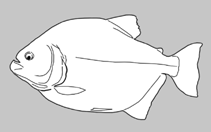 No image available for this species;
drawing shows typical species in Serrasalmidae.
Images Google
drawing shows typical species in Serrasalmidae.
Classification / Noms Noms communs | Synonymes | Catalog of Fishes(Genre, Espèce) | ITIS | CoL | WoRMS | Cloffa
> Characiformes (Characins) > Serrasalmidae (Piranhas and pacus) > Myleinae
Etymology: Myloplus: Greek, mylos, -ou = grey mullet + Greek, plus, ploos = movement of a serpent; zorroi: Named for Mauricio Camargo-Zorro (Instituto Federal de Educação, Ciência e Tecnologia); alludes to the Latin-American fictional character Zorro, because the special features 'masked' this fish as Tometes, concealing its true identity.
Eponymy: Dr Mauricio Camargo-Zorro is a researcher at the Instituto Federal de Educação, Ciência e Tecnologia, São Paulo. [...] (Ref. 128868), visit book page.
Etymology: Myloplus: Greek, mylos, -ou = grey mullet + Greek, plus, ploos = movement of a serpent; zorroi: Named for Mauricio Camargo-Zorro (Instituto Federal de Educação, Ciência e Tecnologia); alludes to the Latin-American fictional character Zorro, because the special features 'masked' this fish as Tometes, concealing its true identity.
Eponymy: Dr Mauricio Camargo-Zorro is a researcher at the Instituto Federal de Educação, Ciência e Tecnologia, São Paulo. [...] (Ref. 128868), visit book page.
Environnement : milieu / zone climatique / profondeur / gamme de distribution Écologie
; eau douce benthopélagique. Tropical
Distribution Territoires | Zones FAO | Écosystèmes | Occurrences | Carte par point | Introductions | Faunafri
South America: Brazil.
Taille / Poids / Âge
Description synthétique Clés d'identification | Morphologie | Morphométrie
This species is distinguished from its congeners by the following characters: absence of the abdominal keel and prepelvic serrae formed by 13-19 low spines (vs. a well-marked abdominal keel and prepelvic serrae of more than 20 high spines). It differs from asterias, levis, torquatus by having fewer branched dorsal-fin rays 20-22 (vs. 23 or more); from arnoldi, ternetzi, torquatus by having a greater number of branched anal-fin rays 32-34 (vs. 31 or fewer); differs significantly from lobatus, schomburgkii, rhomboidalis by having two rows of premaxillary teeth forming a slight arc (vs. 2 rows of premaxillary teeth forming a shape that resembles the uppercase letter 'A'; shorter dorsal-fin base 27.6-30.1% of SL (vs. 31.8% of SL or higher); differs from asterias, levis, ternetzi, torquatus in having a larger interdorsal distance 11.4-12.7% of SL (vs. 10.8% of SL or lower); differs further from M. ternetzi by the presence of a pair of symphyseal teeth (vs. none); from asterias, levis, lobatus, ternetzi by having a smaller vertical diameter of the eye 27.3-35.4% of HL (vs. 35.5% of HL or greater); from arnoldi, torquatus by having a greater number of total vertebrae 40-41 (vs. 37 or less), by having anterior dorsal-fin rays lacking pigmentation (vs. strongly dark pigmented), and the presence of a diffuse dark band at caudal-fin distal border (vs. the presence of a well-defined dark band); from M. asterias by having an elongated fontanel with similarly sized anterior and posterior portions (vs. very short posterior fontanel and rounded anterior fontanel) (Ref. 114773).
Body shape (shape guide): short and / or deep; Cross section: compressed.
Body shape (shape guide): short and / or deep; Cross section: compressed.
Cycle de vie et comportement reproducteur Maturité | Reproduction | Frai | Œufs | Fécondité | Larves
Référence principale
Téléchargez vos références | Références | Coordinateur | Collaborateurs
Andrade, M.C., M. Jégu and T. Giarrizzo, 2016. A new large species of Myloplus (Characiformes: Serrasalmidae) from rio Madeira basin, Brazil. ZooKeys 571:153-167. (Ref. 114773)
CITES
Not Evaluated
Menace pour l'homme
Harmless
Utilisations par l'homme
FAO - Publication: search | FishSource |
Plus d'informations
Écologie trophique
Aliments (proies)
Composition du régime alimentaire
Consommation alimentaire
Rations alimentaires
Prédateurs
Aliments (proies)
Composition du régime alimentaire
Consommation alimentaire
Rations alimentaires
Prédateurs
Écologie
Écologie
Écologie
Dynamique des populations
Paramètres de croissance
Âges / tailles maximales
Longueur-poids rel.
Rel. longueur-longueur.
Fréquences de longueurs
Conversion de masse
Recrutement
Abondance
Paramètres de croissance
Âges / tailles maximales
Longueur-poids rel.
Rel. longueur-longueur.
Fréquences de longueurs
Conversion de masse
Recrutement
Abondance
Cycle de vie
Reproduction
Maturité
Maturité/épines rel.
Fécondité
Frai
Agrégats de frai
Œufs
Développement de l'œuf
Larves
Dynamique des populations larvaires
Reproduction
Maturité
Maturité/épines rel.
Fécondité
Frai
Agrégats de frai
Œufs
Développement de l'œuf
Larves
Dynamique des populations larvaires
Anatomie
Surface branchiale
Cerveau
Otolithe
Surface branchiale
Cerveau
Otolithe
Physiologie
Composition corporelle
Nutriments
Consommation d'oxygène
Type de natation
Vitesse de nage
Pigments visuels
Son de poisson
Maladies et parasites
Toxicité (CL50)
Composition corporelle
Nutriments
Consommation d'oxygène
Type de natation
Vitesse de nage
Pigments visuels
Son de poisson
Maladies et parasites
Toxicité (CL50)
Génétique
génôme
Génétique
Hétérozygotie
Héritabilité
Diversité génétique
génôme
Génétique
Hétérozygotie
Héritabilité
Diversité génétique
Liées à l'homme
Systèmes d'aquaculture
Profils d'aquaculture
Souches
Cas de ciguatera
Timbres, pièces de monnaie, divers
Systèmes d'aquaculture
Profils d'aquaculture
Souches
Cas de ciguatera
Timbres, pièces de monnaie, divers
Outils
E-book | Guide de terrain | Générateur de fréquences de longueur | Outil de dynamique de population | Carte par point |
Capture-MSY |
Articles particuliers
Télécharger en XML
Sources Internet
AFORO (otoliths) | Aquatic Commons | BHL | Cloffa | Websites from users | FishWatcher | CISTI | Catalog of Fishes: Genre, Espèce | DiscoverLife | ECOTOX | FAO - Publication: search | Faunafri | Fishipedia | Fishtrace | GloBI | Google Books | Google Scholar | Google | IGFA World Record | OneZoom | Open Tree of Life | Otolith Atlas of Taiwan Fishes | PubMed | Reef Life Survey | Socotra Atlas | TreeBase | Arbre de Vie | Wikipedia: aller à, chercher | World Records Freshwater Fishing | Zoobank | Zoological Record
Estimations basées sur des modèles
Indice de diversité phylogénétique (Réf. 82804): PD50 = 0.5001 [Uniqueness, from 0.5 = low to 2.0 = high].
Bayesian length-weight: a=0.02754 (0.01279 - 0.05932), b=2.97 (2.79 - 3.15), in cm total length, based on LWR estimates for this Genus-body shape (Ref. 93245).
Résilience (Réf. 120179): Haut, temps minimum de doublement de population inférieur à 15 mois (Preliminary K or Fecundity.).