-

- Om denna sida
- Språk
- Återkoppling från användare
- Referens
- Uppladdningar
-
Relaterade arter
- Arter i
Etmopterus - Arter i
Etmopteridae - - Klassificering -
- Etmopteridae
- Squaliformes
- Elasmobranchii
- Chordata
- Animalia
- Arter i
-



Etmopterus lucifer Jordan & Snyder, 1902
Blackbelly lanternshark
Lägg till din observation i Fish Watcher
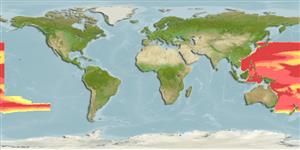
| Native range | All suitable habitat | Point map | Year 2050 |
|
| This map was computer-generated and has not yet been reviewed. |
| Etmopterus lucifer AquaMaps Data sources: GBIF OBIS |
Ladda upp din foton och Videor
Bilder | Google image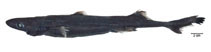 Etmopterus lucifer
Bild av Fischer, L.G.
Bilder | Google image
Bild av Fischer, L.G.
Klassificering / Namn Populärnamn | synonymer | Catalog of Fishes(Släkte, Arter) | ITIS | CoL | WoRMS | Cloffa
Elasmobranchii (hajar och rockor) (sharks and rays) > Squaliformes (Sleeper and dogfish sharks) > Etmopteridae (Lantern sharks)
Etymology: Etmopterus: Greek, ethmos, -ou = sieve or ethmoides bone + Greek, pteron = wing, fin (Ref. 45335).
Eponymy: The fallen angel Lucifer, of the Judeo-Christian tradition, is referred to in the fourteenth chapter of the Biblical book of Isaiah: ‘How art thou fallen from heaven, O Lucifer, son of the morning! How art thou cut down to the ground, which didst we [...] (Ref. 128868), visit book page.
More on authors: Jordan & Snyder.
Etymology: Etmopterus: Greek, ethmos, -ou = sieve or ethmoides bone + Greek, pteron = wing, fin (Ref. 45335).
Eponymy: The fallen angel Lucifer, of the Judeo-Christian tradition, is referred to in the fourteenth chapter of the Biblical book of Isaiah: ‘How art thou fallen from heaven, O Lucifer, son of the morning! How art thou cut down to the ground, which didst we [...] (Ref. 128868), visit book page.
More on authors: Jordan & Snyder.
Issue
Research shows that this species is restricted to northwestern Pacific ; Austral-Indonesian records are considered to represent two or three undescribed species (see Ref. 87957); distribution will be resolved (linked to correct species) when publications are received.
Miljö: miljö / Klimatzon / djupintervall / distributionsområde Ekologi
marina pelagic-oceanic; djupintervall 150 - 1357 m (Ref. 106604). Deep-water; 40°N - 48°S
Utbredning Territorier | FAO områden | Ekosystem | Förekomster | Prickkarta | Utplanteringar | Faunafri
Western Pacific: Japan to Philippines.
Längd vid första mognad / Storlek / Vikt / Ålder
Könsmognad: Lm ?, range 34 - ? cm
Max length : 55.0 cm TL hane/ej könsbestämd; (Ref. 122636); publicerad maxvikt: 775.00 g (Ref. 122636)
Max length : 55.0 cm TL hane/ej könsbestämd; (Ref. 122636); publicerad maxvikt: 775.00 g (Ref. 122636)
Kort beskrivning Bestämningsnycklar | Morfologi | Morfometri
Taggstrålar i ryggfenan (totalt) : 2; Taggstrålar i analfenan: 0. Dark grey (Ref. 6577) or brown dorsally, black ventrally, with a distinct black streak above and behind pelvic fins; fins lighter; belly luminous (Ref. 26346). Small and slender with a moderately elongate caudal peduncle and with flank denticles mostly arranged in regular rows. The base of the pelvic flank marking is under the second dorsal-fin spine, the anterior branch is usually longer than the posterior branch, and the caudal marking is considerably longer than the precaudal marking (Ref. 6871).
Body shape (shape guide): elongated.
Body shape (shape guide): elongated.
Found on the outer continental and insular shelves and upper slopes (Ref. 247). Its luminescent belly may attract prey (Ref. 26346), which consists mainly of squid (reported to bite squid bigger than itself), small bony fishes, and shrimps (Ref. 247). Often caught in large schools which may suggest that the luminescence may also be used to keep the group together in the dark deep ocean (Ref. 26346). Ovoviviparous (Ref. 205), size at birth about 15 cm (Ref. 6871).
Livscykel och parningsbeteende Könsmognad | Reproduktion | Lek | Ägg | Fekunditet | Larver
Presumably ovoviviparous (Ref. 6871). Size at birth about 15 cm (Ref. 6871). Distinct pairing with embrace (Ref. 205).
Huvudreferens
Ladda upp dina referenser | referenser | Koordinator | Medarbetare
Compagno, L.J.V., 1984. FAO Species Catalogue. Vol. 4. Sharks of the world. An annotated and illustrated catalogue of shark species known to date. Part 1 - Hexanchiformes to Lamniformes. FAO Fish. Synop. 125(4/1):1-249. Rome, FAO. (Ref. 247)
Status på IUCN:s rödlista (Ref. 130435: Version 2025-2)
Least Concern (LC) ; Date assessed: 01 July 2017
CITES
Not Evaluated
Hot mot människor
Harmless
Mänskliga användningsområden
Fiskeri: saknar intresse
FAO - Publication: search | FishSource |
Ytterligare information
Populationsdynamik
Tillväxtparametrar
Max. åldrar / storlekar
Längd-vikt rel.
Längd-längd rel.
Längd-frekvenser
Massakonvertering
Rekrytering
Abundans
Tillväxtparametrar
Max. åldrar / storlekar
Längd-vikt rel.
Längd-längd rel.
Längd-frekvenser
Massakonvertering
Rekrytering
Abundans
Livscykel
Reproduktion
Könsmognad
Mognad/Gills rel.
Fekunditet
Lek
Lekande aggregat
Ägg
Utveckling av ägg
Larver
Larvdynamik
Reproduktion
Könsmognad
Mognad/Gills rel.
Fekunditet
Lek
Lekande aggregat
Ägg
Utveckling av ägg
Larver
Larvdynamik
Fysiologi
Kroppssammansättning
Näringsämnen
Syreförbrukning
Typ av simning
Simhastighet
Visuella pigment
Ljud från fisk
Sjukdomar & Parasiter
Toxicitet (LC50)
Kroppssammansättning
Näringsämnen
Syreförbrukning
Typ av simning
Simhastighet
Visuella pigment
Ljud från fisk
Sjukdomar & Parasiter
Toxicitet (LC50)
Människorelaterad
Vattenbrukssystem
Vattenbruksprofiler
Avelslinjer
Ciguatera-fall
Frimärken, mynt, diverse.
Vattenbrukssystem
Vattenbruksprofiler
Avelslinjer
Ciguatera-fall
Frimärken, mynt, diverse.
Verktyg
E-bok | Fälthandbok | Bestämningsnycklar | Längdfördelnings-verktyg | Livshistorie-verktyg | Prickkarta |
Fångst-MSY |
Särskilda rapporter
Kontrollera för underhåll av akvarium | Kontrollera om det finns faktablad om arter | Kontrollera om det finns faktablad om vattenbruk
Ladda ner XML
Internet-källor
AFORO (otoliths) | Aquatic Commons | BHL | Cloffa | Websites from users | Check FishWatcher | CISTI | Catalog of Fishes: Släkte, Arter | DiscoverLife | ECOTOX | FAO - Publication: search | Faunafri | Fishipedia | Fishtrace | GloBI | Google Books | Google Scholar | Google | IGFA World Record | Nationella databaser | OneZoom | Open Tree of Life | Otolith Atlas of Taiwan Fishes | PubMed | Reef Life Survey | Socotra Atlas | TreeBase | Tree of Life | Wikipedia: Go, sök | World Records Freshwater Fishing | Zoobank | Zoologiskt register
Uppskattningar baserade på modeller
Önskad temperatur (Ref. 123201): 6.7 - 14.6, mean 9.6 °C (based on 350 cells).
Index för fylogenetisk mångfald (Ref. 82804): PD50 = 0.5000 [Uniqueness, from 0.5 = low to 2.0 = high].
Bayesian length-weight: a=0.00245 (0.00160 - 0.00376), b=3.07 (2.94 - 3.20), in cm total length, based on LWR estimates for this species & Genus-body shape (Ref. 93245).
Trofisk nivå (Ref. 69278): 4.2 ±0.3 se; based on diet studies.
Resiliens (Ref. 120179): Mycket låg, lägsta populationsfördubblingstid mer än 14 år (Fec assumed to be <10).
Näringsämnen (Ref. 124155): Calcium = 8.37 [1.63, 45.94] mg/100g; Iron = 0.348 [0.084, 1.304] mg/100g; Protein = 19.1 [16.5, 21.3] %; Omega3 = 0.331 [0.114, 1.053] g/100g; Selenium = 10.4 [2.6, 35.8] μg/100g; VitaminA = 31.4 [5.4, 200.3] μg/100g; Zinc = 0.478 [0.223, 0.979] mg/100g (wet weight);