-

- À propos de cette page
- Langues
- Commentaires des utilisateurs
- Citation
- Téléchargements
-
Espèces associées
- Espèces pour
Gymnochanda - Espèces pour
Ambassidae - - Classification -
- Ambassidae
- Ovalentaria/misc
- Teleostei
- Chordata
- Animalia
- Espèces pour
-



Gymnochanda ploegi Tan & Lim, 2014
Envoyez vos Photos et vidéos
Images Google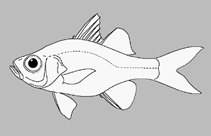 No image available for this species;
drawing shows typical species in Ambassidae.
Images Google
drawing shows typical species in Ambassidae.
Classification / Noms Noms communs | Synonymes | Catalog of Fishes(Genre, Espèce) | ITIS | CoL | WoRMS | Cloffa
> Ovalentaria/misc (Various families in series Ovalentaria) > Ambassidae (Asiatic glassfishes)
Etymology: ploegi: Named for Alex Ploeg, a good friend, fellow taxonomist, advisor and fellow conservationist against alien aquatic species; for his services to the ornamental fish trade in this region and abroad in his role as the Secretary General of the Ornamental Fish International; who unfortunately perished in a terrible tragedy over Ukraine on 17 July 2014.
Eponymy: Dr Alex A Ploeg (d: 2014) was a Dutch ichthyologist who was Secretary General of Ornamental Fish International (2004–2014) and Secretary General of the European Pet Organization (2006–2014). [...] (Ref. 128868), visit book page.
Etymology: ploegi: Named for Alex Ploeg, a good friend, fellow taxonomist, advisor and fellow conservationist against alien aquatic species; for his services to the ornamental fish trade in this region and abroad in his role as the Secretary General of the Ornamental Fish International; who unfortunately perished in a terrible tragedy over Ukraine on 17 July 2014.
Eponymy: Dr Alex A Ploeg (d: 2014) was a Dutch ichthyologist who was Secretary General of Ornamental Fish International (2004–2014) and Secretary General of the European Pet Organization (2006–2014). [...] (Ref. 128868), visit book page.
Environnement : milieu / zone climatique / profondeur / gamme de distribution Écologie
; eau douce benthopélagique. Tropical
Distribution Territoires | Zones FAO | Écosystèmes | Occurrences | Carte par point | Introductions | Faunafri
Asia: Sanggau and Kapuas Lakes regions in West Kalimantan, Indonesia.
Taille / Poids / Âge
Description synthétique Clés d'identification | Morphologie | Morphométrie
Épines dorsales (Total) : 8; Rayons mous dorsaux (Total) : 11; Épines anales: 3; Rayons mous anaux: 11; Vertèbres: 25. Distinguished from all other species of Gymnochanda by the following characters: mature males have pinkish body with dorsal half suffused with reddish pigments, anal and second dorsal fins expanded with their soft rays also expanded to reach 2/3 of caudal fin forming a crescentic profile, without any individual fin ray free from the interradial fin membrane; anterior part to whole of both anal and second dorsal fins maroon red in life, with posterior portion of distal rays black forming a crescentic pattern (hyaline when preserved); caudal fin entirely lightly suffused with red in life (hyaline when preserved); females possess yellowish body suffused with reddish pigments without any fin elongation (hyaline when preserved), both dorsal fins suffused with reddish pigments (hyaline when preserved) (Ref. 97398).
Body shape (shape guide): fusiform / normal.
Body shape (shape guide): fusiform / normal.
Found in pools with still water near swamp forest and riverine systems (Ref. 97398).
Cycle de vie et comportement reproducteur Maturité | Reproduction | Frai | Œufs | Fécondité | Larves
Référence principale
Téléchargez vos références | Références | Coordinateur | Collaborateurs
Tan, H.H. and K.K.P. Lim, 2014. Gymnochanda ploegi, a new species of ambassid glassperch from West Kalimantan, Indonesia. Raffles Bulletin of Zoology 62:688-695. (Ref. 97398)
Statut dans la liste rouge de l'IUCN (Ref. 130435: Version 2025-2)
Données manquantes (DD) ; Date assessed: 18 November 2019
CITES
Not Evaluated
Menace pour l'homme
Harmless
Utilisations par l'homme
FAO - Publication: search | FishSource |
Plus d'informations
Écologie trophique
Aliments (proies)
Composition du régime alimentaire
Consommation alimentaire
Rations alimentaires
Prédateurs
Aliments (proies)
Composition du régime alimentaire
Consommation alimentaire
Rations alimentaires
Prédateurs
Dynamique des populations
Paramètres de croissance
Âges / tailles maximales
Longueur-poids rel.
Rel. longueur-longueur.
Fréquences de longueurs
Conversion de masse
Recrutement
Abondance
Paramètres de croissance
Âges / tailles maximales
Longueur-poids rel.
Rel. longueur-longueur.
Fréquences de longueurs
Conversion de masse
Recrutement
Abondance
Cycle de vie
Reproduction
Maturité
Maturité/épines rel.
Fécondité
Frai
Agrégats de frai
Œufs
Développement de l'œuf
Larves
Dynamique des populations larvaires
Reproduction
Maturité
Maturité/épines rel.
Fécondité
Frai
Agrégats de frai
Œufs
Développement de l'œuf
Larves
Dynamique des populations larvaires
Anatomie
Surface branchiale
Cerveau
Otolithe
Surface branchiale
Cerveau
Otolithe
Physiologie
Composition corporelle
Nutriments
Consommation d'oxygène
Type de natation
Vitesse de nage
Pigments visuels
Son de poisson
Maladies et parasites
Toxicité (CL50)
Composition corporelle
Nutriments
Consommation d'oxygène
Type de natation
Vitesse de nage
Pigments visuels
Son de poisson
Maladies et parasites
Toxicité (CL50)
Génétique
génôme
Génétique
Hétérozygotie
Héritabilité
Diversité génétique
génôme
Génétique
Hétérozygotie
Héritabilité
Diversité génétique
Liées à l'homme
Systèmes d'aquaculture
Profils d'aquaculture
Souches
Cas de ciguatera
Timbres, pièces de monnaie, divers
Systèmes d'aquaculture
Profils d'aquaculture
Souches
Cas de ciguatera
Timbres, pièces de monnaie, divers
Outils
E-book | Guide de terrain | Générateur de fréquences de longueur | Outil de dynamique de population | Carte par point |
Capture-MSY |
Articles particuliers
Télécharger en XML
Sources Internet
AFORO (otoliths) | Aquatic Commons | BHL | Cloffa | Websites from users | FishWatcher | CISTI | Catalog of Fishes: Genre, Espèce | DiscoverLife | ECOTOX | FAO - Publication: search | Faunafri | Fishipedia | Fishtrace | GloBI | Google Books | Google Scholar | Google | IGFA World Record | OneZoom | Open Tree of Life | Otolith Atlas of Taiwan Fishes | PubMed | Reef Life Survey | Socotra Atlas | TreeBase | Arbre de Vie | Wikipedia: aller à, chercher | World Records Freshwater Fishing | Zoobank | Zoological Record
Estimations basées sur des modèles
Indice de diversité phylogénétique (Réf. 82804): PD50 = 0.5312 [Uniqueness, from 0.5 = low to 2.0 = high].
Bayesian length-weight: a=0.01175 (0.00496 - 0.02782), b=3.02 (2.82 - 3.22), in cm total length, based on LWR estimates for this (Sub)family-body shape (Ref. 93245).
Niveau trophique (Réf. 69278): 3.2 ±0.4 se; based on size and trophs of closest relatives
Résilience (Réf. 120179): Haut, temps minimum de doublement de population inférieur à 15 mois (Preliminary K or Fecundity.).