-

- Über diese Seite
- Sprachen
- Rückmeldungen der Nutzer
- Zitat
- Uploads
-
Verwandte Arten
- Arten in
Notoraja - Arten in
Arhynchobatidae - - Klassifizierung -
- Arhynchobatidae
- Rajiformes
- Elasmobranchii
- Chordata
- Animalia
- Arten in
-



Notoraja longiventralis Séret & Last, 2012
Hochladen Photos und videos
Google Bild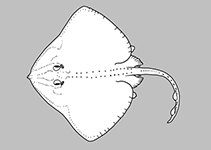 No image available for this species;
drawing shows typical species in Arhynchobatidae.
Google Bild
drawing shows typical species in Arhynchobatidae.
Klassifizierung / Names Namen | Synonyme | Catalog of Fishes(Gattung, Arten) | ITIS | CoL | WoRMS | Cloffa
Elasmobranchii (Haie und Rochen) (sharks and rays) > Rajiformes (Skates and rays) > Arhynchobatidae (Softnose skates)
Etymology: Notoraja: Greek, noton = back + Latin, raja = fish, Raja sp. (Ref. 45335); longiventralis: Name from Latin 'longi' for long and 'ventralis'; referring to the very long anterior lobe of the pelvic fin.
Etymology: Notoraja: Greek, noton = back + Latin, raja = fish, Raja sp. (Ref. 45335); longiventralis: Name from Latin 'longi' for long and 'ventralis'; referring to the very long anterior lobe of the pelvic fin.
Umwelt: Milieu / Klimazone / Tiefenbereich / Verbreitungsgebiet Ökologie
seewasser bathypelagisch; tiefenbereich 660 - 953 m (Ref. 91035). Tropical; 14°S - 20°S, 166°E - 178°W (Ref. 114953)
Verbreitung Territorien | FAO Gebiete | Ökosysteme | Vorkommen | Punkt Karte | Einführungen | Faunafri
Western Pacific: Fiji and Vanuatu.
Größe / Gewicht / Alter
Kurzbeschreibung Bestimmungsschlüssel | Morphologie | Morphometrie
This species (probably of medium size) is distinguished by the following set of characters: presence of a single rudimentary preorbital thorn; velvety dorsal and ventral surfaces of disc which are covered with fine denticles; long and slender tail is velvety and without enlarged thorns; lateral tail folds are not expanded distally, always narrower than tail width; nasal lobes not greatly expanded, width of nasal curtain 7.6-8.0% TL; relatively broad mouth, its width more than 66% of maximum width of nasal curtain; anterior pelvic-fin lobe is longer than posterior lobe; dorsal and ventral surfaces are dark, almost uniformly purplish grey; faint whitish spots over pores along the anterior margins of disc; total pectoral-fin radials 64-65, monospondylous centra 26-27, total diplospondylous centra 109-118, total number of centra 135-145 (Ref. 91035).
Body shape (shape guide): other (see remarks); Cross section: flattened.
Body shape (shape guide): other (see remarks); Cross section: flattened.
A demersal species found on mid-insular slopes. Known from few specimens. Hatching size at ca. 17 cm TL. Life history unknown (Ref. 114953).
Lebenszyklus und Paarungsverhalten Geschlechtsreife | Fortpflanzung | Ablaichen | Eier | Fruchtbarkeit | Larven
Hauptreferenz
Laden Sie Ihre Referenzen hoch | Referenzen | Koordinator : McEachran, John | Partner
Séret, B. and P.R. Last, 2012. New deep water skates of the genus Notoraja Ishiyama, 1958 (Rajoidei, Arhynchobatidae) from the southwest Pacific. Zoosystema, 34 (2):319-341. (Ref. 91035)
IUCN Rote Liste Status (Ref. 130435: Version 2025-2)
nicht bedroht (LC) ; Date assessed: 23 June 2017
CITES
Not Evaluated
Bedrohung für Menschen
Harmless
Nutzung durch Menschen
FAO - Publication: search | FishSource |
Mehr Information
Trophische Ökologie
Lebensmittel (Beutetiere)
Nahrungszusammensetzung
Nahrungsaufnahme
Lebensmittelrationen
Räuber
Lebensmittel (Beutetiere)
Nahrungszusammensetzung
Nahrungsaufnahme
Lebensmittelrationen
Räuber
Ökologie
Ökologie
Ökologie
Populationsdynamik
Wachstumsparameter
Max. Alter/Größen
Länge-Gewicht-Rel.
Länge-Länge-Verhältnis.
Längenhäufigkeiten
Massenkonvertierung
Rekrutierung
Dichte
Wachstumsparameter
Max. Alter/Größen
Länge-Gewicht-Rel.
Länge-Länge-Verhältnis.
Längenhäufigkeiten
Massenkonvertierung
Rekrutierung
Dichte
Lebenszyklus
Fortpflanzung
Geschlechtsreife
Reifung/Kiemen rel.
Fruchtbarkeit
Ablaichen
Laichaggregationen
Eier
Eientwicklung
Larven
Larven Pop.Dyn.
Fortpflanzung
Geschlechtsreife
Reifung/Kiemen rel.
Fruchtbarkeit
Ablaichen
Laichaggregationen
Eier
Eientwicklung
Larven
Larven Pop.Dyn.
Anatomie
Kiemenoberfläche
Gehirn
Otolith
Kiemenoberfläche
Gehirn
Otolith
Physiologie
Körperliche Zusammensetzung
Nährstoffe
Sauerstoffverbrauch
Schwimmart
Schwimmgeschwindigkeit
Visuelle Pigmente
Fischgeräusche
Krankheiten und Parasiten
Toxizität (LC50s)
Körperliche Zusammensetzung
Nährstoffe
Sauerstoffverbrauch
Schwimmart
Schwimmgeschwindigkeit
Visuelle Pigmente
Fischgeräusche
Krankheiten und Parasiten
Toxizität (LC50s)
Genetik
Genom
Genetik
Heterozygotie
Vererbbarkeit
Genetische Vielfalt
Genom
Genetik
Heterozygotie
Vererbbarkeit
Genetische Vielfalt
Menschenbezogen
Aquakultur-Systeme
Aquakultur Profile
Zuchtlinien
Ciguatera-Fälle
Briefmarken, Münzen, Verschiedenes.
Aquakultur-Systeme
Aquakultur Profile
Zuchtlinien
Ciguatera-Fälle
Briefmarken, Münzen, Verschiedenes.
Tools
Zusatzinformationen
Download XML
Zusammenfassung | Punktdaten | Namen | Photos
Internet Quellen
AFORO (otoliths) | Aquatic Commons | BHL | Cloffa | Websites from users | FishWatcher Einträge suchen | CISTI | Catalog of Fishes: Gattung, Arten | DiscoverLife | ECOTOX | FAO - Publication: search | Faunafri | Fishipedia | Fishtrace | GloBI | Google Books | Google Scholar | Google | IGFA World Record | OneZoom | Open Tree of Life | Otolith Atlas of Taiwan Fishes | PubMed | Reef Life Survey | Socotra Atlas | TreeBase | Tree of Life | Wikipedia: Gehe zu, Suchen | World Records Freshwater Fishing | Zoobank | Zoologischer Rekord
Schätzungen auf der Grundlage von Modellen
Bevorzugte Temperatur (Ref. 123201): 1.8 - 2.7, mean 2.2 °C (based on 1549 cells).
Phylogenetischer Diversitätsindex (Ref. 82804): PD50 = 0.5000 [Uniqueness, from 0.5 = low to 2.0 = high].
Bayesian length-weight: a=0.00562 (0.00288 - 0.01097), b=3.11 (2.94 - 3.28), in cm total length, based on LWR estimates for this (Sub)family-body shape (Ref. 93245).
Trophische Ebene (Ref. 69278): 3.7 ±0.7 se; based on size and trophs of closest relatives
Widerstandsfähigkeit (Ref. 120179): mittel, Verdopplung der Population dauert 1,4 - 4,4 Jahre. (Preliminary K or Fecundity.).