-

- Über diese Seite
- Sprachen
- Rückmeldungen der Nutzer
- Zitat
- Uploads
- Verwandte Arten
-



Nothobranchius milvertzi Nagy, 2014
Hochladen Photos und videos
Google Bild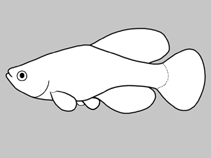 No image available for this species;
drawing shows typical species in Nothobranchiidae.
Google Bild
drawing shows typical species in Nothobranchiidae.
Klassifizierung / Names Namen | Synonyme | Catalog of Fishes(Gattung, Arten) | ITIS | CoL | WoRMS | Cloffa
> Cyprinodontiformes (Rivulines, killifishes and live bearers) > Nothobranchiidae (African rivulines)
Etymology: Nothobranchius: Greek, nothos = false + Greek, brangchia = gill (Ref. 45335); milvertzi: The species is named in honour of Finn Christian Milvertz (Solrød Strand, Denmark), renowned breeder and collector of killifish (Ref. 95524).
Eponymy: Finn Christian Milvertz of Solrød Strand, Denmark, is an aquarist; a ‘renowned’ killifish breeder and collector. He co-collected the type with Béla Nagy at ephemeral pools of the Lushiba Marsh, Zambia. (Ref. 128868), visit book page.
Etymology: Nothobranchius: Greek, nothos = false + Greek, brangchia = gill (Ref. 45335); milvertzi: The species is named in honour of Finn Christian Milvertz (Solrød Strand, Denmark), renowned breeder and collector of killifish (Ref. 95524).
Eponymy: Finn Christian Milvertz of Solrød Strand, Denmark, is an aquarist; a ‘renowned’ killifish breeder and collector. He co-collected the type with Béla Nagy at ephemeral pools of the Lushiba Marsh, Zambia. (Ref. 128868), visit book page.
Umwelt: Milieu / Klimazone / Tiefenbereich / Verbreitungsgebiet Ökologie
; süßwasser pelagisch; pH range: 6.9 - 6.9. Tropical
Verbreitung Territorien | FAO Gebiete | Ökosysteme | Vorkommen | Punkt Karte | Einführungen | Faunafri
Africa: ephemeral pools in the Lushiba Marsh, part of Lake Mweru drainage, in Zambia (Ref. 95524).
Größe / Gewicht / Alter
Kurzbeschreibung Bestimmungsschlüssel | Morphologie | Morphometrie
Rückenflossenstacheln (insgesamt) : 0; Rückenflossenweichstrahlen (insgesamt) : 15 - 17; Afterflossenstacheln: 0; Afterflossenweichstrahlen: 15 - 18. Diagnosis: Nothobranchius milvertzi belongs to the Nothobranchius taeniopygus species-group, presenting the diagnostic characters of this complex of caudal and anal fin with broad light submarginal band and dark distal margin in males (Ref. 95524). Nothobranchius milvertzi is distinguished from all other species of this complex, with the exception of N. malaissei and N. hassoni, by having an anal fin with orange submarginal band and a dark red-brown distal margin (Ref. 95524). It is distinguished from these two last mentioned species by having a red caudal fin with narrow orange semicircular submarginal band and wide dark red-brown distal margin (Ref. 95524). Furthermore, the species presents within the species-group the unique morphometric characters of head length 28.5-31.5% of standard length, interorbital width 39-46% of head length, and snout length 18-20% of head length (Ref. 95524).
Body shape (shape guide): short and / or deep.
Body shape (shape guide): short and / or deep.
The accompanying fauna of the ephemeral pools consisted of non-annual species, such as Barbus haasianus, Lacustricola moeruensis, Protopterus sp. and Pseudocrenilabrus cf. philander (Ref. 95524). The type locality was a large ephemeral pool formed in a river bed, as a standing fragment of the seasonal river, about 50 m long and 10 m wide, and about 2 m deep at its deepest point; the edge of the habitat was heavily overgrown by grass and the aquatic vegetation consisted of Nymphea species; the water was brown and slightly turbid, whereas at shallower parts the bottom of the pool was visible (Ref. 95524). Eggs slightly oval, measuring 1.27-1.36 mm on average, with short filaments on chorion (Ref. 95524).
Lebenszyklus und Paarungsverhalten Geschlechtsreife | Fortpflanzung | Ablaichen | Eier | Fruchtbarkeit | Larven
Hauptreferenz
Laden Sie Ihre Referenzen hoch | Referenzen | Koordinator | Partner
Nagy, B., 2014. Nothobranchius milvertzi, a new species of killifish from the Lushiba Marsh in the Lake Mweru drainage, Zambia (Teleostei: Cyprinodontiformes: Nothobranchiidae). Ichthyol. Explor. Freshwat. 24(4):347-360. (Ref. 95524)
IUCN Rote Liste Status (Ref. 130435: Version 2025-2)
stark gefährdet (EN) (B1ab(iii)+2ab(iii)); Date assessed: 04 January 2019
CITES
Not Evaluated
Bedrohung für Menschen
Harmless
Nutzung durch Menschen
Fischereien: nicht kommerziell
FAO - Publication: search | FishSource |
Mehr Information
Trophische Ökologie
Lebensmittel (Beutetiere)
Nahrungszusammensetzung
Nahrungsaufnahme
Lebensmittelrationen
Räuber
Lebensmittel (Beutetiere)
Nahrungszusammensetzung
Nahrungsaufnahme
Lebensmittelrationen
Räuber
Populationsdynamik
Wachstumsparameter
Max. Alter/Größen
Länge-Gewicht-Rel.
Länge-Länge-Verhältnis.
Längenhäufigkeiten
Massenkonvertierung
Rekrutierung
Dichte
Wachstumsparameter
Max. Alter/Größen
Länge-Gewicht-Rel.
Länge-Länge-Verhältnis.
Längenhäufigkeiten
Massenkonvertierung
Rekrutierung
Dichte
Lebenszyklus
Fortpflanzung
Geschlechtsreife
Reifung/Kiemen rel.
Fruchtbarkeit
Ablaichen
Laichaggregationen
Eier
Eientwicklung
Larven
Larven Pop.Dyn.
Fortpflanzung
Geschlechtsreife
Reifung/Kiemen rel.
Fruchtbarkeit
Ablaichen
Laichaggregationen
Eier
Eientwicklung
Larven
Larven Pop.Dyn.
Anatomie
Kiemenoberfläche
Gehirn
Otolith
Kiemenoberfläche
Gehirn
Otolith
Physiologie
Körperliche Zusammensetzung
Nährstoffe
Sauerstoffverbrauch
Schwimmart
Schwimmgeschwindigkeit
Visuelle Pigmente
Fischgeräusche
Krankheiten und Parasiten
Toxizität (LC50s)
Körperliche Zusammensetzung
Nährstoffe
Sauerstoffverbrauch
Schwimmart
Schwimmgeschwindigkeit
Visuelle Pigmente
Fischgeräusche
Krankheiten und Parasiten
Toxizität (LC50s)
Genetik
Genom
Genetik
Heterozygotie
Vererbbarkeit
Genetische Vielfalt
Genom
Genetik
Heterozygotie
Vererbbarkeit
Genetische Vielfalt
Menschenbezogen
Aquakultur-Systeme
Aquakultur Profile
Zuchtlinien
Ciguatera-Fälle
Briefmarken, Münzen, Verschiedenes.
Aquakultur-Systeme
Aquakultur Profile
Zuchtlinien
Ciguatera-Fälle
Briefmarken, Münzen, Verschiedenes.
Tools
Zusatzinformationen
Download XML
Zusammenfassung | Punktdaten | Namen | Photos
Internet Quellen
AFORO (otoliths) | Aquatic Commons | BHL | Cloffa | Websites from users | FishWatcher Einträge suchen | CISTI | Catalog of Fishes: Gattung, Arten | DiscoverLife | ECOTOX | FAO - Publication: search | Faunafri | Fishipedia | Fishtrace | GloBI | Google Books | Google Scholar | Google | IGFA World Record | OneZoom | Open Tree of Life | Otolith Atlas of Taiwan Fishes | PubMed | Reef Life Survey | Socotra Atlas | TreeBase | Tree of Life | Wikipedia: Gehe zu, Suchen | World Records Freshwater Fishing | Zoobank | Zoologischer Rekord
Schätzungen auf der Grundlage von Modellen
Phylogenetischer Diversitätsindex (Ref. 82804): PD50 = 0.5000 [Uniqueness, from 0.5 = low to 2.0 = high].
Bayesian length-weight: a=0.01000 (0.00244 - 0.04107), b=3.04 (2.81 - 3.27), in cm total length, based on all LWR estimates for this body shape (Ref. 93245).
Trophische Ebene (Ref. 69278): 3.2 ±0.4 se; based on size and trophs of closest relatives