This website uses cookies to enhance your browsing experience and ensure the functionality of our site. For more detailed information about the types of cookies we use and how we protect your privacy, please visit our Privacy Information page.
×
Cookie Settings
This website uses different types of cookies to enhance your experience. Please select your preferences below:
> Gobiiformes (Gobies) > Gobiidae (Gobies) > Gobiinae
Etymology: Gobiodon:Latin, gobius = gudgeon + Greek, odous = teeth (Ref. 45335); bilineatus:Named for its two distinct, bright blue lines through the eye, the remaining distinct colour pattern that remains in the largest adults when alive; from Latin words 'bi' for two and 'linea' for line.
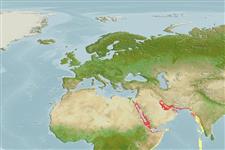
Umwelt: Milieu / Klimazone / Tiefenbereich / Verbreitungsgebiet Ökologie
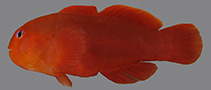
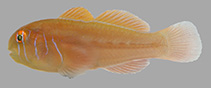
Rückenflossenstacheln (insgesamt) : 6; Rückenflossenweichstrahlen (insgesamt) : 10 - 11; Afterflossenstacheln: 1; Afterflossenweichstrahlen: 8; Wirbelzahl: 26. This species is distinguished by the following characters: D VI+I,10-11; A I,8-9 (usually 9); head and body naked; body slightly compressed and relatively elongate (body depth at pelvic-fin origin 36-40% SL), dorso-ventrally symmetrical; distance between D1 insertion and dorsal insertion of pectoral-fin 53-71% of head length; rounded head with upper lip curved; small mouth, upper jaw extending to anterior margin of the eye; groove between isthmus and interopercle absent; caudal peduncle deep (minimal depth 16.3-17.9% SL); caudal fin relatively short (21.7-23.2% SL). Colour of juveniles and subadults light greenish or reddish with 5 vertical blue lines on head while adults are usually uniformly orange-red or dark red, sometimes with remnants of lines on the head but always with 2 distinct bluish lines through the eyes, sometimes extending ventrally to suborbital area; dorsal and anal fin usually with a narrow light bluish band along bases, fading with growth (Ref. 94082). Body shape (shape guide): short and / or deep; Cross section: compressed.
Facultative air-breathing in the genus (Ref. 126274); Usually occupies the reef slope and fore reef areas and often in large colonies of Acropora samoensis but also present in Acropora secale and A. gemmifera in northern Red Sea (Ref. 94082).
Herler, J., S.V. Bogorodsky and T. Suzuki, 2013. Four new species of coral gobies (Teleostei: Gobiidae: Gobiodon), with comments on their relationships within the genus. Zootaxa 3709(4):301-329. (Ref. 94082)
IUCN Rote Liste Status (Ref. 130435: Version 2025-2)
Bevorzugte Temperatur (Ref. 123201): 24.8 - 29.3, mean 28 °C (based on 172 cells).
Phylogenetischer Diversitätsindex (Ref. 82804): PD50 = 0.5000 [Uniqueness, from 0.5 = low to 2.0 = high].
Bayesian length-weight: a=0.01995 (0.00906 - 0.04395), b=3.01 (2.83 - 3.19), in cm total length, based on all LWR estimates for this body shape (Ref. 93245).
Trophische Ebene (Ref. 69278): 3.3 ±0.4 se; based on size and trophs of closest relatives
Widerstandsfähigkeit (Ref. 120179): hoch, Verdopplung der Population dauert weniger als 15 Monate. (Preliminary K or Fecundity.).
Anfälligkeit der Fischerei (Ref. 59153): Low vulnerability (10 of 100). 🛈