-

- 关于本页
- 语言
- 用户反馈
- 引用出处
- 上传
- 相关物种
-



Nannocharax rubensteini (Jerep & Vari, 2013)
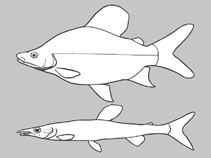
分类 / 名称 俗名 | 同种异名 | Catalog of Fishes(属, 种) | ITIS | CoL | WoRMS | Cloffa
Teleostei > Characiformes (Characins) > Distichodontidae (Distichodus)
Etymology: Nannocharax: Latin, nannus = small + Greek, charax = a marine fish without identification (Ref. 45335); rubensteini: The species name, rubensteini, is in recognition of David Rubenstein who generously funded the Rubenstein Fellowships of the Encyclopedia of Life at the National Museum of Natural History (Ref. 93227).
Eponymy: David Mark Rubenstein (d: 1949) is an American philanthropist who founded the Rubenstein Fellowships of the Encyclopedia of Life at the Smithsonian Institution. [...] (Ref. 128868), visit book page.
Etymology: Nannocharax: Latin, nannus = small + Greek, charax = a marine fish without identification (Ref. 45335); rubensteini: The species name, rubensteini, is in recognition of David Rubenstein who generously funded the Rubenstein Fellowships of the Encyclopedia of Life at the National Museum of Natural History (Ref. 93227).
Eponymy: David Mark Rubenstein (d: 1949) is an American philanthropist who founded the Rubenstein Fellowships of the Encyclopedia of Life at the Smithsonian Institution. [...] (Ref. 128868), visit book page.
环境:氛围 / 气候带 / 深度上下限 / 分布范围 生态学
; 淡水 大洋性.
分布 领土 | FAO区域 | 生态系 | 标本纪录 | 分布图 | 简介 | Faunafri
Africa: Likouala drainage (middle Congo River basin) in Republic of Congo (Ref. 93227).
大小 / 重量 / 年龄
简单描述 检索表 | 型态特徵 | 形态测量图
背棘 (总数) : 0; 臀棘: 0; 脊椎骨: 35 - 37. Diagnosis: Hemigrammocharax rubensteini is distinguished from all congeners, except H. lineostriatus, by the presence of a dark, typically continuous, longitudinal band extending from the posterodorsal margin of the opercle to the dark spot overlying the caudal peduncle, vs. a body pigmentation pattern consisting of several vertical bars in H. angolensis, H. machadoi, H. minutus, H. monardi, H. multifasciatus, and H. wittei or lacking a dark longitudinal band in H. ocellicauda and H. uniocellatus (Ref. 93227). Hemigrammocharax rubensteini differs from H. lineostriatus in having the dorsal-fin origin located anterior to the vertical through the pelvic-fin origin, vs. the dorsal-fin origin located posterior to the vertical through the pelvic-fin insertion; 18 to 30 perforated scales along the lateral line, vs. 6 to 9; and 12 to 14 branched dorsal-fin rays, vs. 9 to 11 (Ref. 93227). Hemigrammocharax rubensteini has a variably discontinuous lateral line which in some instances has only a few unpored scales and thus approximates the completely pored lateral line characteristic of the species of Nannocharax; it differs also from the members of that genus with a continuous dark midlateral longitudinal band both in the incompletely pored lateral line, vs. completely pored; and the lower number of total scales along that series, 35-38 vs. 39 or greater in N. ansorgii, N. latifasciatus, N. lineomaculatus, N. parvus and N. usongo (Ref. 93227).
Body shape (shape guide): elongated; Cross section: compressed.
Body shape (shape guide): elongated; Cross section: compressed.
生命周期和交配行为 成熟度 | 繁殖 | 产卵场 | 卵 | 孕卵数 | 仔鱼
主要参考文献
上传您的参考资料 | 参考文献 | 合作者 | 合作者
Jerep, F.C. and R.P. Vari, 2013. New species of Hemigrammocharax (Characiformes: Distichodontidae) from the Northwestern Congo River Basin. Copeia 2013(1):31-37. (Ref. 93227)
CITES
Not Evaluated
对人类的威胁
人类利用
渔业: 潜在的兴趣
FAO - Publication: search | FishSource |
更多信息
营养生态学
食物(猎物)
食性组成
食物消耗量
口粮
捕食者
食物(猎物)
食性组成
食物消耗量
口粮
捕食者
生态学
生态学
生态学
人口动态
成长参数
最大年龄/尺寸
长度-重量关系
长短关系
体长-频率
质量转换
入添量
丰度
成长参数
最大年龄/尺寸
长度-重量关系
长短关系
体长-频率
质量转换
入添量
丰度
解剖学
鳃区
大脑
耳石
鳃区
大脑
耳石
生理学
身体成分
营养素
耗氧量
游泳类型
游泳速度
视觉色素
鱼声
疾病与寄生虫
毒性(半数致死浓度)
身体成分
营养素
耗氧量
游泳类型
游泳速度
视觉色素
鱼声
疾病与寄生虫
毒性(半数致死浓度)
遗传学
基因组
遗传学
异质性
遗传率
基因多样性
基因组
遗传学
异质性
遗传率
基因多样性
工具
特别资料
下载 XML
网络资源
AFORO (otoliths) | Aquatic Commons | BHL | Cloffa | Websites from users | 核实 FishWatcher | CISTI | Catalog of Fishes: 属, 种 | DiscoverLife | ECOTOX | FAO - Publication: search | Faunafri | Fishipedia | Fishtrace | GloBI | Google Books | Google Scholar | Google | IGFA World Record | OneZoom | Open Tree of Life | Otolith Atlas of Taiwan Fishes | PubMed | Reef Life Survey | Socotra Atlas | TreeBase | 树状分类阶层 | Wikipedia: 转至, 搜寻 | World Records Freshwater Fishing | 动物学的记录
基于模型的估算
系统发育多样性指数 (参考文献 82804): PD50 = 0.5000 [Uniqueness, from 0.5 = low to 2.0 = high].
Bayesian length-weight: a=0.00447 (0.00189 - 0.01058), b=3.17 (2.96 - 3.38), in cm total length, based on LWR estimates for this (Sub)family-body shape (Ref. 93245).
营养阶层 (参考文献 69278): 3.1 ±0.4 se; based on size and trophs of closest relatives