-

- Over deze pagina
- Talen
- Feedback van gebruikers
- Citatie
- Uploads
- Verwante soorten
-



Hoplostethus melanopeza Roberts & Gomon, 2012
New Zealand giant sawbelly
Waarneming toevoegen in Fish Watcher
| Native range | All suitable habitat | Point map | Year 2050 |

|
| This map was computer-generated and has not yet been reviewed. |
| Hoplostethus melanopeza AquaMaps Data sources: GBIF OBIS |
Uploaden van uw Foto's en video's
Google afbeelding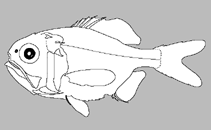 No image available for this species;
drawing shows typical species in Trachichthyidae.
Google afbeelding
drawing shows typical species in Trachichthyidae.
Classificatie / Namen Lokale namen | Synoniemen | Catalog of Fishes(Genus, Soort(en)) | ITIS | CoL | WoRMS | Cloffa
> Trachichthyiformes (Roughies) > Trachichthyidae (Slimeheads)
Etymology: Hoplostethus: Greek, hoplon = weapon + Greek, stetho, stethion = brest; literal = to prick a little breast (Ref. 45335); melanopeza: Name from Greek 'melano' for ‘black’ and 'peza‘ for 'edge’; referring to the characteristic black edge on all fins in large individuals of this species; noun in apposition.
Etymology: Hoplostethus: Greek, hoplon = weapon + Greek, stetho, stethion = brest; literal = to prick a little breast (Ref. 45335); melanopeza: Name from Greek 'melano' for ‘black’ and 'peza‘ for 'edge’; referring to the characteristic black edge on all fins in large individuals of this species; noun in apposition.
Milieu: milieu / Klimaatzone / Diepte / verspreidingsgebied Ecologie
Verspreiding Gebieden | FAO regio's | Ecosystemen | Voorkomen | Verspreidingskaart | Introducties | Faunafri
South Pacific: sub-tropical and temperate latitudes of the Tasman and South Fiji Basins; SE Australian slopes on the west to the outer Bay of Plenty and southern Kermadec Ridge at the north end of the North Island in New Zealand in the east.
Grootte / Gewicht / Leeftijd
Korte beschrijving Determinatiesleutels | Morfologie | Morfometrie
Dorsale stekels (totaal) : 6 - 7; Dorsale zachte stralen (totaal) : 12 - 13; Anale stekels: 3; Anale zachte stralen: 3 - 10. This species is distinguished by the following characters: 15 pectoral-fin rays, rarely 13, 14 or 16; 18-21 total gill rakers on outer side of first arch; 9-12 abdominal scutes, some scutes in large individuals with multiple apical points; 16-22 predorsal scales; isthmus lacking scales; body scales adherent; lateral–line scales with strong medial ridge, but no spine in small and medium sized adults, with strong spine centrally on posterior margin in large adults; scales on predorsal midline forming low raised ridge; body ovoid and deep, depth 1.9-2.1 in SL; nape gently curved, forehead almost straight to above upper lip; dorsal- and anal-fin spines of moderate thickness; body of adults grey, superimposed with deep red in life, outer margin of all fins with narrow black edge in adults; buccal cavity and opercular recess black, vomer, margins of mouth roof lateral to palatines, underside of tongue and upper surface of lower jaw stark white (Ref. 92805).
Body shape (shape guide): short and / or deep; Cross section: compressed.
Body shape (shape guide): short and / or deep; Cross section: compressed.
Inhabits continental slopes, seamounts and submarine rises with collection depths recorded between about 140 and 760 m, but most often 250-400 m (Ref. 92805).
Levenscyclus en paargedrag Maturiteit | Voortplanting | Paaien | Eieren | Fecunditeit | Larven
Hoofdreferentie
Upload uw referenties | Referenties | Coördinator : Moore, Jon A. | Medewerkers
Roberts, C.D. and M.F. Gomon, 2012. A review of giant roughies of the genus Hoplostethus (Beryciformes, Trachichthyidae), with descriptions of two new Australasian species. Memoirs of Museum Victoria 69:341-354. (Ref. 92805)
CITES
Not Evaluated
Gevaar voor de mens
Harmless
Gebruik door de mens
FAO - Publication: search | FishSource |
Meer informatie
Trofische ecologie
Voedsel (prooien)
Dieetsamenstelling
Voedselconsumptie
Voedselrantsoenen
Predatoren
Voedsel (prooien)
Dieetsamenstelling
Voedselconsumptie
Voedselrantsoenen
Predatoren
Ecologie
Ecologie
Ecologie
Populatiedynamica
Groeiparameters
Max. leeftijden / maten
Lengte-gewicht rel.
Lengte-lengte rel.
Lengtefrequenties
Massaconversie
Rekrutering
Abundantie
Groeiparameters
Max. leeftijden / maten
Lengte-gewicht rel.
Lengte-lengte rel.
Lengtefrequenties
Massaconversie
Rekrutering
Abundantie
Levenscyclus
Voortplanting
Maturiteit
Rijpheid/kieuwen rel.
Fecunditeit
Paaien
Paaibestanden
Eieren
Ontwikkeling van de eieren
Larven
Larvale populatiedynamiek
Voortplanting
Maturiteit
Rijpheid/kieuwen rel.
Fecunditeit
Paaien
Paaibestanden
Eieren
Ontwikkeling van de eieren
Larven
Larvale populatiedynamiek
Anatomie
Kieuwoppervlak
Hersenen
Otoliet
Kieuwoppervlak
Hersenen
Otoliet
Fysiologie
Lichaamssamenstelling
Voedingsstoffen
Zuurstofverbruik
Type zwemmen
Zwemsnelheid
Visuele pigmenten
Vis geluid
Ziekten en parasieten
Toxiciteit (LC50)
Lichaamssamenstelling
Voedingsstoffen
Zuurstofverbruik
Type zwemmen
Zwemsnelheid
Visuele pigmenten
Vis geluid
Ziekten en parasieten
Toxiciteit (LC50)
Genetica
genoom
Genetica
Heterozygositeit
Erfelijkheid
Genetische diversiteit
genoom
Genetica
Heterozygositeit
Erfelijkheid
Genetische diversiteit
Menselijk gerelateerd
Aquacultuursystemen
Aquacultuurprofielen
Kweeklijnen
Ciguatera gevallen
Postzegels, munten, diversen.
Aquacultuursystemen
Aquacultuurprofielen
Kweeklijnen
Ciguatera gevallen
Postzegels, munten, diversen.
Tools
Speciale rapporten
Bekijk gegevens voor het houden in een aquarium | Bekijk Fact Sheets voor de soort | Bekijk Aquacultuur Fact Sheets
Download XML
Internetbronnen
AFORO (otoliths) | Aquatic Commons | BHL | Cloffa | Websites from users | Bekijk FishWatcher | CISTI | Catalog of Fishes: Genus, Soort(en) | DiscoverLife | ECOTOX | FAO - Publication: search | Faunafri | Fishipedia | Fishtrace | GloBI | Google Books | Google Scholar | Google | IGFA World Record | OneZoom | Open Tree of Life | Otolith Atlas of Taiwan Fishes | PubMed | Reef Life Survey | Socotra Atlas | TreeBase | Tree of Life | Wikipedia: ga naar, zoek | World Records Freshwater Fishing | Zoobank | Zoological Record
Schattingen op basis van modellen
Gewenste temperatuur (Ref. 123201): 4.3 - 9.7, mean 5.4 °C (based on 46 cells).
Fylogenetische diversiteitsindex (Ref. 82804): PD50 = 0.5000 [Uniqueness, from 0.5 = low to 2.0 = high].
Bayesian length-weight: a=0.01660 (0.00714 - 0.03859), b=3.05 (2.85 - 3.25), in cm total length, based on LWR estimates for this (Sub)family-body shape (Ref. 93245).
Trofisch niveau (Ref. 69278): 3.7 ±0.6 se; based on size and trophs of closest relatives
Weerstandsvermogen (Ref. 120179): Zeer laag, minimale populatieverdubbelingstijd meer dan 14 jaar (Preliminary K or Fecundity.).