-

- Om denna sida
- Språk
- Återkoppling från användare
- Referens
- Uppladdningar
-
Relaterade arter
- Arter i
Chimarrichthys - Arter i
Sisoridae - - Klassificering -
- Glyptosterninae
- Sisoridae
- Siluriformes
- Teleostei
- Chordata
- Animalia
- Arter i
-



Chimarrichthys longus (Zhou, Li & Thomson, 2011)
Ladda upp din foton och Videor
Google image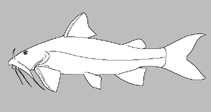 No image available for this species;
drawing shows typical species in Sisoridae.
Google image
drawing shows typical species in Sisoridae.
Klassificering / Namn Populärnamn | synonymer | Catalog of Fishes(Släkte, Arter) | ITIS | CoL | WoRMS | Cloffa
> Siluriformes (Catfishes) > Sisoridae (Sisorid catfishes) > Glyptosterninae
Etymology: longus: From the Latin adjective longus, meaning long, referring to the long body and long caudal peduncle (Ref. 86867).
Etymology: longus: From the Latin adjective longus, meaning long, referring to the long body and long caudal peduncle (Ref. 86867).
Miljö: miljö / Klimatzon / djupintervall / distributionsområde Ekologi
; sötvatten bentopelagisk. Subtropical; 25°N - 24°N, 100°E - 101°E
Utbredning Territorier | FAO områden | Ekosystem | Förekomster | Prickkarta | Utplanteringar | Faunafri
Asia: China. Known only from the Lixian-Jiang, the upper Black River (Song Da), a tributary of Red River (Ref. 86867).
Storlek / Vikt / Ålder
Kort beskrivning Bestämningsnycklar | Morfologi | Morfometri
Euchiloglanis longus differs from E. longibarbatus by having a pointed maxillary barbel, not elongated as a thread, with the tip only reaching to the gill opening (vs. the maxillary barbel elongated as a thread, with the tip reaching beyond the gill opening. Euchiloglanis longus differs from E. kishinouyei and E. longibarbatus by having one median indentation in the premaxillary tooth band (vs. indentations absent in E. kishinouyei, and E. longibarbatus with three indentations in the premaxillary tooth band, one in the middle and two on the sides. Euchiloglanis longus differs from E. davidi by having the length of the pectoral fin equal to 78.4–89.5% (vs. 90.5–117.1%) of the distance between the insertions of the pectoral and pelvic fins and from E. kishinouyei and E. longibarbatus by having the distance between the insertion of the pelvic fin and the anus equal to 108.9–140.6% (vs. 81.5–97.5 and 75.5–92.2%, respectively) of the distance between the insertions of the pectoral and pelvic fins. Euchiloglanis longus differs from E. davidi, E. kishinouyei and E. longibarbatus by having the depth of the caudal peduncle equal to 14.1–27.0% of the caudal-peduncle length (vs. 29.3–46.2, 28.2–34.3, and 26.8–44.5%, respectively). Euchiloglanis longus differs from E. dorsoarcus by having the anal-fin origin closer to the caudal-fin base than to the pelvic-fin origin (vs. the anal-fin origin closer to the pelvic-fin origin than to the caudal-fin base), and from E. phongthoensis by having the distance from the adipose-fin origin to the dorsal-fin insertion about 50% of the length of the adipose-fin base (vs. equal to the length of the adipose-fin base) (Ref. 86867).
Body shape (shape guide): elongated.
Body shape (shape guide): elongated.
Livscykel och parningsbeteende Könsmognad | Reproduktion | Lek | Ägg | Fekunditet | Larver
Huvudreferens
Ladda upp dina referenser | referenser | Koordinator | Medarbetare
Zhou, W., X. Li and A.W. Thomson, 2011. Two new species of the Glyptosternine catfish genus Euchiloglanis (Teleostei: Sisoridae) from southwest China with redescriptions of E. davidi and E. kishinouyei. Zootaxa 2871:1-18. (Ref. 86867)
CITES
Not Evaluated
Hot mot människor
Harmless
Mänskliga användningsområden
FAO - Publication: search | FishSource |
Ytterligare information
Trofisk ekologi
Livsmedelsartiklar (preys)
Födosammansättning
Födointag
Matransoner
Predatorer
Livsmedelsartiklar (preys)
Födosammansättning
Födointag
Matransoner
Predatorer
Populationsdynamik
Tillväxtparametrar
Max. åldrar / storlekar
Längd-vikt rel.
Längd-längd rel.
Längd-frekvenser
Massakonvertering
Rekrytering
Abundans
Tillväxtparametrar
Max. åldrar / storlekar
Längd-vikt rel.
Längd-längd rel.
Längd-frekvenser
Massakonvertering
Rekrytering
Abundans
Livscykel
Reproduktion
Könsmognad
Mognad/Gills rel.
Fekunditet
Lek
Lekande aggregat
Ägg
Utveckling av ägg
Larver
Larvdynamik
Reproduktion
Könsmognad
Mognad/Gills rel.
Fekunditet
Lek
Lekande aggregat
Ägg
Utveckling av ägg
Larver
Larvdynamik
Anatomi
Gälyta
Hjärna
Otolit
Gälyta
Hjärna
Otolit
Fysiologi
Kroppssammansättning
Näringsämnen
Syreförbrukning
Typ av simning
Simhastighet
Visuella pigment
Ljud från fisk
Sjukdomar & Parasiter
Toxicitet (LC50)
Kroppssammansättning
Näringsämnen
Syreförbrukning
Typ av simning
Simhastighet
Visuella pigment
Ljud från fisk
Sjukdomar & Parasiter
Toxicitet (LC50)
Genetik
Genom
Genetik
Heterozygositet
Ärftlighet
Genetisk mångfald
Genom
Genetik
Heterozygositet
Ärftlighet
Genetisk mångfald
Människorelaterad
Vattenbrukssystem
Vattenbruksprofiler
Avelslinjer
Ciguatera-fall
Frimärken, mynt, diverse.
Vattenbrukssystem
Vattenbruksprofiler
Avelslinjer
Ciguatera-fall
Frimärken, mynt, diverse.
Verktyg
Särskilda rapporter
Kontrollera för underhåll av akvarium | Kontrollera om det finns faktablad om arter | Kontrollera om det finns faktablad om vattenbruk
Ladda ner XML
Internet-källor
AFORO (otoliths) | Aquatic Commons | BHL | Cloffa | Websites from users | Check FishWatcher | CISTI | Catalog of Fishes: Släkte, Arter | DiscoverLife | ECOTOX | FAO - Publication: search | Faunafri | Fishipedia | Fishtrace | GloBI | Google Books | Google Scholar | Google | IGFA World Record | OneZoom | Open Tree of Life | Otolith Atlas of Taiwan Fishes | PubMed | Reef Life Survey | Socotra Atlas | TreeBase | Tree of Life | Wikipedia: Go, sök | World Records Freshwater Fishing | Zoologiskt register
Uppskattningar baserade på modeller
Index för fylogenetisk mångfald (Ref. 82804): PD50 = 1.0000 [Uniqueness, from 0.5 = low to 2.0 = high].
Bayesian length-weight: a=0.00589 (0.00264 - 0.01315), b=3.08 (2.88 - 3.28), in cm total length, based on LWR estimates for this (Sub)family-body shape (Ref. 93245).
Trofisk nivå (Ref. 69278): 3.2 ±0.4 se; based on size and trophs of closest relatives
Resiliens (Ref. 120179): Mellan, lägsta populationsfördubblingstid 1,4-4,4 år (Preliminary K or Fecundity.).