-

- À propos de cette page
- Langues
- Commentaires des utilisateurs
- Citation
- Téléchargements
- Espèces associées
-



Ajouter votre observation dans Fish Watcher
| Native range | All suitable habitat | Point map | Year 2050 |

|
| This map was computer-generated and has not yet been reviewed. |
| Cruriraja hulleyi AquaMaps Data sources: GBIF OBIS |
Envoyez vos Photos et vidéos
Images Google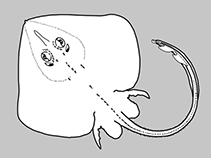 No image available for this species;
drawing shows typical species in Gurgesiellidae.
Images Google
drawing shows typical species in Gurgesiellidae.
Classification / Noms Noms communs | Synonymes | Catalog of Fishes(Genre, Espèce) | ITIS | CoL | WoRMS | Cloffa
Élasmobranches (requins et raies) (sharks and rays) > Rajiformes (Skates and rays) > Gurgesiellidae (Pygmy skates)
Etymology: Cruriraja: Latin, crur, cruris = pertaining to a leg + Latin, raja = a ray (Raja sp) (Ref. 45335); hulleyi: Named for P.A. ‘‘Butch’’ Hulley, for his pioneering research on southern African skates.
Eponymy: Dr Percy Alexander ‘Butch’ Hulley (d: 1941) is a South African zoologist and ichthyologist. [...] (Ref. 128868), visit book page.
Etymology: Cruriraja: Latin, crur, cruris = pertaining to a leg + Latin, raja = a ray (Raja sp) (Ref. 45335); hulleyi: Named for P.A. ‘‘Butch’’ Hulley, for his pioneering research on southern African skates.
Eponymy: Dr Percy Alexander ‘Butch’ Hulley (d: 1941) is a South African zoologist and ichthyologist. [...] (Ref. 128868), visit book page.
Environnement : milieu / zone climatique / profondeur / gamme de distribution Écologie
marin benthopélagique; profondeur 39 - 545 m (Ref. 85323), usually 200 - 500 m (Ref. 85323). Subtropical
Distribution Territoires | Zones FAO | Écosystèmes | Occurrences | Carte par point | Introductions | Faunafri
Southeast Atlantic: Lüderitz, Namibia to Algoa (and possibly East London) on the Eastern Cape coast of South Africa.
Taille / Poids / Âge
Maturité: Lm ? range ? - ? cm
Max length : 58.0 cm TL mâle / non sexé; (Ref. 85323); 59.4 cm TL (female)
Max length : 58.0 cm TL mâle / non sexé; (Ref. 85323); 59.4 cm TL (female)
Description synthétique Clés d'identification | Morphologie | Morphométrie
This species is distinct from its congeners in having the following characters: spatulate distal ends of the anterior pelvic lobes (wider tip in C. cadenati, tapering in others); dorsal mid-disk and tail with continuous semiparallel rows of thorns in adults (no thorns on mid-disk in C. rugosa, present on midline in others); claspers with small, flattened process (boss) on accessory terminal 2 cartilage and blind-ended sac with posterior opening at the distal end of the clasper (sentina), both unique within genus to C. hulleyi; interdorsal thorns 6 (none in C. durbanensis, 2 in C. parcomaculata, 4 in C. poeyi, 1 in C. rugosa, many in C. atlantis). This species is further distinguished from its congeners by the following set of characters: interdorsal distance greater than half, and not exceeding, dorsal-fin base length (vs. at least 1.5 times dorsal-fin base length in C. atlantis, half or less dorsal-fin base length in C. parcomaculata); outer lateral margin of clasper dorsal marginal cartilage elongated and bluntly rounded (truncate in C. rugosa); proximal margin of dorsal terminal I cartilage forms a point (a series of points in C. rugosa); distal point (eperon) of ventral terminal cartilage relatively narrow and claw-like (bifurcate in C. parcomaculata, expanded in C. rugosa); ventral surface of clasper without dermal denticles (present in C. parcomaculata) (Ref. .85323).
Body shape (shape guide): other.
Body shape (shape guide): other.
Reported to be a moderately common species of the outer shelf and upper continental slope, 39-545 m deep, but most common between 200 and 500 depth. Larger individuals tend to occur on the west coast of southern Africa, while those on the south coast are slightly smaller. The egg case was described to be small, vase-like, measuring less than 50 mm long excluding horns, surface coarsely striated, and with very narrow lateral keels, <1% of maximum egg case width; its posterior horns are approximately 45% longer than the anterior horns, tapering to thin tips, curving inwards and with fine attachment fibers; the anterior horns are hook-shaped, with acute tips (Ref. 85323).
Cycle de vie et comportement reproducteur Maturité | Reproduction | Frai | Œufs | Fécondité | Larves
Référence principale
Téléchargez vos références | Références | Coordinateur | Collaborateurs
Aschliman, N.C., D.A. Ebert and L.J.V. Compagno, 2010. A new legskate (Rajoidei: Genus Cruriraja) from Southern Africa. Copeia 2010(3):364-372. (Ref. 85323)
Statut dans la liste rouge de l'IUCN (Ref. 130435: Version 2025-2)
Préoccupation mineure (LC) ; Date assessed: 24 April 2018
CITES
Not Evaluated
Menace pour l'homme
Harmless
Utilisations par l'homme
FAO - Publication: search | FishSource |
Plus d'informations
Écologie trophique
Aliments (proies)
Composition du régime alimentaire
Consommation alimentaire
Rations alimentaires
Prédateurs
Aliments (proies)
Composition du régime alimentaire
Consommation alimentaire
Rations alimentaires
Prédateurs
Écologie
Écologie
Écologie
Dynamique des populations
Paramètres de croissance
Âges / tailles maximales
Longueur-poids rel.
Rel. longueur-longueur.
Fréquences de longueurs
Conversion de masse
Recrutement
Abondance
Paramètres de croissance
Âges / tailles maximales
Longueur-poids rel.
Rel. longueur-longueur.
Fréquences de longueurs
Conversion de masse
Recrutement
Abondance
Cycle de vie
Reproduction
Maturité
Maturité/épines rel.
Fécondité
Frai
Agrégats de frai
Œufs
Développement de l'œuf
Larves
Dynamique des populations larvaires
Reproduction
Maturité
Maturité/épines rel.
Fécondité
Frai
Agrégats de frai
Œufs
Développement de l'œuf
Larves
Dynamique des populations larvaires
Anatomie
Surface branchiale
Cerveau
Otolithe
Surface branchiale
Cerveau
Otolithe
Physiologie
Composition corporelle
Nutriments
Consommation d'oxygène
Type de natation
Vitesse de nage
Pigments visuels
Son de poisson
Maladies et parasites
Toxicité (CL50)
Composition corporelle
Nutriments
Consommation d'oxygène
Type de natation
Vitesse de nage
Pigments visuels
Son de poisson
Maladies et parasites
Toxicité (CL50)
Génétique
génôme
Génétique
Hétérozygotie
Héritabilité
Diversité génétique
génôme
Génétique
Hétérozygotie
Héritabilité
Diversité génétique
Liées à l'homme
Systèmes d'aquaculture
Profils d'aquaculture
Souches
Cas de ciguatera
Timbres, pièces de monnaie, divers
Systèmes d'aquaculture
Profils d'aquaculture
Souches
Cas de ciguatera
Timbres, pièces de monnaie, divers
Outils
E-book | Guide de terrain | Générateur de fréquences de longueur | Outil de dynamique de population | Carte par point |
Capture-MSY |
Articles particuliers
Télécharger en XML
Sources Internet
AFORO (otoliths) | Aquatic Commons | BHL | Cloffa | Websites from users | FishWatcher | CISTI | Catalog of Fishes: Genre, Espèce | DiscoverLife | ECOTOX | FAO - Publication: search | Faunafri | Fishipedia | Fishtrace | GloBI | Google Books | Google Scholar | Google | IGFA World Record | OneZoom | Open Tree of Life | Otolith Atlas of Taiwan Fishes | PubMed | Reef Life Survey | Socotra Atlas | TreeBase | Arbre de Vie | Wikipedia: aller à, chercher | World Records Freshwater Fishing | Zoobank | Zoological Record
Estimations basées sur des modèles
Température préférée (Réf. 123201): 6.7 - 14, mean 9.5 °C (based on 54 cells).
Indice de diversité phylogénétique (Réf. 82804): PD50 = 0.5039 [Uniqueness, from 0.5 = low to 2.0 = high].
Bayesian length-weight: a=0.00661 (0.00222 - 0.01969), b=2.95 (2.71 - 3.19), in cm total length, based on LWR estimates for this (Sub)family-body shape (Ref. 93245).
Niveau trophique (Réf. 69278): 3.9 ±0.6 se; based on size and trophs of closest relatives