This website uses cookies to enhance your browsing experience and ensure the functionality of our site. For more detailed information about the types of cookies we use and how we protect your privacy, please visit our Privacy Information page.
×
Cookie Settings
This website uses different types of cookies to enhance your experience. Please select your preferences below:
> Gobiiformes (Gobies) > Gobiidae (Gobies) > Gobiinae
Etymology: Ancistrogobius:Name from Greek word 'agkistros' meaning fishhook and Gobius , a genus name of gobiine fish, in reference to the short, ventrally directed, spur-like preopercular spine; yanoi:Named for K.Yano, who provided several type specimens and habitat information for all the new species of Ancistrogobius. Eponymy: Korechika Yano is a diving instructor and underwater photographer at the Dive Service YANO, Iriomote Island, Japan. [...] (Ref. 128868), visit book page.
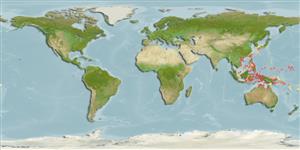
Milieu: milieu / Klimaatzone / Diepte / verspreidingsgebied Ecologie
marien benthopelagisch; diepte 0 - 12 m (Ref. 84001). Tropical
Dorsale stekels (totaal) : 7; Dorsale zachte stralen (totaal) : 10; Anale stekels: 1; Anale zachte stralen: 9. This species differs from its congeners in having the following set of characters: no scales on head and most of nape (no predorsal scales); third spine of first dorsal fin elongate and filamentous, obviously longer than preceding spine (at least in specimens that are more than 21 mm SL), with alternating pale and dusky pattern in life or when fresh (typically faded and indistinct in preserved specimens, but its distal tip tinged with black); 17-19 (usually 18 or 19) pectoral-fin rays 1; pelvic fins fused medially by well developed connecting membrane and frenum (frenum often rudimentary); fifth segmented ray of pelvic fin 89.9-100.0% of preceding ray in length; faint, dusky blotches below eye (not forming a distinct vertical bar); distal tip of first dorsal fin with a black blotch, relatively wide, extending posteriorly to just behind third spine (but not to middle of third interspinal membrane); sensory papilla rows x^1 and x^2 not continuous (interrupted by row trp); sensory papilla rows trp extending dorsally to slightly above a longitudinal line through rows x^1 + x^2; anterior tip of sensory papilla row b closed to, or attaching with, row 4 and well apart from row 3; row d typically extending posteriorly to well beyond ventral end of row 6i (Ref. 84001). Body shape (shape guide): elongated; Cross section: oval.
Collected from sandy-mud bottoms at depths of 0-12 m (Ref. 84001).
Shibukawa, K., T. Yoshino and G.R. Allen, 2010. Ancistrogobius, a new cheek-spine goby genus from the West Pacific and Red Sea, with descriptions of four new species (Perciformes: Gobiidae: Gobiinae). Bull. Natl. Mus. Nat. Sci., Ser. A, (Suppl. 4):67-87. (Ref. 84001)
Status op de Rode Lijst van het IUCN (Ref. 130435: Version 2025-2)
Gewenste temperatuur (Ref. 123201): 26.7 - 29.4, mean 28.8 °C (based on 1104 cells).
Fylogenetische diversiteitsindex (Ref. 82804): PD50 = 0.5625 [Uniqueness, from 0.5 = low to 2.0 = high].
Bayesian length-weight: a=0.00724 (0.00339 - 0.01546), b=3.10 (2.92 - 3.28), in cm total length, based on LWR estimates for this (Sub)family-body shape (Ref. 93245).
Trofisch niveau (Ref. 69278): 3.2 ±0.3 se; based on size and trophs of closest relatives
Kwetsbaarheid van de visserij (Ref. 59153): Low vulnerability (10 of 100). 🛈