-

- À propos de cette page
- Langues
- Commentaires des utilisateurs
- Citation
- Téléchargements
-
Espèces associées
- Espèces pour
Polydactylus - Espèces pour
Polynemidae - - Classification -
- Polynemidae
- Carangaria/misc
- Teleostei
- Chordata
- Animalia
- Espèces pour
-



Polydactylus luparensis Lim, Motomura & Gambang, 2010
Sarawak Giant Threadfin
Envoyez vos Photos et vidéos
Images | Images Google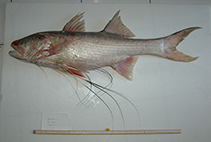 Polydactylus luparensis
Photo de Lim, A.P.K.
Images | Images Google
Photo de Lim, A.P.K.
Classification / Noms Noms communs | Synonymes | Catalog of Fishes(Genre, Espèce) | ITIS | CoL | WoRMS | Cloffa
> Carangaria/misc (Various families in series Carangaria) > Polynemidae (Threadfins)
Etymology: Polydactylus: Greek, poly = a lot of + greek, daktylos = finger (Ref. 45335); luparensis: The specific name luparensis is based on the Batang Lupar River in reference to the holotype locality. Local name of this species is Gemian.
Etymology: Polydactylus: Greek, poly = a lot of + greek, daktylos = finger (Ref. 45335); luparensis: The specific name luparensis is based on the Batang Lupar River in reference to the holotype locality. Local name of this species is Gemian.
Environnement : milieu / zone climatique / profondeur / gamme de distribution Écologie
; eau douce pélagique; profondeur 3 - 5 m (Ref. 83753). Tropical; 2°N - 1°N, 111°E - 112°E
Distribution Territoires | Zones FAO | Écosystèmes | Occurrences | Carte par point | Introductions | Faunafri
Asia: Malaysia, Borneo. Currently known only from the mouth of the Batang Lupar River, Borneo, Malaysia (Ref. 83753).
Taille / Poids / Âge
Description synthétique Clés d'identification | Morphologie | Morphométrie
Épines dorsales (Total) : 9; Rayons mous dorsaux (Total) : 13; Épines anales: 3; Rayons mous anaux: 11. A species of Polydactylus that differs from all of its congeners by the following combination of characters: 8 dorsal-fin spines, first spine tiny, second spine very strong (its width more than 5 times of width of remaining spines); 13 second dorsal-fin soft rays; 11 anal-fin soft rays; 12 pectoral-fin rays, its length 22–24% (mean 23%) of SL, posterior tip not reaching a vertical through posterior tip of depressed pelvic fin; 6 pectoral filaments, fourth or fifth filament longest, its length 77–85% (mean 81%) of SL, posterior tip extending slightly beyond caudal-fin base; pored lateral-lined scales 67–75 (mean 71); lateral line unbranched, extending onto upper end of lower caudal-fin lobe; 6 scale rows above lateral line, 8 below; 14 gill rakers on upper limb, 18 on lower limb, 32 in total; occipital profile concave; posterior margin of maxilla extending considerably beyond a vertical through posterior margin of adipose eyelid; depth of posterior margin of maxilla 4–5% (mean 5%) of SL, greater than orbit diameter; well-developed swimbladder present; basal half of third to sixth pectoral filament white, becoming black distally. Polydactylus luparensis can be easily distinguished from all Indo-Pacific congeners by having the black distal half of the third to sixth pectoral filaments (whitish in the latter). Only two other taxa, Polynemus melanochir dulcis Motomura & Sabaj, 2002 and P. melanochir melanochir Valenciennes in Cuvier & Valenciennes, 1831, in the family Polynemidae have the black pectoral filaments (Motomura & Sabaj, 2002; Motomura, 2004b) (Ref. 83753).
Inhabiting turbid brackish water. The species is abundant in the river mouth especially from June to August and mainly caught by gill nets. Juveniles have also been observed in the same place (local fishermen, pers. comm.) (Ref. 83753).
Cycle de vie et comportement reproducteur Maturité | Reproduction | Frai | Œufs | Fécondité | Larves
Référence principale
Téléchargez vos références | Références | Coordinateur | Collaborateurs
Lim, P.K.A., H. Motomura and A.C. Gambang, 2010. Polydactylus luparensis, a new species of threadfin (Perciformes: Polynemidae) from the Batang Lupar River, Sarawak, Borneo, Malaysia. Zootaxa 2405:63-68. (Ref. 83753)
Statut dans la liste rouge de l'IUCN (Ref. 130435: Version 2025-2)
Données manquantes (DD) ; Date assessed: 21 June 2018
CITES
Not Evaluated
Menace pour l'homme
Harmless
Utilisations par l'homme
FAO - Publication: search | FishSource |
Plus d'informations
Écologie trophique
Aliments (proies)
Composition du régime alimentaire
Consommation alimentaire
Rations alimentaires
Prédateurs
Aliments (proies)
Composition du régime alimentaire
Consommation alimentaire
Rations alimentaires
Prédateurs
Écologie
Écologie
Écologie
Dynamique des populations
Paramètres de croissance
Âges / tailles maximales
Longueur-poids rel.
Rel. longueur-longueur.
Fréquences de longueurs
Conversion de masse
Recrutement
Abondance
Paramètres de croissance
Âges / tailles maximales
Longueur-poids rel.
Rel. longueur-longueur.
Fréquences de longueurs
Conversion de masse
Recrutement
Abondance
Cycle de vie
Reproduction
Maturité
Maturité/épines rel.
Fécondité
Frai
Agrégats de frai
Œufs
Développement de l'œuf
Larves
Dynamique des populations larvaires
Reproduction
Maturité
Maturité/épines rel.
Fécondité
Frai
Agrégats de frai
Œufs
Développement de l'œuf
Larves
Dynamique des populations larvaires
Anatomie
Surface branchiale
Cerveau
Otolithe
Surface branchiale
Cerveau
Otolithe
Physiologie
Composition corporelle
Nutriments
Consommation d'oxygène
Type de natation
Vitesse de nage
Pigments visuels
Son de poisson
Maladies et parasites
Toxicité (CL50)
Composition corporelle
Nutriments
Consommation d'oxygène
Type de natation
Vitesse de nage
Pigments visuels
Son de poisson
Maladies et parasites
Toxicité (CL50)
Génétique
génôme
Génétique
Hétérozygotie
Héritabilité
Diversité génétique
génôme
Génétique
Hétérozygotie
Héritabilité
Diversité génétique
Liées à l'homme
Systèmes d'aquaculture
Profils d'aquaculture
Souches
Cas de ciguatera
Timbres, pièces de monnaie, divers
Systèmes d'aquaculture
Profils d'aquaculture
Souches
Cas de ciguatera
Timbres, pièces de monnaie, divers
Outils
E-book | Guide de terrain | Générateur de fréquences de longueur | Outil de dynamique de population | Carte par point |
Capture-MSY |
Articles particuliers
Télécharger en XML
Sources Internet
AFORO (otoliths) | Aquatic Commons | BHL | Cloffa | Websites from users | FishWatcher | CISTI | Catalog of Fishes: Genre, Espèce | DiscoverLife | ECOTOX | FAO - Publication: search | Faunafri | Fishipedia | Fishtrace | GloBI | Google Books | Google Scholar | Google | IGFA World Record | OneZoom | Open Tree of Life | Otolith Atlas of Taiwan Fishes | PubMed | Reef Life Survey | Socotra Atlas | TreeBase | Arbre de Vie | Wikipedia: aller à, chercher | World Records Freshwater Fishing | Zoobank | Zoological Record
Estimations basées sur des modèles
Indice de diversité phylogénétique (Réf. 82804): PD50 = 0.5000 [Uniqueness, from 0.5 = low to 2.0 = high].
Bayesian length-weight: a=0.00562 (0.00268 - 0.01179), b=3.06 (2.87 - 3.25), in cm total length, based on LWR estimates for this (Sub)family-body shape (Ref. 93245).
Niveau trophique (Réf. 69278): 3.8 ±0.5 se; based on size and trophs of closest relatives
Résilience (Réf. 120179): Milieu, temps minimum de doublement de population : 1,4 à 4,4 années (Preliminary K or Fecundity.).