-

- Over deze pagina
- Talen
- Feedback van gebruikers
- Citatie
- Uploads
- Verwante soorten
-



Alionematichthys crassiceps Møller & Schwarzhans, 2008
Bighead viviparous brotula
Waarneming toevoegen in Fish Watcher
| Native range | All suitable habitat | Point map | Year 2050 |

|
| This map was computer-generated and has not yet been reviewed. |
| Alionematichthys crassiceps AquaMaps Data sources: GBIF OBIS |
Uploaden van uw Foto's en video's
Afbeeldingen | Google afbeelding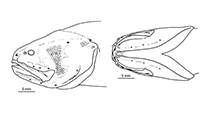 Alionematichthys crassiceps
Male Afbeelding van W. Schwarzhans & P. R. Møller
Afbeeldingen | Google afbeelding
Male Afbeelding van W. Schwarzhans & P. R. Møller
Classificatie / Namen Lokale namen | Synoniemen | Catalog of Fishes(Genus, Soort(en)) | ITIS | CoL | WoRMS | Cloffa
> Ophidiiformes (Cusk eels) > Dinematichthyidae (Viviparous brotula)
Etymology: Alionematichthys: Name from Latin alius meaning the other or different, and nematichthys, the stem of the genus name Dinematichthys, to which this genus is most similar; crassiceps: Named for the characteristic big head (Latin crassus for thick and the adjective ending derived from caput or head; noun in apposition.
More on authors: Møller & Schwarzhans.
Etymology: Alionematichthys: Name from Latin alius meaning the other or different, and nematichthys, the stem of the genus name Dinematichthys, to which this genus is most similar; crassiceps: Named for the characteristic big head (Latin crassus for thick and the adjective ending derived from caput or head; noun in apposition.
More on authors: Møller & Schwarzhans.
Milieu: milieu / Klimaatzone / Diepte / verspreidingsgebied Ecologie
marien rifbewoner; diepte 0 - 5 m (Ref. 90102). Tropical
Verspreiding Gebieden | FAO regio's | Ecosystemen | Voorkomen | Verspreidingskaart | Introducties | Faunafri
Eastern Indian Ocean: Western Australia (Ref. 88966). Western Pacific: along oceanic islands, from Micronesia (Palau, Chuuk, Pohnpei, Kapingamarangi Atoll), Hermit I., and the Kiriwina (Trobriand) Is., New Guinea, Vanuatu, Fiji to Tonga. Probable records from Taiwan (NW Pacific).
Grootte / Gewicht / Leeftijd
Korte beschrijving Determinatiesleutels | Morfologie | Morfometrie
Dorsale zachte stralen (totaal) : 72 - 81; Anale zachte stralen: 57 - 64; Wervels: 41 - 43. This species is distinguished by the following characters: ; D 72-81; A 57-64; small eyes (1.3-2.5%SL); blunt snout, no cirri; cheeks with scales and 3-10 scales above opercular spine; with upper preopercular pore; outer pseudoclasper broad-based, simple flap like, while the inner one with free, forward-pointing anterior lobe and broad posterior lobe; otolith length to height 1.9-2.0, with rounded dorsal rim; otolith length to sulcus length 1.7-1.8, very short caudal, ostium length to cauda length 4.5-5.0 (Ref. 81230).
Body shape (shape guide): elongated; Cross section: compressed.
Body shape (shape guide): elongated; Cross section: compressed.
Cryptic, solitary inhabitant of shallow water, usually in rocky crevices (Ref. 90102). A 5.6 cm SL gravid female (USNM 394976) with 95 embryos, 0.41 cm TL in length, and approximately 50 orange eggs, 0.06 cm in diameter (Ref. 81230).
Levenscyclus en paargedrag Maturiteit | Voortplanting | Paaien | Eieren | Fecunditeit | Larven
Hoofdreferentie
Upload uw referenties | Referenties | Coördinator | Medewerkers
Møller, P.R. and W. Schwarzhans, 2008. Review of the Dinematichthyini (Teleostei, Bythitidae) of the Indo-west Pacific, Part IV. Dinematichthys and two new genera with descriptions of nine new species. The Beagle 24:87-146. (Ref. 81230)
Status op de Rode Lijst van het IUCN (Ref. 130435: Version 2025-2)
Niet bedreigd (LC) ; Date assessed: 16 August 2019
CITES
Not Evaluated
Gevaar voor de mens
Harmless
Gebruik door de mens
Visserij: van geen belang
FAO - Publication: search | FishSource |
Meer informatie
Trofische ecologie
Voedsel (prooien)
Dieetsamenstelling
Voedselconsumptie
Voedselrantsoenen
Predatoren
Voedsel (prooien)
Dieetsamenstelling
Voedselconsumptie
Voedselrantsoenen
Predatoren
Ecologie
Ecologie
Ecologie
Populatiedynamica
Groeiparameters
Max. leeftijden / maten
Lengte-gewicht rel.
Lengte-lengte rel.
Lengtefrequenties
Massaconversie
Rekrutering
Abundantie
Groeiparameters
Max. leeftijden / maten
Lengte-gewicht rel.
Lengte-lengte rel.
Lengtefrequenties
Massaconversie
Rekrutering
Abundantie
Levenscyclus
Voortplanting
Maturiteit
Rijpheid/kieuwen rel.
Fecunditeit
Paaien
Paaibestanden
Eieren
Ontwikkeling van de eieren
Larven
Larvale populatiedynamiek
Voortplanting
Maturiteit
Rijpheid/kieuwen rel.
Fecunditeit
Paaien
Paaibestanden
Eieren
Ontwikkeling van de eieren
Larven
Larvale populatiedynamiek
Anatomie
Kieuwoppervlak
Hersenen
Otoliet
Kieuwoppervlak
Hersenen
Otoliet
Fysiologie
Lichaamssamenstelling
Voedingsstoffen
Zuurstofverbruik
Type zwemmen
Zwemsnelheid
Visuele pigmenten
Vis geluid
Ziekten en parasieten
Toxiciteit (LC50)
Lichaamssamenstelling
Voedingsstoffen
Zuurstofverbruik
Type zwemmen
Zwemsnelheid
Visuele pigmenten
Vis geluid
Ziekten en parasieten
Toxiciteit (LC50)
Genetica
genoom
Genetica
Heterozygositeit
Erfelijkheid
Genetische diversiteit
genoom
Genetica
Heterozygositeit
Erfelijkheid
Genetische diversiteit
Menselijk gerelateerd
Aquacultuursystemen
Aquacultuurprofielen
Kweeklijnen
Ciguatera gevallen
Postzegels, munten, diversen.
Aquacultuursystemen
Aquacultuurprofielen
Kweeklijnen
Ciguatera gevallen
Postzegels, munten, diversen.
Tools
Speciale rapporten
Bekijk gegevens voor het houden in een aquarium | Bekijk Fact Sheets voor de soort | Bekijk Aquacultuur Fact Sheets
Download XML
Internetbronnen
AFORO (otoliths) | Aquatic Commons | BHL | Cloffa | Websites from users | Bekijk FishWatcher | CISTI | Catalog of Fishes: Genus, Soort(en) | DiscoverLife | ECOTOX | FAO - Publication: search | Faunafri | Fishipedia | Fishtrace | GloBI | Google Books | Google Scholar | Google | IGFA World Record | Nationale databanken | OneZoom | Open Tree of Life | Otolith Atlas of Taiwan Fishes | PubMed | Reef Life Survey | Socotra Atlas | TreeBase | Tree of Life | Wikipedia: ga naar, zoek | World Records Freshwater Fishing | Zoobank | Zoological Record
Schattingen op basis van modellen
Gewenste temperatuur (Ref. 123201): 24.4 - 29.3, mean 28.4 °C (based on 1383 cells).
Fylogenetische diversiteitsindex (Ref. 82804): PD50 = 0.5005 [Uniqueness, from 0.5 = low to 2.0 = high].
Bayesian length-weight: a=0.00389 (0.00180 - 0.00842), b=3.12 (2.94 - 3.30), in cm total length, based on all LWR estimates for this body shape (Ref. 93245).
Trofisch niveau (Ref. 69278): 3.3 ±0.5 se; based on size and trophs of closest relatives