-

- Over deze pagina
- Talen
- Feedback van gebruikers
- Citatie
- Uploads
- Verwante soorten
-



Parapercis flavolineata Randall, 2008
Yellowline sandperch
Uploaden van uw Foto's en video's
Afbeeldingen | Google afbeelding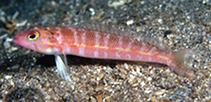 Parapercis flavolineata
Male Afbeelding van Randall, J.E.
Afbeeldingen | Google afbeelding
Male Afbeelding van Randall, J.E.
Classificatie / Namen Lokale namen | Synoniemen | Catalog of Fishes(Genus, Soort(en)) | ITIS | CoL | WoRMS | Cloffa
> Perciformes/Uranoscopoidei (Sand dwellers) > Pinguipedidae (Sandperches)
Etymology: Parapercis: Greek, para = the side of + Greek, perke = perch (Ref. 45335); flavolineata: Name from Latin, referring to the midlateral yellow line on the body.
More on author: Randall.
Etymology: Parapercis: Greek, para = the side of + Greek, perke = perch (Ref. 45335); flavolineata: Name from Latin, referring to the midlateral yellow line on the body.
More on author: Randall.
Milieu: milieu / Klimaatzone / Diepte / verspreidingsgebied Ecologie
marien benthopelagisch; diepte 25 - 70 m (Ref. 90102). Tropical
Verspreiding Gebieden | FAO regio's | Ecosystemen | Voorkomen | Verspreidingskaart | Introducties | Faunafri
Western Pacific: Indonesia.
Grootte / Gewicht / Leeftijd
Korte beschrijving Determinatiesleutels | Morfologie | Morfometrie
Dorsale stekels (totaal) : 5; Dorsale zachte stralen (totaal) : 21; Anale stekels: 1; Anale zachte stralen: 17; Wervels: 30. This species is distinguished by the following characters: body color in life whitish to pinkish white, edges of scales brown to reddish-brown, 10 brown bars with dark brown scale edges on body, the first on nape, the odd-numbered bars narrower and more irregular, the last on caudal peduncle broadest; an irregular midlateral yellow line from edge of preopercle to caudal fin base; dark bars below yellow line on body pink with dark red edges; head pink, becoming dark reddish dorsally on snout, with a narrow oblique orange bar below eye, and an arc of small dark brown spots from occiput to above opercle; lips pink, upper with a large red blotch; median fins translucent pinkish grey; rows of small reddish and whitish spots on soft part of dorsal fin; anal fin white basally; central part of caudal fin with reddish dots; pectoral fins transparent with pale pink rays; pelvic fins white; D V,21; A I,17; pectoral rays 17 (15 on right side); 55 lateral line scales; gill rakers 4 + 10; lower jaw projecting, 3 pairs of canine teeth anteriorly in jaws; palatine teeth absent; vomerine teeth in a chevron-shaped patch of 2 rows, the anterior teeth stout and conical; margin of preopercle non serrate; greatest body depth 4.45 in SL; head length (HL) 3.1 in SL; orbit diameter 4.2 in HL; fourth dorsal spine is the longest, 3.95 in HL; caudal fin truncate, becoming slightly rounded on ventral half; pectoral fins 5.05 in SL; pelvic fins just reaching anus, 3.95 in SL (Ref. 79876).
Body shape (shape guide): elongated.
Body shape (shape guide): elongated.
Collected from sand and rubble adjacent to the wreck of a Dutch ship (Ref. 79876). Inhabits sandy bottoms of coastal reef slopes at 25-70 m, solitray (Ref. 90102).
Levenscyclus en paargedrag Maturiteit | Voortplanting | Paaien | Eieren | Fecunditeit | Larven
Hoofdreferentie
Upload uw referenties | Referenties | Coördinator : Ho, Hsuan-Ching | Medewerkers
Randall, J.E., 2008. Six new sandperches of the genus Parapercis from the Western Pacific, with description of a neotype for P. maculata (bloch and Schneider). The Raffles Bull. Zool. 19:159-178. (Ref. 79876)
CITES
Not Evaluated
Gevaar voor de mens
Harmless
Gebruik door de mens
FAO - Publication: search | FishSource |
Meer informatie
Trofische ecologie
Voedsel (prooien)
Dieetsamenstelling
Voedselconsumptie
Voedselrantsoenen
Predatoren
Voedsel (prooien)
Dieetsamenstelling
Voedselconsumptie
Voedselrantsoenen
Predatoren
Ecologie
Ecologie
Ecologie
Populatiedynamica
Groeiparameters
Max. leeftijden / maten
Lengte-gewicht rel.
Lengte-lengte rel.
Lengtefrequenties
Massaconversie
Rekrutering
Abundantie
Groeiparameters
Max. leeftijden / maten
Lengte-gewicht rel.
Lengte-lengte rel.
Lengtefrequenties
Massaconversie
Rekrutering
Abundantie
Levenscyclus
Voortplanting
Maturiteit
Rijpheid/kieuwen rel.
Fecunditeit
Paaien
Paaibestanden
Eieren
Ontwikkeling van de eieren
Larven
Larvale populatiedynamiek
Voortplanting
Maturiteit
Rijpheid/kieuwen rel.
Fecunditeit
Paaien
Paaibestanden
Eieren
Ontwikkeling van de eieren
Larven
Larvale populatiedynamiek
Anatomie
Kieuwoppervlak
Hersenen
Otoliet
Kieuwoppervlak
Hersenen
Otoliet
Fysiologie
Lichaamssamenstelling
Voedingsstoffen
Zuurstofverbruik
Type zwemmen
Zwemsnelheid
Visuele pigmenten
Vis geluid
Ziekten en parasieten
Toxiciteit (LC50)
Lichaamssamenstelling
Voedingsstoffen
Zuurstofverbruik
Type zwemmen
Zwemsnelheid
Visuele pigmenten
Vis geluid
Ziekten en parasieten
Toxiciteit (LC50)
Genetica
genoom
Genetica
Heterozygositeit
Erfelijkheid
Genetische diversiteit
genoom
Genetica
Heterozygositeit
Erfelijkheid
Genetische diversiteit
Menselijk gerelateerd
Aquacultuursystemen
Aquacultuurprofielen
Kweeklijnen
Ciguatera gevallen
Postzegels, munten, diversen.
Aquacultuursystemen
Aquacultuurprofielen
Kweeklijnen
Ciguatera gevallen
Postzegels, munten, diversen.
Tools
Speciale rapporten
Bekijk gegevens voor het houden in een aquarium | Bekijk Fact Sheets voor de soort | Bekijk Aquacultuur Fact Sheets
Download XML
Internetbronnen
AFORO (otoliths) | Aquatic Commons | BHL | Cloffa | Websites from users | Bekijk FishWatcher | CISTI | Catalog of Fishes: Genus, Soort(en) | DiscoverLife | ECOTOX | FAO - Publication: search | Faunafri | Fishipedia | Fishtrace | GloBI | Google Books | Google Scholar | Google | IGFA World Record | OneZoom | Open Tree of Life | Otolith Atlas of Taiwan Fishes | PubMed | Reef Life Survey | Socotra Atlas | TreeBase | Tree of Life | Wikipedia: ga naar, zoek | World Records Freshwater Fishing | Zoobank | Zoological Record
Schattingen op basis van modellen
Fylogenetische diversiteitsindex (Ref. 82804): PD50 = 0.5000 [Uniqueness, from 0.5 = low to 2.0 = high].
Bayesian length-weight: a=0.00692 (0.00314 - 0.01524), b=3.06 (2.88 - 3.24), in cm total length, based on LWR estimates for this Genus-body shape (Ref. 93245).
Trofisch niveau (Ref. 69278): 3.5 ±0.4 se; based on size and trophs of closest relatives
Weerstandsvermogen (Ref. 120179): Hoog, minimale populatieverdubbelingstijd minder dan 15 maanden (Preliminary K or Fecundity.).