-

- Về trang này
- Ngôn ngữ
- Phản hồi của người dùng
- Trích dẫn
- Tải lên
- Các loài liên quan
-



Parapercis diagonalis Randall, 2008
Diagonal sandperch
Tải lên của bạn hình ảnh Và Video
Các tranh (Ảnh) | Google image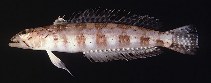 Parapercis diagonalis
Hình ảnh của Randall, J.E.
Các tranh (Ảnh) | Google image
Hình ảnh của Randall, J.E.
Phân loại / Tên Tên thường gặp | Các synonym ( Các tên trùng) | Catalog of Fishes(Giống, Các loài) | ITIS | CoL | WoRMS | Cloffa
> Perciformes/Uranoscopoidei (Sand dwellers) > Pinguipedidae (Sandperches)
Etymology: Parapercis: Greek, para = the side of + Greek, perke = perch (Ref. 45335); diagonalis: Name from Latin, referring to the diagonal black line on the cheek.
More on author: Randall.
Etymology: Parapercis: Greek, para = the side of + Greek, perke = perch (Ref. 45335); diagonalis: Name from Latin, referring to the diagonal black line on the cheek.
More on author: Randall.
Môi trường: môi trường / vùng khí hậu / Mức độ sâu / phạm vi phân phối Sinh thái học
biển sống nổi và đáy; mức độ sâu 1 - 25 m (Ref. 90102). Tropical
Sự phân bố Lãnh thổ | Các khu vực của FAO | Các hệ sinh thái | Những lần xuất hiện | Bản đồ điểm | Những chỉ dẫn | Faunafri
Western Pacific: Indonesia.
Bộ gần gũi / Khối lượng (Trọng lượng) / Tuổi
Chín muồi sinh dục: Lm ? range ? - ? cm
Max length : 15.0 cm TL con đực/không giới tính; (Ref. 79876); 12.8 cm SL (female)
Max length : 15.0 cm TL con đực/không giới tính; (Ref. 79876); 12.8 cm SL (female)
Mô tả ngắn gọn Khóa để định loại | Hình thái học | Sinh trắc học
Các tia vây lưng cứng (tổng cộng) : 5; Các vây lưng mềm (tổng cộng) : 21; Tia cứng vây hậu môn: 1; Tia mềm vây hậu môn: 17; Động vật có xương sống: 30. This species is distinguished by the following characters: body's upper third greenish-brown in life with a series of 6 large, quadrangular, blackish spots, progressively shorter posteriorly; the lower 2/3 of it white, faintly blotched with pink and dotted with black, and the lower third with 6 large, quadrangular, dark reddish spots, dotted with black dorsally; head bluish grey with an oblique black line on cheek below eye, ending in a small black spot, followed by 2 broad reddish bands; a large black spot on dorsal fin centered on base of spinous part, and a row of small black spots on the soft portion; base of anal fin with a row of black spots; caudal fin with 2 broad blackish stripes; D V,21; A I,17; pectoral rays 16; 57 lateral line scales; gill rakers 7 + 11; lower jaw projecting, 3 pairs of canine teeth anteriorly in jaws; palatine teeth absent; vomerine teeth in a narrow, chevron-shaped patch of 3-4 rows; ctenoid scales dorsally on opercle, becoming cycloid, progressively smaller, and nonimbricate ventrally on cheek; 4th dorsal spine longest 3.7 in HL; greatest body depth 4.8 in SL; head length (HL) 3.65 in SL; orbit diameter 4.4 in HL; fourth dorsal spine is the longest; caudal fin emarginate on upper half with a narrow protruding posterior upper lobe and rounded on ventral half; pectoral fins 5.75 in SL; pelvic fins just reaching anus, 5.05 in SL (Ref. 79876).
Body shape (shape guide): elongated.
Body shape (shape guide): elongated.
Specimen collected on silty sand substrate, a piece of partially buried plastic tubing was used as a refuge by the fish. It has a well-developed testis, but a small strip of ovarian tissue was also found, indicative of a nearly completed sex change from female to male (Ref. 79876). Solitary (Ref. 90102). Maximum length of 15 cm (TL) of unsexed specimen reported from Ref. 90102.
Vòng đời và hành vi giao phối Chín muồi sinh dục | Sự tái sinh sản | Đẻ trứng | Các trứng | Sự sinh sản | Ấu trùng
Tài liệu tham khảo chính
Tải lên tài liệu tham khảo của bạn | Các tài liệu tham khảo | Người điều phối : Ho, Hsuan-Ching | Người cộng tác
Randall, J.E., 2008. Six new sandperches of the genus Parapercis from the Western Pacific, with description of a neotype for P. maculata (bloch and Schneider). The Raffles Bull. Zool. 19:159-178. (Ref. 79876)
CITES
Not Evaluated
Mối đe dọa đối với con người
Harmless
Sử dụng của con người
FAO - Publication: search | FishSource |
Thêm thông tin
Sinh thái dinh dưỡng
Thức ăn (con mồi)
Thành phần thức ăn
Thành phần thức ăn
Khẩu phần ăn
Các động vật ăn mồi
Thức ăn (con mồi)
Thành phần thức ăn
Thành phần thức ăn
Khẩu phần ăn
Các động vật ăn mồi
Sinh thái học
Sinh thái học
Sinh thái học
Biến động dân số
Các thông số tăng trưởng
Độ tuổi / kích thước tối đa
Chiều dài-trọng lượng tương đối
Chiều dài-chiều dài tương đối.
Chiều dài-tần số
Chuyển đổi khối lượng
Bổ xung
Sự phong phú
Các thông số tăng trưởng
Độ tuổi / kích thước tối đa
Chiều dài-trọng lượng tương đối
Chiều dài-chiều dài tương đối.
Chiều dài-tần số
Chuyển đổi khối lượng
Bổ xung
Sự phong phú
Vòng đời
Sự tái sinh sản
Chín muồi sinh dục
Độ trưởng thành/Mang liên quan
Sự sinh sản
Đẻ trứng
Tập hợp sinh sản
Các trứng
Sự phát triển của trứng
Ấu trùng
Sự biến động ấu trùng
Sự tái sinh sản
Chín muồi sinh dục
Độ trưởng thành/Mang liên quan
Sự sinh sản
Đẻ trứng
Tập hợp sinh sản
Các trứng
Sự phát triển của trứng
Ấu trùng
Sự biến động ấu trùng
Sự phân bố
Lãnh thổ
Các khu vực của FAO
Các hệ sinh thái
Những lần xuất hiện
Những chỉ dẫn
BRUVS - Video
Lãnh thổ
Các khu vực của FAO
Các hệ sinh thái
Những lần xuất hiện
Những chỉ dẫn
BRUVS - Video
Giải phẫu
Vùng mang
Não
sỏi tai
Vùng mang
Não
sỏi tai
Sinh lý học
Thành phần cơ thể
Chất dinh dưỡng
Thành phần ô-xy
Kiểu bơi
Tốc độ bơi
Sắc tố thị giác
Tiếng cá
Bệnh tật & Ký sinh trùng
Độc tính (LC50)
Thành phần cơ thể
Chất dinh dưỡng
Thành phần ô-xy
Kiểu bơi
Tốc độ bơi
Sắc tố thị giác
Tiếng cá
Bệnh tật & Ký sinh trùng
Độc tính (LC50)
Di truyền
Bộ gen
Di truyền
Sự dị hợp tử
Di sản
Đa dạng di truyền
Bộ gen
Di truyền
Sự dị hợp tử
Di sản
Đa dạng di truyền
Liên quan đến con người
Hệ thống nuôi trồng thủy sản
Các tổng quan nuôi trồng thủy sản
Các giống
Các trường hợp ngộ độc Ciguatera
Tem, tiền xu, v.v.
Hệ thống nuôi trồng thủy sản
Các tổng quan nuôi trồng thủy sản
Các giống
Các trường hợp ngộ độc Ciguatera
Tem, tiền xu, v.v.
Các công cụ
Sách điện tử | Hướng dẫn hiện trường | Tần suất chiều dài Wizard | Công cụ của vòng đời | Bản đồ điểm |
Bắt-MSY |
Báo cáo đặc biệt
Kiểm tra bảo trì bể cá | Kiểm tra các tờ thông tin về loài | Kiểm tra các tờ thông tin về nuôi trồng thủy sản
Tải xuống XML
Các nguồn internet
AFORO (otoliths) | Aquatic Commons | BHL | Cloffa | Websites from users | Check FishWatcher | CISTI | Catalog of Fishes: Giống, Các loài | DiscoverLife | ECOTOX | FAO - Publication: search | Faunafri | Fishipedia | Fishtrace | GloBI | Google Books | Google Scholar | Google | IGFA World Record | OneZoom | Open Tree of Life | Otolith Atlas of Taiwan Fishes | PubMed | Reef Life Survey | Socotra Atlas | TreeBase | Cây Đời sống | Wikipedia: Go, tìm | World Records Freshwater Fishing | Zoobank | Tạp chí Zoological Record
Ước tính dựa trên mô hình
Chỉ số đa dạng phát sinh loài (Tài liệu tham khảo 82804): PD50 = 0.5000 [Uniqueness, from 0.5 = low to 2.0 = high].
Bayesian length-weight: a=0.00692 (0.00314 - 0.01524), b=3.06 (2.88 - 3.24), in cm total length, based on LWR estimates for this Genus-body shape (Ref. 93245).
Mức dinh dưỡng (Tài liệu tham khảo 69278): 3.5 ±0.4 se; based on size and trophs of closest relatives
Thích nghi nhanh (Tài liệu tham khảo 120179): Chiêù cao, thời gian nhân đôi của chủng quần tối thiểu là dưới 15 tháng (Preliminary K or Fecundity.).