-

- Aengenai halaman ini
- bahasa
- Umpan balik pengguna
- Kutipan
- Unggahan
- spesis berkaitan
-



Trichomycterus nigroauratus Barbosa & Costa, 2008
muatnaik fotos/gambar dan video
imej Google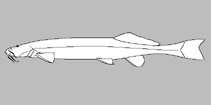 No image available for this species;
drawing shows typical species in Trichomycteridae.
imej Google
drawing shows typical species in Trichomycteridae.
klasifikasi / Nama Nama-nama umum | Sinonim (persamaan) | Catalog of Fishes(Marga, Jenis) | ITIS | CoL | WoRMS | Cloffa
> Siluriformes (Catfishes) > Trichomycteridae (Pencil or parasitic catfishes) > Trichomycterinae
Etymology: Trichomycterus: Greek, thrix = hair + Greek, mykter, -eros = nose (Ref. 45335); nigroauratus: From the latin nigro (black) and auratus (golden), referring to the colour pattern of the new species.
More on authors: Barbosa & Costa.
Etymology: Trichomycterus: Greek, thrix = hair + Greek, mykter, -eros = nose (Ref. 45335); nigroauratus: From the latin nigro (black) and auratus (golden), referring to the colour pattern of the new species.
More on authors: Barbosa & Costa.
Lingkungan: lingkungan / zona iklim / kisaran kedalaman / jangkauan distribusi Ekologi
; air tawar bentopelagis; kisaran kedalaman 0 - 2 m (Ref. 79612). Tropical; 22°S - 23°S, 44°W - 46°W
Penyebaran Wilayah | Daerah-daerah FAO | Ekosistem | Kemunculan | peta titik | Introduksi | Faunafri
South America: Brazil. Upper Barreiro River drainage basin, serra de Bocaina, and upper Piquete, Pirapitinga, Alambari, Pedras, Bonito, and Campo Belo River drainage basins, serra de Mantiqueira, upper rio Paraíba do Sul basin, south-eastern Brazil (Ref. 79612).
Ukuran / Berat / umur
deskripsi pendek Kunci identifiaksi (pengenalan) | Morfologi | Morfometrik
duri punggung lunak (Keseluruhan (total)) : 11 - 12; Sirip dubur lunak: 10 - 11; vertebrata, bertulang belakang: 35 - 36. Distinguished from all other species of the genus from south-eastern Brazil by the unique colour pattern in living specimens, consisting of golden spots on the snout, flank, above and below the midline, and the dorsum; similar to T. itatiayae and T. diabolus Bockmann, Casatti & de Pinna, 2004 and distinguished from all other species from south-eastern Brazil by possessing a broad metapterygoid, which is wider than long; distinguished from T. itatiayae by having eight pectoral rays (vs seven), anal fin origin posterior to dorsal fin base, between base of dorsal fin rays 9-12 (vs through middle of dorsal fin base, between base of dorsal fin rays 7-8), opercular and interopercular odontodes conical (vs incisiform), 16-21 opercular odontodes (vs 10-15), presence of first two infraorbital pores (vs absence), caudal fin subtruncate (vs rounded), smaller predorsal length (58.1-63.1% SL, vs 63.6-64.0% Sl) and larger eye (eye diameter 8.5-10.3% of head length, vs 7.4-8.2% of head length); distinguished from T. diabolus by the absence of the bony contact area between metapterygoid and quadrate (vs presence), moderate pectoral fin filament, about 20% of pectoral fin length (vs pectoral fin filament absent), barbels well developed, tip reaching between posterior margin of interopercular patch of odontodes and pectoral fin base (vs barbels short, tip never reaching beyond anterior margin of interopercular patch of odontodes), smaller head length (18.0-21.7% SL, vs 22.1-25.8% SL), absence of white and black bars on caudal fin (vs presence) and colour pattern with a broad black stripe on the flank (vs absence of stripe) (Ref. 79612).
Body moderately deep, subcylindrical on anterior portion, compressed on caudal peduncle; Head subtriangular in dorsal view; snout blunt; mouth subventral; Nasal, maxillary and rictal barbels well developed; dorsal, anal and pectoral fins approximately triangular (Ref. 79612).
Siklus hidup dan perilaku kawin Kematangan | Reproduksi, perkembang biakan | Pemijahan | telur-telur | Fekunditas | Larva
rujukan utama
Unggah referensi Anda | Acuan | Koordinator : Pinna, Mário de | mitra
Barbosa, M.A. and W.J.E.M. Costa, 2008. Description of a new species of catfish from the upper rio Paraíba do Sul basin, south-eastern Brazil (Teleostei: Siluriformes: Trichomycteridae) and re-description of Trichomycterus itatiayae. aqua, Int. J. Ichthyol. 14(4):175-186. (Ref. 79612)
Status IUCN Red List (Ref. 130435: Version 2025-2)
kurang bimbang (LC) ; Date assessed: 07 November 2018
CITES
Not Evaluated
ancaman kepada manusia
Harmless
penggunaan manusia
FAO - Publication: search | FishSource |
informasi lanjut
Ekologi trofik
Item makanan (mangsa)
Komposisi makanan
Konsumsi makanan
Ransum makanan
Pemangsa
Item makanan (mangsa)
Komposisi makanan
Konsumsi makanan
Ransum makanan
Pemangsa
Dinamika populasi
Parameter pertumbuhan
Maks. usia / ukuran
Panjang-berat rel.
Panjang-panjang rel.
ukuran frekuensi
Konversi massa
pemulihan
Kelimpahan
Parameter pertumbuhan
Maks. usia / ukuran
Panjang-berat rel.
Panjang-panjang rel.
ukuran frekuensi
Konversi massa
pemulihan
Kelimpahan
Siklus hidup
Reproduksi, perkembang biakan
Kematangan
Kedewasaan / insang rel.
Fekunditas
Pemijahan
Agregasi pemijahan
telur-telur
pekembangan telor
Larva
Dinamika larva
Reproduksi, perkembang biakan
Kematangan
Kedewasaan / insang rel.
Fekunditas
Pemijahan
Agregasi pemijahan
telur-telur
pekembangan telor
Larva
Dinamika larva
Anatomi
Area insang
Otak
Otolith
Area insang
Otak
Otolith
Fisiologi
Komposisi tubuh
Nutrisi
Konsumsi oksigen
Jenis renang
Kecepatan berenang
Pigmen visual
Suara ikan
Penyakit & Parasit
Toksisitas (LC50)
Komposisi tubuh
Nutrisi
Konsumsi oksigen
Jenis renang
Kecepatan berenang
Pigmen visual
Suara ikan
Penyakit & Parasit
Toksisitas (LC50)
Genetika
genom
Genetika
Heterozigositas
Diturunkan
Keanekaragaman Genetik
genom
Genetika
Heterozigositas
Diturunkan
Keanekaragaman Genetik
Yang berhubungan dengan manusia
Sistem akuakultur
profil budidaya air
Strain
Kasus Ciguatera
Perangko, koin, dll.
Sistem akuakultur
profil budidaya air
Strain
Kasus Ciguatera
Perangko, koin, dll.
Alat, peralatan
E-book | Penuntun lapangan | tanda freqkuenci panjang | peringkat sejarah hidup | peta titik |
Tangkap-MSY |
laporan khas
muat turun XML
Sumber internet
AFORO (otoliths) | Aquatic Commons | BHL | Cloffa | Websites from users | semak peneliti ikan | CISTI | Catalog of Fishes: Marga, Jenis | DiscoverLife | ECOTOX | FAO - Publication: search | Faunafri | Fishipedia | Fishtrace | GloBI | Google Books | Google Scholar | Google | IGFA World Record | OneZoom | Open Tree of Life | Otolith Atlas of Taiwan Fishes | PubMed | Reef Life Survey | Socotra Atlas | TreeBase | Tree of Life | Wikipedia: pergi, Cari | World Records Freshwater Fishing | Zoobank | Catatan Zoologi
Estimasi berdasarkan model
Indeks keanekaragaman filogenetik (Acuan 82804): PD50 = 0.5000 [Uniqueness, from 0.5 = low to 2.0 = high].
Bayesian length-weight: a=0.00977 (0.00400 - 0.02388), b=3.04 (2.84 - 3.24), in cm total length, based on LWR estimates for this Genus-body shape (Ref. 93245).
Tingkat Trofik (Acuan 69278): 3.2 ±0.4 se; based on size and trophs of closest relatives