-

- Om denna sida
- Språk
- Återkoppling från användare
- Referens
- Uppladdningar
-
Relaterade arter
- Arter i
Ungusurculus - Arter i
Dinematichthyidae - - Klassificering -
- Dinematichthyidae
- Ophidiiformes
- Teleostei
- Chordata
- Animalia
- Arter i
-



Ungusurculus sundaensis Schwarzhans & Møller, 2007
Sunda viviparous brotula
Lägg till din observation i Fish Watcher
| Native range | All suitable habitat | Point map | Year 2050 |
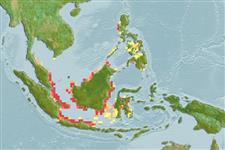
|
| This map was computer-generated and has not yet been reviewed. |
| Ungusurculus sundaensis AquaMaps Data sources: GBIF OBIS |
Ladda upp din foton och Videor
Bilder | Google image Ungusurculus sundaensis
Male Bild av W. Schwarzhans & P. R. Møller
Bilder | Google image
Male Bild av W. Schwarzhans & P. R. Møller
Klassificering / Namn Populärnamn | synonymer | Catalog of Fishes(Släkte, Arter) | ITIS | CoL | WoRMS | Cloffa
> Ophidiiformes (Cusk eels) > Dinematichthyidae (Viviparous brotula)
Etymology: Ungusurculus: Name from Latin words 'ungulus' (= claw) and 'surculus' (= grapevine tendril), refers to the functional analogy with the pseudoclaspers and the specific shape of the inner pseudoclasper; sundaensis: Named for the Sunda Archipelago of Indonesia,.
More on authors: Schwarzhans & Møller.
Etymology: Ungusurculus: Name from Latin words 'ungulus' (= claw) and 'surculus' (= grapevine tendril), refers to the functional analogy with the pseudoclaspers and the specific shape of the inner pseudoclasper; sundaensis: Named for the Sunda Archipelago of Indonesia,.
More on authors: Schwarzhans & Møller.
Miljö: miljö / Klimatzon / djupintervall / distributionsområde Ekologi
marina revassocierade; djupintervall 0 - 8 m (Ref. 90102). Tropical
Utbredning Territorier | FAO områden | Ekosystem | Förekomster | Prickkarta | Utplanteringar | Faunafri
Western Pacific: Indonesia.
Storlek / Vikt / Ålder
Kort beskrivning Bestämningsnycklar | Morfologi | Morfometri
Mjukstrålar i ryggfenan (totalt) : 79 - 86; Mjukstrålar i analfenan: 60 - 64; Ryggkotor: 42 - 43. This species is distinguished by the following characters: D 79-86, A 60-64, D/A 26, V in D 2.2-2.3; vertebrae 12+30-31=42-43; anterior nostril located 1/4 distance from upper lip to aggregate distance to anterior margin of eye; free pseudoclaspers 2 pairs, the outer pseudoclasper is wing-shaped with broad base and distally widened supporter with anterior hook, prominent knob on inner face of outer pseudoclasper fitting into opening of inner pseudoclasper, the inner one is long, very massive, stalked with narrow base, distally with claw-like, outwardly directed strong spines, inner and outer pseudoclasper matching together in lock/key mode; cheeks with 6 scale rows on upper part and 4 rows on lower part; no upper preopercular pore; otolith elongate, its length to height is 2.3-2.4, with pointed anterior and posterior tips, symmetrical pre- and postdorsal angles, the section in between straight, short sulcus with fused colliculi, its centre anterior of centre of otolith, inclined about 5°, otolith length to sulcus length is 2.4-2.5 (Ref. 76869).
Body shape (shape guide): elongated; Cross section: compressed.
Body shape (shape guide): elongated; Cross section: compressed.
Cryptic and solitary, inhabits reef crevices in about 0-8 m (Ref 90102).
Livscykel och parningsbeteende Könsmognad | Reproduktion | Lek | Ägg | Fekunditet | Larver
Huvudreferens
Ladda upp dina referenser | referenser | Koordinator | Medarbetare
Schwarzhans, W. and P.R. Møller, 2007. Review of the Dinematichthyini (Teleostei: Bythitidae) of the Indo-west Pacific. Part III. Beaglichthys, Brosmolus, Monothrix and eight new genera with description of 20 new species. The Beagle, Records of the Museums and Art Galleries of the Northern Territory 23:29-110. (Ref. 76869)
Status på IUCN:s rödlista (Ref. 130435: Version 2025-2)
Least Concern (LC) ; Date assessed: 15 August 2019
CITES
Not Evaluated
Hot mot människor
Mänskliga användningsområden
Fiskeri: saknar intresse
FAO - Publication: search | FishSource |
Ytterligare information
Trofisk ekologi
Livsmedelsartiklar (preys)
Födosammansättning
Födointag
Matransoner
Predatorer
Livsmedelsartiklar (preys)
Födosammansättning
Födointag
Matransoner
Predatorer
Ekologi
Ekologi
Ekologi
Populationsdynamik
Tillväxtparametrar
Max. åldrar / storlekar
Längd-vikt rel.
Längd-längd rel.
Längd-frekvenser
Massakonvertering
Rekrytering
Abundans
Tillväxtparametrar
Max. åldrar / storlekar
Längd-vikt rel.
Längd-längd rel.
Längd-frekvenser
Massakonvertering
Rekrytering
Abundans
Livscykel
Reproduktion
Könsmognad
Mognad/Gills rel.
Fekunditet
Lek
Lekande aggregat
Ägg
Utveckling av ägg
Larver
Larvdynamik
Reproduktion
Könsmognad
Mognad/Gills rel.
Fekunditet
Lek
Lekande aggregat
Ägg
Utveckling av ägg
Larver
Larvdynamik
Anatomi
Gälyta
Hjärna
Otolit
Gälyta
Hjärna
Otolit
Fysiologi
Kroppssammansättning
Näringsämnen
Syreförbrukning
Typ av simning
Simhastighet
Visuella pigment
Ljud från fisk
Sjukdomar & Parasiter
Toxicitet (LC50)
Kroppssammansättning
Näringsämnen
Syreförbrukning
Typ av simning
Simhastighet
Visuella pigment
Ljud från fisk
Sjukdomar & Parasiter
Toxicitet (LC50)
Genetik
Genom
Genetik
Heterozygositet
Ärftlighet
Genetisk mångfald
Genom
Genetik
Heterozygositet
Ärftlighet
Genetisk mångfald
Människorelaterad
Vattenbrukssystem
Vattenbruksprofiler
Avelslinjer
Ciguatera-fall
Frimärken, mynt, diverse.
Vattenbrukssystem
Vattenbruksprofiler
Avelslinjer
Ciguatera-fall
Frimärken, mynt, diverse.
Verktyg
Särskilda rapporter
Kontrollera för underhåll av akvarium | Kontrollera om det finns faktablad om arter | Kontrollera om det finns faktablad om vattenbruk
Ladda ner XML
Internet-källor
AFORO (otoliths) | Aquatic Commons | BHL | Cloffa | Websites from users | Check FishWatcher | CISTI | Catalog of Fishes: Släkte, Arter | DiscoverLife | ECOTOX | FAO - Publication: search | Faunafri | Fishipedia | Fishtrace | GloBI | Google Books | Google Scholar | Google | IGFA World Record | OneZoom | Open Tree of Life | Otolith Atlas of Taiwan Fishes | PubMed | Reef Life Survey | Socotra Atlas | TreeBase | Tree of Life | Wikipedia: Go, sök | World Records Freshwater Fishing | Zoobank | Zoologiskt register
Uppskattningar baserade på modeller
Önskad temperatur (Ref. 123201): 28.8 - 29.2, mean 29 °C (based on 265 cells).
Index för fylogenetisk mångfald (Ref. 82804): PD50 = 0.5156 [Uniqueness, from 0.5 = low to 2.0 = high].
Bayesian length-weight: a=0.00389 (0.00180 - 0.00842), b=3.12 (2.94 - 3.30), in cm total length, based on all LWR estimates for this body shape (Ref. 93245).
Trofisk nivå (Ref. 69278): 3.2 ±0.5 se; based on size and trophs of closest relatives