-

- Acerca de esta página
- Idiomas
- Opiniones de los usuarios
- Citación
- Carga
- Especies relacionadas
-



Sube tu fotos y Vídeos
Google image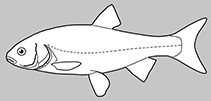 No image available for this species;
drawing shows typical species in Leuciscidae.
Google image
drawing shows typical species in Leuciscidae.
Clasificación / Nombres Nombres comunes | Sinónimos | Catalog of Fishes(Género, Especie) | ITIS | CoL | WoRMS | Cloffa
> Cypriniformes (Carps) > Leuciscidae (Minnows) > Leuciscinae
Etymology: Alburnus: From the city of Al Bura, where the fish was known (Ref. 45335); sarmaticus: Named after the Sarmatians, referring to an earlier group of tribes that inhabited southern European Russia, Ukraine and the eastern Balkans from the 5th century BC to the 4th century AD.
Eponymy: These are not true eponyms but refer to the Sarmatians, a group of tribes that inhabited southern Russia, Ukraine and the eastern Balkans from 5th century BC to 4th century AD. The Sarmatians occupied the area of distribution of these fish. (Ref. 128868), visit book page.
More on authors: Freyhof & Kottelat.
Etymology: Alburnus: From the city of Al Bura, where the fish was known (Ref. 45335); sarmaticus: Named after the Sarmatians, referring to an earlier group of tribes that inhabited southern European Russia, Ukraine and the eastern Balkans from the 5th century BC to the 4th century AD.
Eponymy: These are not true eponyms but refer to the Sarmatians, a group of tribes that inhabited southern Russia, Ukraine and the eastern Balkans from 5th century BC to 4th century AD. The Sarmatians occupied the area of distribution of these fish. (Ref. 128868), visit book page.
More on authors: Freyhof & Kottelat.
Entorno: milieu / zona climática / rango de profundidad / gama de distribución Ecología
; agua dulce; salobre bentopelágico. Temperate
Distribución Territorios | Áreas FAO | Ecosistemas | Ocurrencias, apariciones | Mapa de puntos | Introducciones | Faunafri
Europe: Rivers South Bug and Dniepr in Ukraine; River Danube in Romania and most likely in Ukraine and Bulgaria; River Kolpa, an upper tributary to the River Save in Croatia and Slovenia (Ref. 75106). Almost extirpated in Danube; seems to survive only in River Kolpa (Ref. 59043).
Tamaño / Peso / Edad
Descripción breve Claves de identificación | Morfología | Morfometría
Differs from other species of shemayas by the combination of the following characters: origin of anal fin about 1½ -2½ scales behind dorsal-fin base; anal fin with 15-17½ branched rays; gill rakers 27-34; length of gill raker at angle between upper and lower limbs of first gill arch 30-55% of opposite inner gill filament; lateral line scales 56-63 + 4-5; ventral keel exposed for 4-6 scales in front of anus, reaching about 25% of distance between anus and pelvic-fin base; head length 21-23% SL; predorsal length 53-58% SL; caudal peduncle depth 6.9-8.1% SL,1.7-2.0 times in its length; eye diameter 4.8-5.8% SL, 1.3-1.6 times in interorbital distance; presence of numerous small tubercles in nuptial males; absence of faint, dark midlateral stripe (Ref. 75106).
Body shape (shape guide): fusiform / normal.
Body shape (shape guide): fusiform / normal.
Inhabits lower and middle parts of large rivers, estuaries, coastal lakes and adjacent areas of seas where salinity is lowered by large inflow of freshwater. Can tolerate salinities of up to 12 ppt. Adults mainly prey on planktonic crustaceans, terrestrial insects, and small fish. Larvae and young juveniles feed on zooplankton, algae and insect larvae. Spawns in riffles with heavy current on gravel bottom. There are semi-anadromous and riverine populations. Anadromous populations commence to enter rivers in autumn and move upstream in winter and/or spring. Adults move back to the sea soon after spawning to forage. Young individuals migrate downriver in autumn of same year or the following spring. Hybridizes with Squalius cephalus. All populations sharply declined in the early and middle 20th century due to the constructed dams that hindered in reaching the spawning grounds. Today, spawning occurs only below these dams (Ref. 59043).
Ciclo vital y comportamiento de apareamiento Madurez | Reproducción | Puesta | Huevos | Fecundidad | Larva
Deposits sticky eggs which adhere on pebbles or stones (Ref. 59043).
Referencia principal
Suba sus referencias | Referencias | Coordinador | Colaboradores
Freyhof, J. and M. Kottelat, 2007. Review of the Alburnus mento species group with description of two new species (Teleostei: Cyprinidae). Ichthyol. Explor. Freshwat. 18(3):213-225. (Ref. 75106)
Situación en la Lista Roja de la UICN (Ref. 130435: Version 2025-2)
Endangered (EN) (A2c); Date assessed: 02 May 2023
CITES
Not Evaluated
Amenaza para el ser humano
Harmless
Usos humanos
FAO - Publication: search | FishSource |
Más información
Ecología Trófica
Alimentos (presas)
Composición de la dieta
consumo de alimento
Raciones de comida
Despredadores
Alimentos (presas)
Composición de la dieta
consumo de alimento
Raciones de comida
Despredadores
Dinámica de la población
Coeficiente del crecimiento para
Edades / tallas máximas
Longitud-peso rel.
Longitud-longitud rel.
Longitud-frecuencias
Conversión de masas
Reclutamiento
Abundancia
Coeficiente del crecimiento para
Edades / tallas máximas
Longitud-peso rel.
Longitud-longitud rel.
Longitud-frecuencias
Conversión de masas
Reclutamiento
Abundancia
Ciclo de vida
Reproducción
Madurez
Madurez/Gills rel.
Fecundidad
Puesta
Agregaciones de desove
Huevos
Desarrollo de los huevos
Larva
Dinámica larvaria
Reproducción
Madurez
Madurez/Gills rel.
Fecundidad
Puesta
Agregaciones de desove
Huevos
Desarrollo de los huevos
Larva
Dinámica larvaria
Distribución
Territorios
Áreas FAO
Ecosistemas
Ocurrencias, apariciones
Introducciones
BRUVS - Vídeos
Territorios
Áreas FAO
Ecosistemas
Ocurrencias, apariciones
Introducciones
BRUVS - Vídeos
Anatomía
Superficie branquial
Cerebro
Otolito
Superficie branquial
Cerebro
Otolito
Fisiología
Composición corporal
Nutrientes
Consumo del oxígeno
Tipo de natación
Velocidad de natación
Pigmentos visuales
Sonido de peces
Enfermedades y parásitos
Toxicidad (CL50)
Composición corporal
Nutrientes
Consumo del oxígeno
Tipo de natación
Velocidad de natación
Pigmentos visuales
Sonido de peces
Enfermedades y parásitos
Toxicidad (CL50)
Genética
Genoma
Genética
Heterocigosidad
heritabilidad
Diversidad genética
Genoma
Genética
Heterocigosidad
heritabilidad
Diversidad genética
Relacionados con el ser humano
Sistemas de acuicultura
Perfiles de acuicultura
Razas
Ciguatera cases
Sellos, monedas, varios
Sistemas de acuicultura
Perfiles de acuicultura
Razas
Ciguatera cases
Sellos, monedas, varios
Herramientas
Libro electrónico | Guía de campo | Asistente para frecuencias de tallas | Herramienta de ciclo de vida | Mapa de puntos |
Catch-MSY |
Informes especiales
Comprobar el mantenimiento del acuario | Buscar fichas sobre especies | Consulte las hojas informativas sobre acuicultura
Descargar XML
Fuentes de Internet
AFORO (otoliths) | Aquatic Commons | BHL | Cloffa | Websites from users | Check FishWatcher | CISTI | Catalog of Fishes: Género, Especie | DiscoverLife | ECOTOX | FAO - Publication: search | Faunafri | Fishipedia | Fishtrace | GloBI | Google Books | Google Scholar | Google | IGFA World Record | Bases de datos nacionales | OneZoom | Open Tree of Life | Otolith Atlas of Taiwan Fishes | PubMed | Reef Life Survey | Socotra Atlas | TreeBase | Árbol de la vida | Wikipedia: Go, búsqueda | World Records Freshwater Fishing | Zoobank | Expediente Zoológico
Estimaciones basadas en modelos
Índice de diversidad filogenética (Referencia 82804): PD50 = 0.5000 [Uniqueness, from 0.5 = low to 2.0 = high].
Bayesian length-weight: a=0.00661 (0.00311 - 0.01404), b=3.12 (2.95 - 3.29), in cm total length, based on LWR estimates for this Genus-body shape (Ref. 93245).
Nivel trófico (Referencia 69278): 2.7 ±0.3 se; based on size and trophs of closest relatives
Resiliencia (Referencia 120179): Medio, población duplicada en un tiempo mínimo de 1.4-4.4 años (Assuming Fec < 10,000).